

For many years, I didn’t realise I had a choice in how I saw the world. If someone upset me, I blamed them. If someone criticised me, I decided they were not a very nice person. What I couldn’t see was that I was reacting to the meaning I had attached to what happened.
Perhaps you recognise this. Think of the last time an email landed badly, or a comment stung more than it should have. In that moment, did it feel as though the other person was creating the discomfort you felt, rather than the interpretation you had put on it? That is how it felt to me for years. Discovering I could choose a different interpretation was one of the most useful things I have learned. The way we think shapes how we feel, how we behave, and, in the end, the life we create.
Learning to Choose Between Fear and Love
I mentioned The Heart of the Soul earlier in this series as the place where I first encountered the idea behind Life School. It gave me something else as well. It introduced the possibility that we can experience life either through fear or through love, and this is a genuine choice about how we engage with ourselves and the world, rather than wishful thinking. Looking back, it was the beginning of my ability to distinguish the ego from the Higher Self.
Years later, when I encountered A Course in Miracles, I found that its language brought this into sharp focus. It describes two thought systems: one rooted in fear, which it calls the ego, and one rooted in love, represented by the Holy Spirit. Throughout this series, I use the term Higher Self because it is accessible regardless of our spiritual or religious beliefs.
Whether you approach this idea through spirituality, psychology or your own life experience, the principle is the same. We can interpret what is happening through the fearful lens of the ego or through the loving perspective of our Higher Self.
Seeing a Manager Through a Colleague’s Eyes
I learned more from the first time I felt confident enough to teach this to a coaching client than from any book. My client was convinced her manager didn’t like her. She watched him chatting easily with another colleague, praising their work and appearing genuinely interested. With her, he seemed distant, aloof and difficult to approach. Every interaction confirmed her belief that he didn’t appreciate her.
Rather than discussing confrontation or communication techniques, I suggested a simple experiment. For one week, I asked her to imagine seeing her manager through the eyes of the colleague who genuinely liked him. She thought the colleague would see her boss as approachable, supportive and fundamentally decent. So that was her task. Nothing else was to change, only the lens through which she viewed him.
The change was greater than I expected. Within days, she noticed him smiling more, starting conversations and showing interest in her work. The tension between them eased, and some months later, when a promotion came up, she got it.
I doubt he had become a different manager. What changed first was her. She stopped approaching him expecting rejection; she became warmer and more relaxed, and he responded to the person now in front of him. Changing her thinking changed what she brought to the relationship, and the relationship changed with it. I would not claim the experiment produced the promotion. What it did show was the practical difference between seeing someone through the ego and seeing them through the Higher Self.
What Neuroplasticity Does and Does Not Explain
I described earlier in this series what neuroplasticity meant to me when I first learned about it. It helped me understand that the ways we habitually think are not fixed. When we repeatedly practise a different response, the brain can adapt, making that response more familiar over time.
But I do not believe the brain produces our Higher Self. My experience is that the Higher Self is already there, and I become more aware of it when I stop following every thought that comes into my mind.
When I am caught up in fear, anger or the need to defend myself, my thoughts can become very convincing. I can find plenty of reasons why I am right, why somebody else is wrong or why I need to act immediately. If I keep following those thoughts, I reinforce my way of seeing the situation.
But when I become willing to stop, even for a moment, something different can happen. In the space between my thoughts, I can become aware of a quieter, more loving perspective. I begin to see the situation differently.
This is what I mean when I say we can choose which thought system we want to use. We can continue following the thoughts that keep us in fear and separation, or we can become willing to listen to our Higher Self and respond from there.
The brain supports whichever way of thinking we repeatedly practise. If I continue to react defensively, that response becomes familiar. If I practise stepping back, questioning my thoughts and choosing a more loving response, that can grow.
Neuroscience can help explain how our learned patterns change, but it does not establish where the Higher Self comes from.
That distinction matters because living from our Higher Self is not about positive thinking. We can think positively and still be trying to control an outcome, prove ourselves or avoid something we fear. I mean seeing life differently, not simply thinking more positively, and the brain can support us as we practise doing that.
How the Ego and the Higher Self Compare
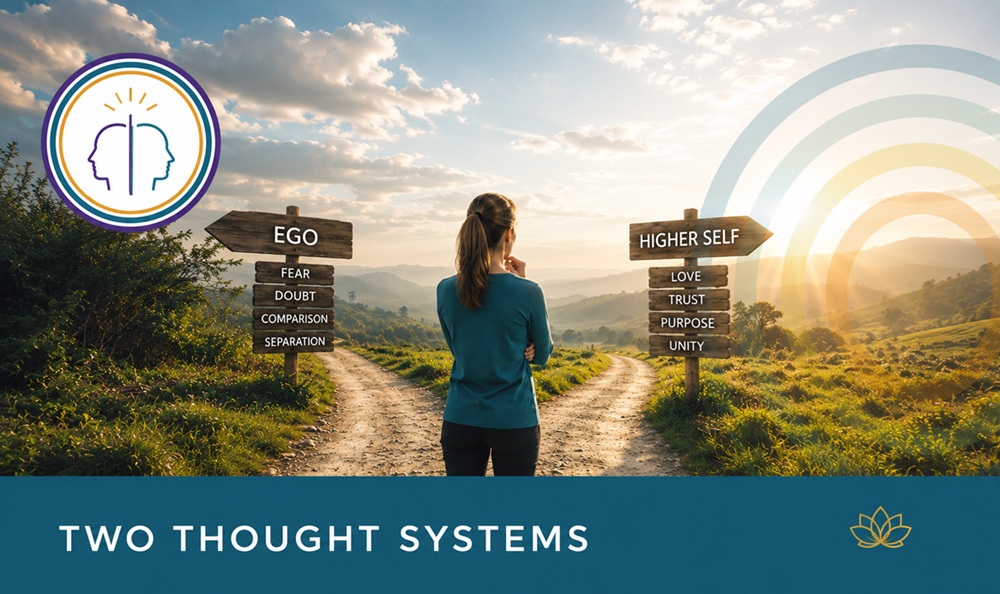
The ego and the Higher Self can look at the same situation and reach completely different conclusions. As you read the pairs below, you might notice which of the two you have been living in today, and which pair feels most familiar.
- The ego sees blame and condemnation. The Higher Self sees love, or a call for love.
- The ego asks who is at fault. The Higher Self asks what there is to learn.
- The ego looks for judgement. The Higher Self looks for understanding.
- The ego labels everything as good or bad. The Higher Self sees what works and what doesn’t.
- The ego holds on to resentment. The Higher Self chooses forgiveness.
- The ego reacts impulsively. The Higher Self responds thoughtfully.
- The ego sees limitation. The Higher Self sees possibility.
- The ego chooses fear. The Higher Self chooses trust.
- The ego wants people to be different. The Higher Self accepts people as they are.
- The ego sees separation. The Higher Self sees connection.
- The ego is defined by its mistakes. The Higher Self learns from them.
- The ego acts from fear. The Higher Self acts from love.
Neither thought system changes the facts, only what those facts mean to us. Because meaning shapes our emotions, our behaviour and our relationships, it shapes the experience we have of our lives.
Pausing to Let the Higher Self Be Heard
I have noticed that the ego is the first voice we hear. It reacts instantly, jumps to conclusions and seeks certainty because it feels safe. It wants to defend itself, compare itself with others and prove it is right. Left unchecked, it will interpret situations in ways that reinforce fear, separation and conflict. This is why pausing before we act matters so much. We have to allow time for our Higher Self to show up, and it has to be invited.
The Higher Self does not compete with the ego or shout louder than it. It patiently waits for us to pause and invite it in. That pause may last only a few seconds, but it is where our choice lies. It gives us just enough space to ask a different question: is there another way of seeing this? Often, a moment of willingness is all it takes to open up another possibility.
Why How We Choose Matters More Than What We Choose
For years, I believed my Higher Self was supposed to tell me exactly what decision to make. Should I change jobs, or should I stay? Should I take a particular opportunity? The Higher Self never gave me a definitive answer. It helped me see what I was missing, which made the way forward clearer.
The Higher Self is less concerned with what we choose than with how we choose. At one point in my career, I wanted a new job badly; I applied, but I didn’t get it. When I looked honestly at my motivation, I saw it was driven largely by fear. I wanted more money because I believed it would make me feel secure. My thinking was rooted in scarcity rather than in contribution.
Later, I applied for another role, and this time my motivation had changed completely. I believed I could make a meaningful difference, and the opportunity felt right. This time, everything about getting the role fell into place. I was doing much the same thing as before, but from an entirely different thought system.
We Can Always Choose Again
The most useful thing I have realised is that neither thought system traps us. Whatever happens, we can choose again.
I won’t pretend the choice is always easy. When we have been badly hurt, or when something feels deeply unjust, choosing love can seem almost offensive, let alone difficult. In those moments, the choice is to remain willing to consider, even for a few seconds, that there might be another way of seeing.
What Would Love See Here?
Living from our Higher Self does not mean pretending life is always positive, denying painful emotions or ignoring genuine problems. It means recognising that every circumstance can be interpreted through fear or love, and that the perspective we choose shapes our experience far more than we realise. I know from experience that when I feel aggrieved, being told I could see it differently can be really hard. My ego loves to dwell on my resentment.
The ego’s first question is always: How do I protect myself? The Higher Self asks something entirely different: What would love see here?
The choice we make affects how we think, how we relate to people and the decisions we make, whatever life brings.
“The Higher Self does not compete with the ego or shout louder than it. It patiently waits for us to pause and invite it in.”

Try This: The One-Week Lens Experiment
Bring to mind one person or situation that is troubling you: someone you find difficult, or a circumstance that feels unfair. Then take a few minutes to answer these questions, ideally in writing.
- What story am I telling myself about this? Write it down exactly as the ego tells it.
- Which of the two readings am I in, and what is this interpretation costing me in peace, energy or connection?
- If I saw this through the eyes of someone who loves and trusts this person or situation, what would they notice I’m missing?
- What might I learn from this?
Now, like my client, run the experiment. For one week, choose the more loving interpretation each time this person or situation appears, not by pretending, but by staying willing to see differently. Change nothing else. At the end of the week, notice what has shifted. It may be them, but it will almost certainly be you.
Before you begin to be guided by your Higher Self, you need to recognise the voice of the ego, and that is where we go to next.
Continue Exploring
Living From Your Higher Self is a journey of understanding and practice. These ten articles are designed to be read in any order, but together they provide a complete framework for living with greater peace, purpose and self-awareness.
Foundations
Living the Philosophy
- The Life School
- Discerning Your Thoughts (Current)
- Emotional Compass
- Transformational Relationships
- Love
Discerning Your Thoughts – Choosing Between the Ego and Your Higher Self
Enjoyed this article? Add People Development Magazine as a preferred source on Google:
Enjoyed This? . This Essential Guide brings the whole framework together in one place, free to download.
