

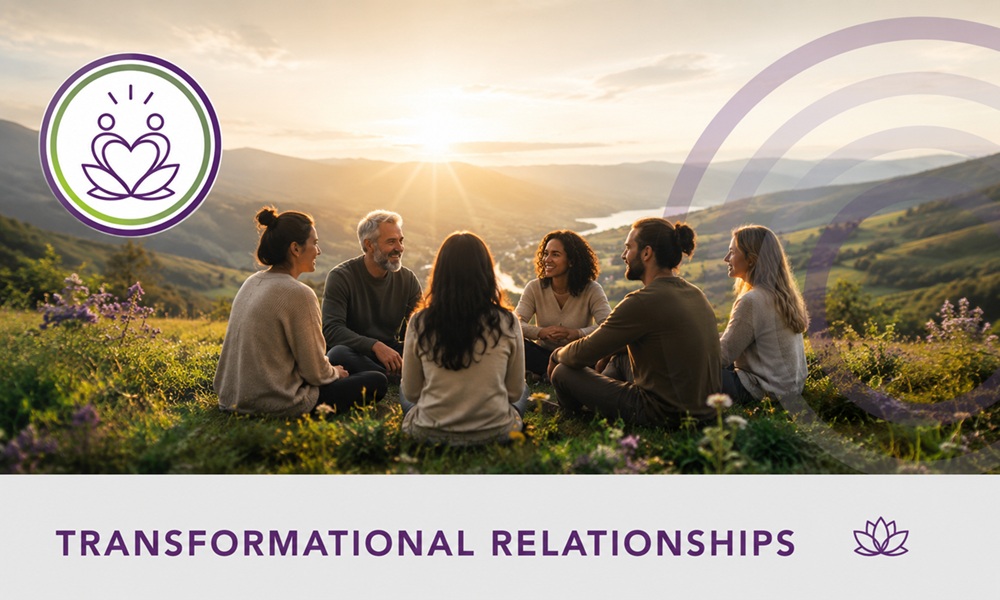
For many years, I believed personal growth was largely a solitary pursuit. I read books, attended courses, journalled, reflected and spent time trying to understand myself. These practices were valuable, but I eventually realised that some of my greatest learning came through my relationships.
I believe we learn more about ourselves through our closest relationships than anywhere else.
A client once described a difficult relationship with a close relative. They seemed to disagree about almost everything, and conversations could quickly turn into arguments. My client was frustrated by how defensive and bad-tempered the other person could be, and by how easily things seemed to be taken the wrong way.
Then one day she realised something uncomfortable. Many of the things she was criticising in the other person were things she was doing herself. Until then, she had been so focused on the other person’s behaviour that she had barely noticed her own part in the pattern.
She decided to change what she brought to the relationship. Instead of reacting in the same old way, she tried to respond with more patience and love. Gradually, the relationship changed.
Later, she learned that the other person had been just as frustrated and had felt equally unheard.
Our Relationships With Money, Food and Work Too
When we talk about relationships, we immediately think of other people. Yet we are in relationship with everything. For instance, I have an annoying yet deeply familiar relationship with food and what it means for my body. I also have an avoidant relationship with exercise, which, as you can imagine, doesn’t exactly help my relationship with food.
Often, the thing we are in relationship with is only part of the picture; our interpretation shapes our experience too. Two people can face exactly the same circumstances and experience them completely differently, because each brings their own beliefs, expectations, fears and assumptions. Our relationships can therefore reveal a great deal about what is going on inside us.
As I discussed earlier, I struggled with money for many years, believing I was destined to be poor. What I eventually saw was that my relationship with money rested on a belief: I was one of those poor people, and anyone who had more than enough was somehow a different sort of person from me. Once I could see the belief that had shaped the relationship, I was able to make substantial changes.
What Our Reactions to Others Show Us
One of the most important shifts we can make is to stop asking, Why are they like that? and begin asking, What is this experience showing me about myself?
This does not mean other people are always right, nor does it excuse harmful behaviour. Healthy boundaries remain essential, and some relationships are best left behind. Nor does it assume everything is a projection. Sometimes the clearest lesson is that we do not like how we are being treated and need to act on it. A more useful question than How is this all my fault? is: What is mine to understand, choose or change here?
What changes is where we place our attention. Instead of being consumed by another person’s behaviour, we become curious about our own response. Why did those words affect me so deeply? Why does this situation create anxiety in me while someone else remains completely at peace? The answers tell us far more about ourselves than about the other person.
This is where the Emotional Compass we explored earlier in the series becomes useful in practice. When fear, resentment, shame or anger arise, those emotions aren’t a sign that we are bad or broken. They can alert us to the fact that we may be interpreting the situation through the fearful perspective of the ego rather than the wiser perspective of our Higher Self. Relationships do not create everything we feel or believe, but they often reveal what we are already bringing to the experience.
The Psychology of Projection
Modern psychology helps explain why relationships serve as such powerful mirrors. Carl Jung described projection: our tendency to unconsciously attribute aspects of ourselves to other people. Sometimes we project qualities we have rejected or denied, which is why another person’s arrogance, for example, can irritate us so deeply. At other times, we project strengths we have not yet recognised in ourselves, which is why someone’s confidence, compassion or courage can move and inspire us. We recognise those qualities because something within us already responds to them.
In A Course in Miracles, projection is one of the ego’s main ways of protecting itself. Rather than recognising fear, guilt, judgement or conflict within ourselves, the ego encourages us to see the problem outside us, in other people and circumstances. We then react to what appears to be happening “out there” without recognising the role our own thinking plays in our experience. The Higher Self reverses this process by helping us look inward without blame, recognise the thought behind our reaction and choose a more loving interpretation. So relationships can show us both what limits us and what is possible for us.
A Spiritual Perspective: Life as a Mirror
Many spiritual traditions have long suggested that life continually reflects our state of consciousness. One framework that illustrates this is the Seven Essene Mirrors, popularised by Gregg Braden and based on teachings attributed to the ancient Essenes. These ideas are spiritual rather than scientifically established, so I offer them as a reflective framework rather than as fact. Their value lies in the questions they invite us to ask about recurring relationship patterns.
The mirrors suggest that the people and situations we encounter may reveal:
- Who we are in the present moment.
- Qualities we judge or reject in ourselves.
- Gifts or strengths we have forgotten.
- Unresolved emotional wounds.
- Patterns learned in childhood.
- Opportunities for deep healing.
- The greatness we are only beginning to recognise.
Whether or not we take the framework literally, it raises a useful question: what might this experience teach me about myself? Asking it can help turn blame into curiosity and conflict into learning.
Choosing How We Respond in Every Interaction
In Living From Your Higher Self, Unity Consciousness holds that beneath our individual personalities, we share the same source of awareness. Seen this way, every relationship offers another chance to question how separate we really are.
Every interaction presents a choice between two thought systems. The ego asks: how can I defend myself, prove I’m right, and change them? The Higher Self asks: what can I understand here, what would love see, and what is this experience inviting me to learn?
We cannot control another person’s behaviour, but we can choose the thought system from which we respond. This choice often determines whether we repeat the conflict or learn from it.
What Different Relationships Can Teach Us
Some of our most valuable personal growth happens when relationships make us uncomfortable enough to question our assumptions, broaden our perspective and choose again.
Seen this way, every relationship belongs to the curriculum of Life School. The difficult colleague may reveal our impatience. Supportive friends may remind us that we are worthy of love. A struggle with diet, finances or health may expose long-held patterns ready to be released. Our relationship with work can reveal our beliefs about purpose and contribution; with money, our beliefs about worth and security; and with our body, whether we meet it with criticism or compassion. Even our relationship with our own thoughts can show whether we are listening primarily to the ego or to our Higher Self.
Life constantly offers feedback, and all we need to do is notice it without judging what we find. The lesson is rarely about changing someone else. It might be forgiveness, courage, setting healthy boundaries or recognising our own gifts, and it is almost always about becoming more self-aware.
Using Relationships to Understand Ourselves
When we begin to see relationships in this way, a great deal changes. Rather than merely trying to manage what is happening, we can use the experience to understand ourselves more clearly and choose how we want to respond.
Relationships may not complete us, fix us or even make us happy, but perhaps their deepest purpose is to help us remember who we have always been.
“Relationships do not create everything we feel or believe, but they often reveal what we are already bringing to the experience.”

Try This: What Is the Mirror Showing You?
Bring to mind one relationship that unsettles you right now. It might be with a person, with money, with your work, or with your own body.
Ask yourself gently: What am I pointing at? Is any of it something I’m also demonstrating, or something I’m judging in them that I haven’t yet looked at in myself? What would happen if, for one month, I stopped playing my part in the drama and brought love to it instead?
You don’t need to fix anything today. Just notice what the mirror shows you, because noticing comes before anything can change.
So now we’ve looked at how our relationships can help us learn more about ourselves; we now take a look at relationships from the perspective of separation.
Continue Exploring
Living From Your Higher Self is a journey of understanding and practice. These ten articles are designed to be read in any order, but together they provide a complete framework for living with greater peace, purpose and self-awareness.
Foundations
Living the Philosophy
- The Life School
- Discerning Your Thoughts
- Emotional Compass
- Transformational Relationships (Current)
- Love
Transformational Relationships: How Every Connection Reflects and Refines You
- Experiencing Relationship From The Perspective Of Separation
- What Our Relationships Can Teach Us About Ourselves
Enjoyed this article? Add People Development Magazine as a preferred source on Google:
Enjoyed This? . This Essential Guide brings the whole framework together in one place, free to download.
