


I had been waiting twenty minutes when the waiter came over, apologetic, to tell me the dish I’d ordered was no longer available and to ask whether I would choose again.
I should have been told at the time of ordering. We were hungry. Instead of picking something else, I took the opportunity to tell him it wasn’t good enough and that I expected better.
He couldn’t have been more apologetic. Eventually, with a shake of my head, I chose again and off he went. I sat there feeling perfectly justified for about four minutes.
The Belief Underneath the Behaviour
The behaviour towards the waiter wasn’t unusual for me at that time. When I thought someone was incompetent, I could become impatient and sometimes expressed it quite sharply. I never felt good about it afterwards. For years, I thought it was arrogance. I had spoken to someone who was not really in a position to answer back, in a way I would never have spoken to a friend. I was not proud of it, and arrogance seemed like the right word.
It took me a long time to realise something else was going on. Underneath the impatience, I did not actually believe I was better than the other person. What I was feeling was that I was not being listened to, that my needs did not matter, or that I was somehow being disregarded. I was taking the mistake personally, as though it said something about my worth.
Of course, that did not make my reaction acceptable. But it did help me understand it. I had been judging myself for being arrogant when, in reality, I was reacting from an old sense of not being good enough. The behaviour could look the same from the outside, but the belief driving it was very different.
For years, I had the reaction, regretted it and promised myself I would do better next time. What I had not done was question what I was believing in the moment. Once I began to see that, I had something I could actually work with.
Why Looking at Ourselves Can Be Kinder Than We Fear
I’d assumed that examining this properly would make me think worse of myself. That’s precisely why I left it alone for so long, and I suspect this expectation is what stops most people from looking.
It did the reverse. What I found was not a woman who thought she was better than a waiter, but a much younger version of me who had, on reasonable evidence at the time, concluded she didn’t count for very much, and who, years later, was still checking whether she did. That was sadder to realise, but it was also much kinder. We cannot be ashamed of a child for drawing a sensible conclusion from the information she had.
Self-Awareness has a reputation for being an exercise in finding fault with ourselves. In my experience, it’s closer to the opposite. Almost every pattern I’ve examined closely has turned out to be less damning than the story I’d been telling myself about it.
The Person Who Showed Me
My son responds to these situations in a way I never have, and watching him finally made my own pattern visible. When things go wrong, he reassures those involved that these things happen and helps them find a way through. It costs him nothing.
What I noticed was that he wasn’t sharp with anyone and had no wish to make someone else’s day harder because his own had been disrupted.
I had needed to see someone do it differently, right in front of me, before I could see myself at all. Left to myself, I’d have gone on believing I had high standards.
Three Ways My Reactions Showed Up
The restaurant incident was one of the times it showed. Most days, I was perfectly civil, and nobody would have guessed what was going on beneath the surface. These reactions had been happening for decades, yet I had never really examined them. How could I have missed something that was happening inside me?
Looking back, I can see that my reactions tended to show up in different ways.
The ones that showed. Sometimes the reaction escaped before I could catch it: a sharp reply, an impatient tone or something I later wished I had handled differently. Those were easier to recognise because somebody else could see them too.
The ones I tried to contain. At other times, I knew how I wanted to respond and could behave accordingly, but underneath, the old reaction was still there. I felt this particularly when I was beginning to follow Higher Self thinking, but my old patterns had not yet caught up. Outwardly, I might be calm or gracious while inwardly I was still angry, hurt or resentful.
The ones that stayed entirely inside. These were the conversations I replayed in my head, the judgements I never expressed, the irritation I swallowed or the disappointment I kept to myself. Some of these were so familiar that for years I barely noticed them.
What surprised me was how much of my inner life could carry on unnoticed. I could appear to be getting on with things perfectly well while old beliefs and reactions were still shaping how I experienced them. Self-Awareness began when I started noticing what was happening beneath the surface.
Where Our Reactions Come From
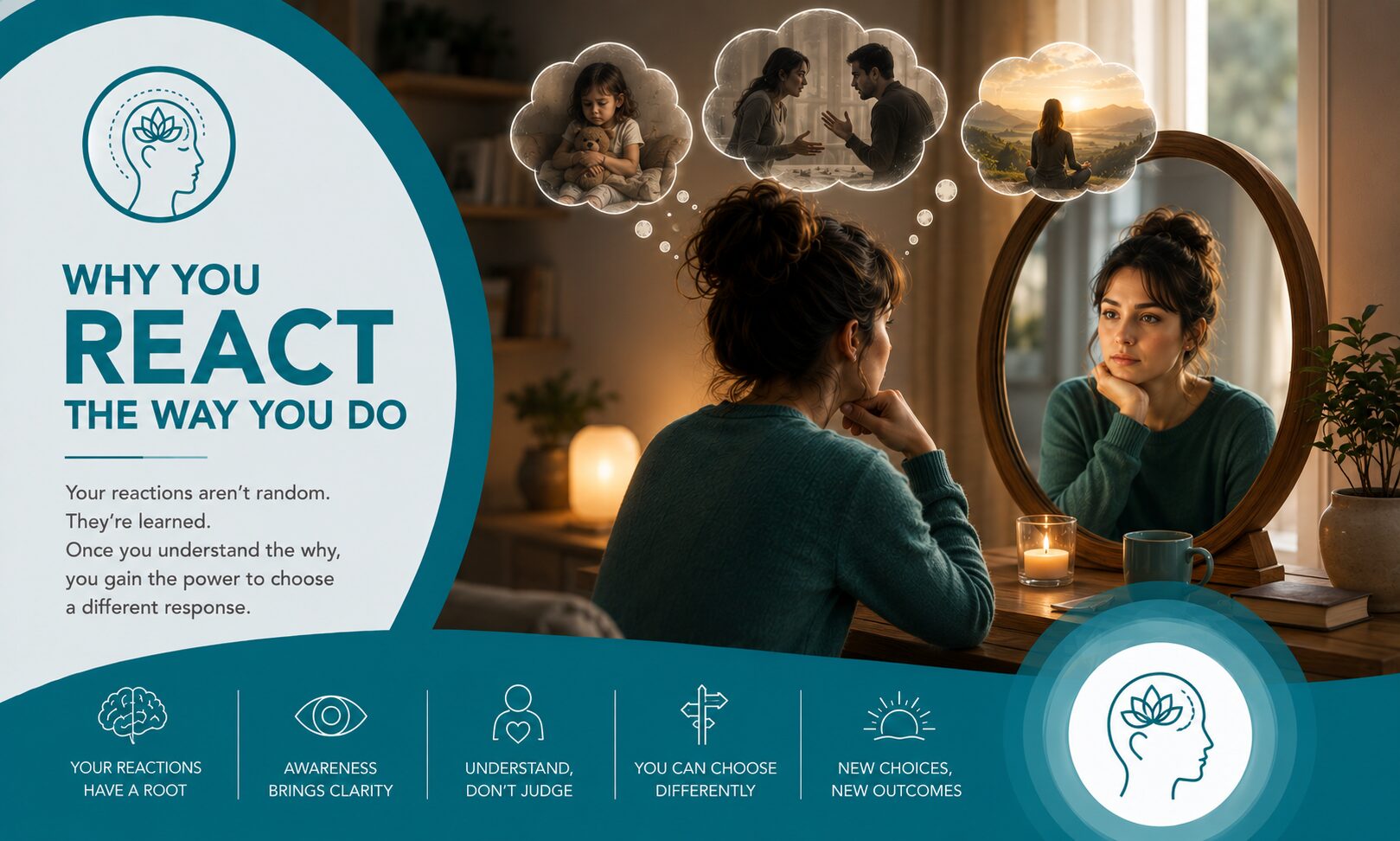
Every family has its own rules, especially the unspoken ones. As children, we develop ways of thinking and behaving to cope with our circumstances. The problem is that we often carry them into adult life without questioning whether they still serve us.
For example, a child who grows up feeling unimportant may become an adult who takes a mistake in a restaurant order personally, seeing it as further evidence that she doesn’t matter.
You may recognise some of these patterns:
- You can’t let a mistake go without mentioning it.
- You go quiet rather than risk a disagreement.
- You say yes and resent it afterwards.
- You hear a suggestion as criticism.
- You can’t accept help without feeling slightly diminished.
- A small setback feels like proof of something much bigger.
These patterns may have served a purpose when we were younger, but that doesn’t mean they are still useful. Once we recognise them, we can begin to question whether we need to keep responding in the same way.
Strengths That Grew From the Same Experiences
It would be easy to read this far and think we need to get rid of our programming. We don’t. Some of the qualities we value most in ourselves may have grown out of the very experiences that also created our difficulties.
I am a solution finder. I rarely sit with a problem for long, which people around me sometimes find a little disconcerting. I learned to find solutions because, growing up, I believed nobody else would do it for me. That belief also contributed to my sense that I did not matter. The same experience gave me both a strength and a difficulty.
My independence developed similarly. My parents took very little interest in the details of my life and mostly didn’t impose their beliefs on me. I was free to form my own opinions and make my own choices. Some of those choices led me down poor paths, and I probably learned from my mistakes more often than I needed to. But I also developed an independence I value enormously.
We don’t need to reject everything we learned growing up. We can begin to understand where our patterns came from and decide which ones we want to keep. I do not want to stop being a solution finder or become less independent. I want to recognise when those qualities are being driven by an old belief that no longer serves me.
We learned them through our experiences, and over time they became part of who we are. We can value those qualities while still questioning the beliefs that helped create them.
What Is Learned Can Be Changed
What we learn, we can look at, and looking usually gives us a moment between what happens and how we respond. The difficulty is that we can’t see a pattern clearly while we are in the middle of it.
“We can begin to understand where our patterns came from and decide which ones we want to keep.”


Try This: The Reaction Nobody Saw
This week, notice one reaction that nobody else saw. Not the ones that showed. Those are easy, and they aren’t where most of your life is happening. Look for the one that stayed inside, and write down three things:
- What happened.
- What you felt and how strongly.
- What you did on the outside instead.
Then leave it alone. Don’t analyse it or rush to name it. The first label you reach for will be the harshest available, and there’s a decent chance it’s wrong.
You are not looking for a fault. You’re looking for something interesting.
Next, we will look at how these patterns, and the beliefs they come from, shape our experience.
Articles in Self-Awareness
Self-Awareness: The Gateway to Your Higher Self
- Why You React the Way You Do
- How Beliefs Shape Your Experience
- The Only Thing You Have to Do Is Be Willing
- Turning From Experience To Observation
- From Observing to Choosing
Enjoyed this article? Add People Development Magazine as a preferred source on Google:
