

If you were asked to describe yourself in three words, you might manage it in about four seconds. Loyal. Organised. Ambitious. A worrier. The reliable one. Someone who has never been much good at confrontation.
Whatever comes to mind, you will notice how little effort it took. And you will notice that the three words probably aren’t all complaints. Some of them you will welcome, and you’d be right to.
When your conclusions about yourself are ones you are proud of, they will work for you in all sorts of ways. If they are ones you’re less proud of, they probably don’t work for you so well.
In any event, those three words are conclusions you drew from your own experience. Some of them were accurate, and some were not, and at the time you had no way of telling which was which. The difficulty comes later, when a conclusion stops being something you worked out and becomes part of who you think you are.
When a Learned Habit Becomes Our Identity
There is a small but important difference between recognising something we learned and believing it defines who we are. We might say, “I learned to worry because life was unpredictable for a while,” but over time that becomes “I’m an anxious person.” Or “I learned that disagreement wasn’t safe” becomes “I’m just not assertive.” Perhaps “I coped because somebody had to” becomes “I’m the strong one.”
In the first version, we can see how the pattern developed. In the second, we have turned it into part of our identity. Once we believe something is who we are, we are much less likely to question it.
This is why understanding our history can be so useful. It helps us recognise that some of the things we have always considered part of our personality may be learned responses. We do not have to reject them, but we can begin to ask whether they are still helping us or whether we would like to respond differently. The important question here is not whether this is right or wrong, but whether it works for us.
The Five Levels of Attachment
In an earlier article, I mentioned don Miguel Ruiz Jr’s Five Levels of Attachment. Here is the model as I understand it.
- Authentic self. You can pick the idea up or put it down. It’s information, not you.
- Preference. You like it. You’d choose it. But you could manage without it.
- Identity. The idea has become a description of you. You’ve started saying “I am” where you used to say “I prefer”.
- Internalisation. You defend it. Someone disagreeing feels less like disagreement and more like being got at.
- Fanaticism. You need other people to agree, because not agreeing is a threat to who you are.
The model applies far beyond self-belief, but for now the important threshold is the one between preference and identity.
When a Criticism of Something We Love Feels Personal
A friend’s partner is a staunch football fan. His life revolves around his team’s matches, and his mood can depend on how well they are doing. One day, we met a rival fan who made a disparaging comment about his team. To me, it was just banter, a mischievous tease. To him, it felt like a personal insult. He was furious, and nothing we said could persuade him to let it go. He spent the rest of the day fuming about it, though he did see the funny side in the end.
We ribbed him about it, of course, and there is nothing wrong with being passionate about football. For most people, that kind of attachment is part of the fun and causes no real problem.
What interested me was the moment when something he cared about became so closely tied to his sense of self that a criticism of the team felt like a criticism of him. Harmless banter suddenly felt personal.
Most of us have beliefs, loyalties or preferences we identify with strongly, and there is nothing wrong with that either. The useful thing is to notice when something has become so bound up with our identity that we begin defending it as though we are defending ourselves. In this case, the consequence was fairly minor: an enjoyable day was spoiled. In other areas of life, the same pattern can have much greater consequences.
It can be useful to recognise how attached we are to our relationships, our work, our beliefs and even our ideas about ourselves. The more closely we identify with something, the harder it can be when it changes or we lose it.
In relationships, attachment can lead to dependency or unhealthy patterns, particularly when we rely on another person for our sense of worth or happiness. That doesn’t mean we should become detached or stop caring. The aim is to learn how to connect in healthy ways, where we can love and support each other without losing ourselves.
Pain is a natural response to loss, but we can add to our suffering through what we believe that loss says about us. Even positive beliefs can become a problem when we feel we have to defend them.
Think about the three words you chose earlier, particularly the one you’re proudest of. Imagine no longer needing that word to describe yourself. Does that feel freeing, or do you immediately want to defend it?
How Beliefs Combine Into a Way of Seeing Life
What took me much longer to understand was that our beliefs do not operate in isolation. Over time, they become connected and form what we might call a paradigm, or a way of being. They shape how we see ourselves, other people and the world around us. Eventually, we become so used to them that we no longer recognise them as beliefs. They feel like who we are.
This is why our beliefs can influence our lives without our being aware of it. They affect the opportunities we consider, the relationships we pursue, the choices we make and even the things we decide are not possible for us. We may believe we are making those decisions freely, without realising that our expectations have already narrowed the possibilities.
Looking back on my own life, I can see how my belief that certain opportunities were not for people like me shaped the choices I made long before I ever questioned it. At the time, I was not consciously deciding to limit myself. I did not see those opportunities as available to me. This is how powerful a way of being can become, and why learning to recognise it is such an important part of Self-Awareness.
How My Paradigm Played Out
Looking back, I can see how two sets of beliefs were working together. On the one hand, I believed I was not worth much, not especially lovable and that I did not really matter. On the other hand, I knew I was resilient, loved learning and was loyal and loving. For years, I thought of these as separate: the first to overcome and the second to be grateful for. What I did not realise was how they could work together, sometimes in ways that were not good for me.
Why I Stayed Too Long in Relationships
My romantic relationships have probably been the most painful example. I can see now that my sense of unworthiness shaped the partners I chose. I was drawn to people who, in different ways, reinforced what I already believed about myself. But it was my loyalty that kept me in those relationships, and my resilience that kept me far longer than was good for me.
I used to think I was not very good at protecting myself because I was weak. I can see now that it was more complicated than that. I was strong, but I was using that strength to endure situations I needed to leave. The qualities I valued in myself were not the problem. It was the beliefs that directed them.
Achieving to Prove I Mattered
For a working-class girl, I did reasonably well in my career, certainly better than I had imagined possible when I was younger. I have often wondered how I managed that while still holding those beliefs about myself. Part of the answer is that I was trying to prove something. Achievement became a way of showing myself, and perhaps other people, that I was capable and mattered.
I can see this particularly clearly in the business I set up. It never became what I wanted it to be, and when it began to struggle, I did not fight for it as I might have expected. For a long time, I saw that as a failure of resilience, which was difficult because resilience was one of the qualities I had always relied on.
I have since come to understand that I did not really want the business itself. I wanted to be the sort of woman who had a business. There is a difference between pursuing something because it genuinely matters to us and pursuing it because we believe it will prove something about us. I could have shown more staying power, but I also needed to question why I had taken that path in the first place.
How My Choices Affected My Children
Then there are my three children, the loves of my life, who grew up in split homes as a result of the choices I made. My beliefs did not only affect me. They influenced the decisions that shaped their childhoods, and I have had to come to terms with that.
They are adults now, and I am eternally proud of them. They are loving, capable people who are doing well in their own lives. I do not want to use this as a way of dismissing the difficulties they experienced. But one thing I did try to do, because I was so aware of where my own choices had taken me, was to help them recognise and trust their own Higher Selves from an early age.
The Loving Presence That Stayed With Me
There was one thing, though, that seemed to survive all those beliefs. From as far back as I can remember, I had a sense of a loving presence I could turn to. I had not been taught to think this way, and I did not have a name for it. I just knew it was there.
Looking back, I can see that this loving perspective was the part of me my old beliefs never quite reached. I might have doubted my worth or made choices based on those doubts, but somewhere underneath, I could still access something that saw things differently. It kept me questioning, helped me find another way when I needed one, and, I believe, helped me give my children some of what I had struggled to give myself.
None of the choices I made at the time felt driven by beliefs. They felt perfectly reasonable given my circumstances. Only looking back can I see how much my expectations and sense of self were shaping them. This is what makes our paradigms so difficult to recognise. They do not feel like beliefs. They feel like the way things are.
Examining Our Beliefs Without Rejecting Who We Are
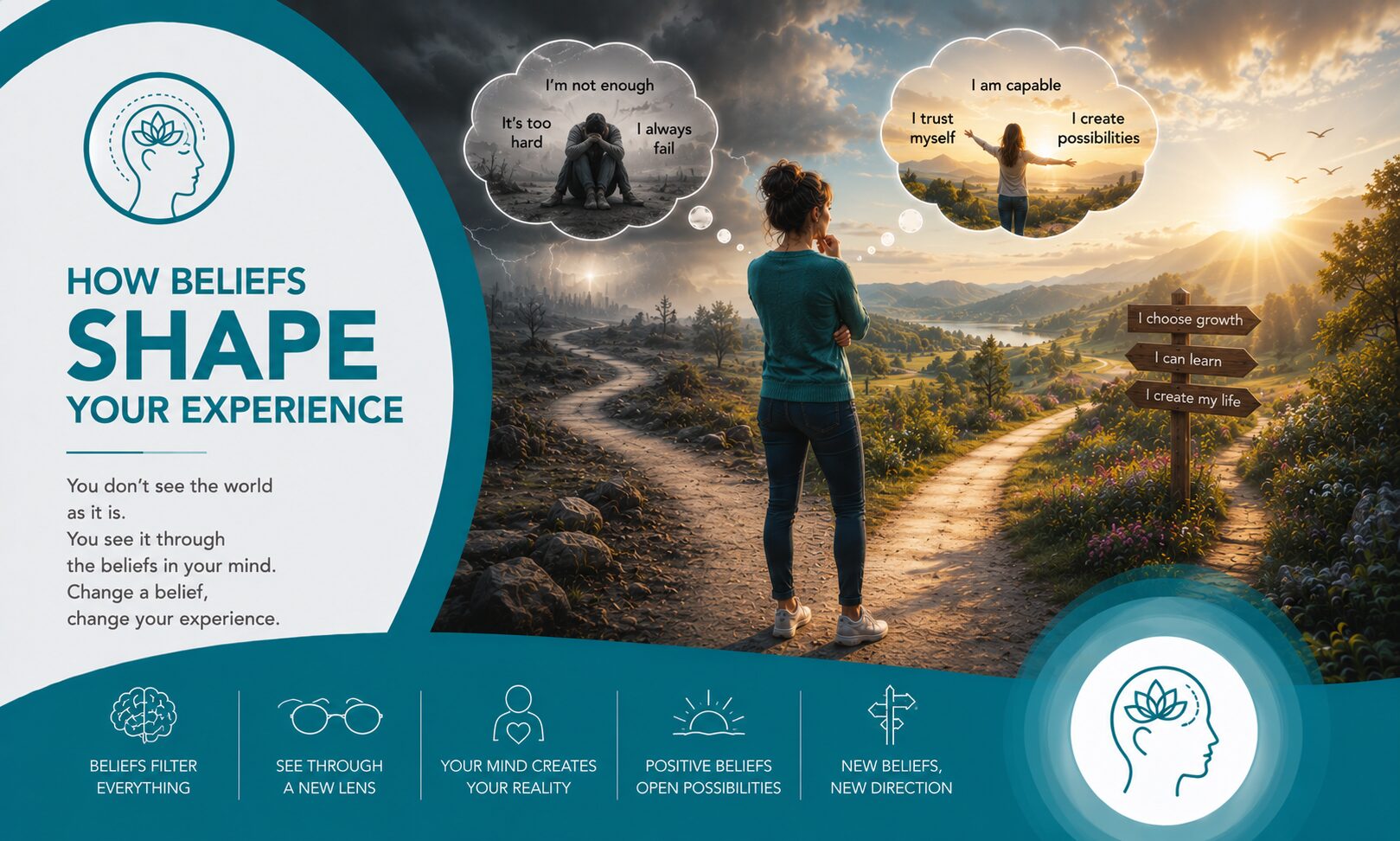
Our beliefs shape what we notice, how we interpret what happens and what we take as evidence that we were right all along. This is why arguing with ourselves about a belief is not always enough. We may understand intellectually that it is not true, yet still experience life as though it is.
For me, the first step was learning to step back and look at what was happening. I want to say I chose to do that, but in fact pain eventually forced me to look. I had spent years living my life without really questioning the beliefs behind my reactions. Only when some of those experiences became too painful to continue in the same way did I begin to ask what was going on.
It was not always straightforward. Sometimes I could recognise a pattern quickly and see which belief had been influencing me. At other times, I could look at something I had done and have no idea why I had done it. I might recognise that my reaction had not been helpful, but still not understand what lay beneath it. That did not mean I was doing anything wrong. It simply meant I had not yet understood it.
The important thing is that we do not lose anything by looking. We do not have to reject the person we have become or decide that everything we learned was a mistake. Many of the qualities we developed through our experiences are valuable, and we can choose to keep them.
I still value my appetite for learning, my independence and my ability to stay reasonably calm when other people cannot. Understanding how those qualities developed does not make them any less mine. It helps me recognise when I am using them because I genuinely want to, and when an old belief is driving me.
This, for me, is the difference Self-Awareness makes. We can appreciate who we have become while giving ourselves the freedom to choose how we want to live now.
“We do not have to reject the person we have become or decide that everything we learned was a mistake.”


Try This: Putting Down Your Three Words
Choose three words you would use to describe yourself. They might be qualities you value, such as strong, independent or caring, or words you are less comfortable with, such as anxious, impatient or not good enough.
Take each one in turn and imagine you no longer need to be that kind of person.
For example, if one of your words is “strong”, imagine you no longer have to be the strong one. You can still be strong when you need to be, but you do not have to prove it or live up to that label.
Notice how you feel. Does the thought bring relief, or make you uncomfortable? Do you immediately want to explain why the word really does describe you?
If you feel uncomfortable or want to defend the word, it may be a sign that you have become quite attached to that part of your identity. There is nothing wrong with that, but it is worth being curious about.
Ask yourself: Have I ever made a choice, stayed in a situation or turned down an opportunity because I believed I had to be this kind of person?
You do not need to find an answer today. The purpose is to begin recognising how your beliefs about yourself may be influencing your choices.
When we begin to develop self-awareness, it can be a revealing but sometimes painful exercise. Undoubtedly it might take a long time. Because of that, you must be willing to begin this journey, and that’s what we look at next.
Articles in Self-Awareness
Self-Awareness: The Gateway to Your Higher Self
- Why You React the Way You Do
- How Beliefs Shape Your Experience
- The Only Thing You Have to Do Is Be Willing
- Turning From Experience To Observation
- From Observing to Choosing
Enjoyed this article? Add People Development Magazine as a preferred source on Google:
