

For many years, I asked myself the same question over and over: Why is this happening to me? I suspect most of us have asked that at some point. When relationships fail, money becomes a struggle, or the same problems keep recurring in different forms, it is natural to wonder why life seems to be treating us unfairly.
The difficulty is that the question can keep our attention on what is happening outside us. We look for an explanation in another person, our circumstances or a run of bad luck, hoping that if we understand what caused the problem, we will know how to put it right.
Sometimes those explanations are entirely valid. Our upbringing, relationships, employers or financial circumstances can have a significant effect on our lives. Recognising this does not mean we have to blame ourselves for what has happened.
But I have learned that understanding why something happened is not always enough to change what happens next. I could spend a great deal of time working out who or what was responsible and still find myself facing the same difficulties. Eventually, I began to realise I needed to ask a different question: What can I learn from this, and what can I do differently?
What Am I Unknowingly Contributing?
I spent years looking for answers, but although the circumstances changed, the same patterns kept recurring.
Things only began to shift when I asked a different question. It was much simpler, and much harder to avoid.
What am I unknowingly contributing to the life I’m experiencing?
The word that matters there is unknowingly. This isn’t about blaming ourselves for every difficult thing that has ever happened to us. Life brings all of us experiences we neither chose nor deserved. It means accepting that, alongside those events, our beliefs and expectations influence the decisions we make, the relationships we enter, the opportunities we pursue and the risks we avoid, often without our noticing.
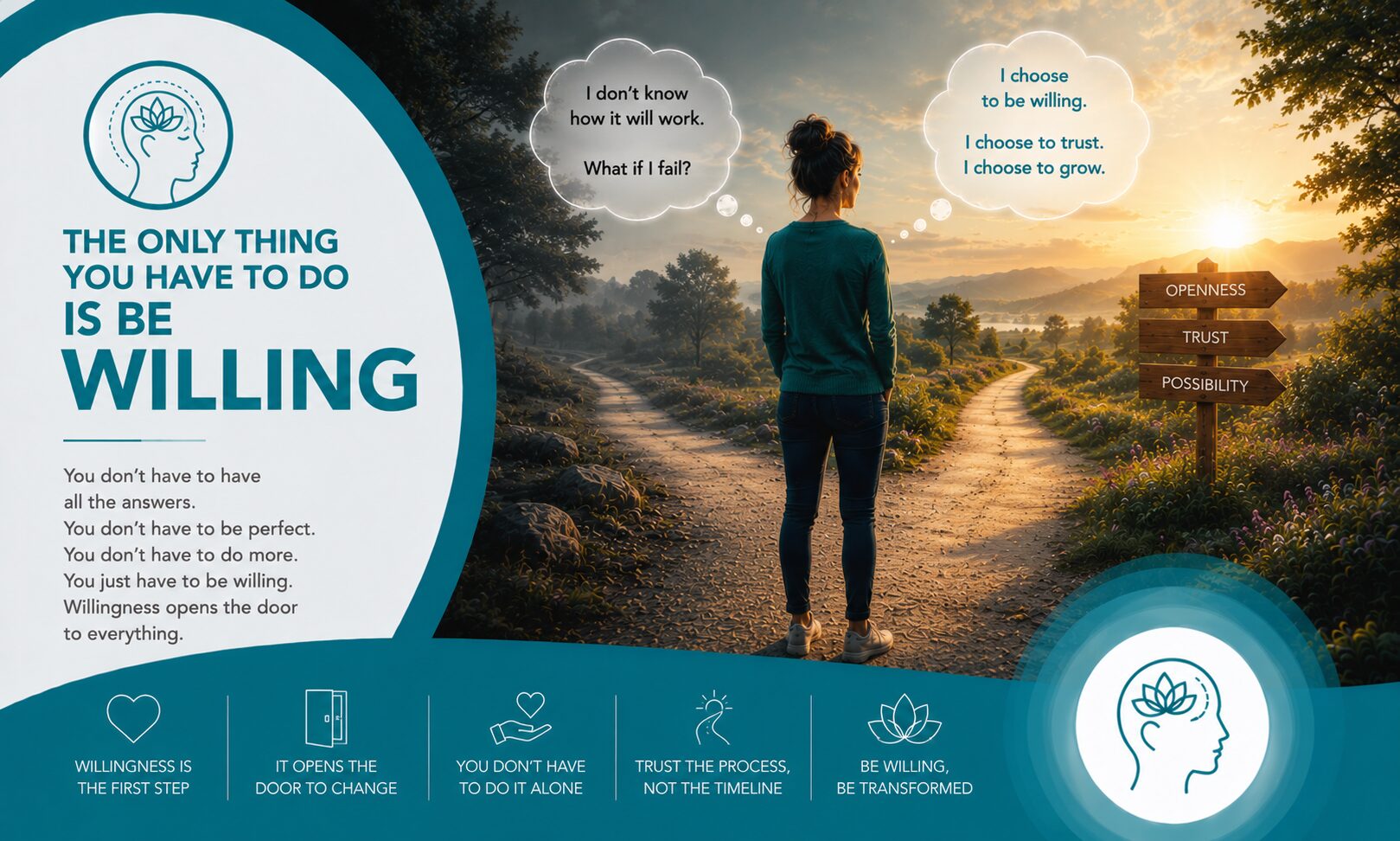
This is all willingness really asks of us. It doesn’t ask us to have the answers, to become a different person, or to know how anything is going to change. It asks us to consider that there may be something about ourselves we have not yet seen, and to look at it with curiosity rather than judgement.
The Dream That Tried to Warn Me
About a year before my house was repossessed, I had a vivid dream.
I was hosting a party, and the house was full of friends and neighbours. Instead of enjoying it, I sensed they were looking at me with pity. I felt I did not belong there and did not really deserve to live in such a lovely house or be surrounded by people like them.
I woke up feeling sad, but by later that morning I had pushed the dream aside. I did not think about it again until much later, after I had lost the house. I do not see the dream as a prediction of what was going to happen. It was showing me something I already believed about myself. Underneath everything I had achieved, there was still a sense that I did not deserve it.
More importantly, that belief was not just affecting how I felt. It was influencing the decisions I made and the way I behaved, and some of those choices helped create the circumstances in which I eventually lost the house. I could not see that at the time because the belief itself was still invisible to me.
The information was already there. I was not ready to recognise it.
Why We Don’t Want to Look
We have already seen that beliefs can become so much a part of our identity that they no longer feel like beliefs at all. They feel like facts. This is what makes them so difficult to examine.
I did not consciously ignore the dream about the house. At the time, I did not understand what it was showing me. But looking back, I can see I had ignored many other signs pointing to the same belief.
The reason was not laziness or an unwillingness to change. Somewhere beneath the surface, I was afraid to look too closely. If I examined that old sense of unworthiness, what if I discovered there really was something wrong with me? It felt safer not to question it.
Eventually, losing the house caused enough pain that I could no longer avoid looking. What I discovered was not that the belief was true, but that I had been living as though it were. That was a very different thing.
And this is why willingness has nothing to do with blame. Seeing how our beliefs have shaped our choices doesn’t mean condemning ourselves. It means we can stop letting those beliefs decide what happens next.
How Childhood Beliefs About Money Shaped My Choices
My parents worked incredibly hard, but money was a constant worry. We were well cared for in every practical sense, though the day-to-day struggle left little room for emotional warmth.
Without anyone ever sitting me down to teach me these things, I drew some powerful conclusions: life was a struggle, money was scarce, people like us did not really get ahead, and we knew our place.
By most measures, I got past all of that. I became a workaholic, built a decent career and earned a reasonable salary. For someone starting where I started, I had come a long way.
What I had not realised was that part of me was still making financial decisions based on those early beliefs. I rarely felt financially secure, even though I was much better off than I had ever dreamed I would be. I spent beyond my means, accumulated credit card debt and regularly found myself waiting anxiously for payday. At the time, I could not understand why I kept doing it. Eventually, my outer circumstances reflected what had been going on underneath.
Painful Lessons
Losing my home was one of the most difficult and, indeed, humiliating experiences of my life, particularly because I was raising three young children on my own. For a long time, I was angry that life had dealt me a terrible blow. It did not occur to me that any of my own beliefs or choices might have contributed to what had happened.
When I eventually saw that connection, I had to be careful not to turn it into another reason to blame myself. The financial struggles of my childhood were real. I did not create them, and I certainly did not choose the conclusions I reached as a child. They made complete sense to me at the time. What I did, without knowing it, was carry those conclusions forward.
Recognising Conclusions I Formed as a Child
I also realised these were my conclusions, not necessarily those of everyone around me. Other members of my family lived through many of the same circumstances and came away with different beliefs, expectations and very different outcomes. We do not all experience the same family in the same way, nor do we all make the same meaning of what happens to us.
So, when I saw how painfully those conclusions had shaped my life, I recognised that I was no longer the child who had formed them, yet I was still living by some of them.
They shaped what felt safe, what I expected, what I thought was possible and what I believed I deserved. Because they felt like reality rather than beliefs, I never thought to question them.
Once I could see them, something changed. I could not alter what had happened in the past, but I could begin to question the meaning I had taken from it. My future did not have to keep being shaped by conclusions I had reached before I was old enough to understand them.
Willingness Is Enough
For years, I needed to understand what was wrong before I could change it. In fact, I needed much less. I only needed to be willing to look. I did not do this particularly well. I looked in the wrong places, reached conclusions I later changed and went round in the same circles more than once. But every time I was willing to question what I thought I knew, something else became possible.
The other thing I had to learn was how to look without turning what I found into evidence against myself. If Self-Awareness becomes another way of asking What is wrong with me? then it is hardly surprising that we avoid it.
The loving presence I described earlier helped me see the difference. It did not ask why I had been so stupid or why I had not known better. It helped me understand what I had believed, how those beliefs had affected my choices, and what I could now see differently.
Even the dream about the house made more sense from that perspective. I don’t see it as a warning that something bad was going to happen. I see it as information about a belief I was already living from, long before I was ready to recognise it.
That changed how I looked at difficult experiences. Instead of asking why life was doing this to me, I could sometimes ask a more useful question: Is there something here I am ready to see?
Willingness does not mean being ready for everything we might discover. It means being prepared to look, without using what we find to punish ourselves.
“Willingness asks us to consider that there may be something about ourselves we have not yet seen and to look at it with curiosity.”


Try This: Something You Keep Noticing
Think about something you have noticed about yourself more than once. Perhaps a friend or partner has pointed it out, or you keep finding yourself in similar situations. It might be a feeling you recognise, a recurring dream or a reaction you have never quite understood.
Choose one thing you have tended to dismiss, explain away or avoid looking at.
Ask yourself:
What is it that I keep noticing?
What am I afraid it might mean about me?
Am I willing to look at it, even if I do not yet understand it?
You do not have to decide whether it is true, nor do you have to do anything about it today. Just allow yourself to consider it without judging yourself.
This is what willingness means in practice. We do not have to know the answer or be ready to change everything. We only have to be willing to look. No one else can make that choice for us.
In the next article, I will explain what looking actually consists of, and why so much of it has to be done indirectly.
Articles in Self-Awareness
Self-Awareness: The Gateway to Your Higher Self
-
- Why You React the Way You Do
- How Beliefs Shape Your Experience
- The Only Thing You Have to Do Is Be Willing
- Turning From Experience To Observation
- From Observing to Choosing
Enjoyed this article? Add People Development Magazine as a preferred source on Google:
