


Quite early on, I knew I wanted to work with people and help them develop. I had almost fallen into managing people, and Human Resources seemed the obvious route. So I completed the qualifications, applied for the next job and then the next, and gradually worked my way up.
I learned a great deal along the way and achieved things I was proud of. But I was also frustrated, though I could not really explain why at the time. I had gone into HR to make a difference to people, yet much of the work did not feel like I was doing that.
The difficulty was that I did not hate my job. I was good at it; I kept progressing, and I had three children to provide for. There were plenty of reasons to carry on.
It was only much later, when I began working with people through one-to-one coaching, that I realised what had been missing. This was much closer to what I had wanted to do in the first place.
Looking back, I had spent years working towards goals that made sense. I wanted the qualifications, the promotion and the better job, and I worked hard to get them. But achieving them did not give me quite what I had expected.
Sometimes we reach a goal and need another one. But sometimes reaching it helps us realise that the goal was not really what we wanted. In my case, HR had taken me in the right general direction, but it took me years to work out which part of that work genuinely mattered to me.
Asking What We Expect a Goal to Give Us
Over the years, I’ve begun to ask a different question about what I want: what am I expecting this to give me?
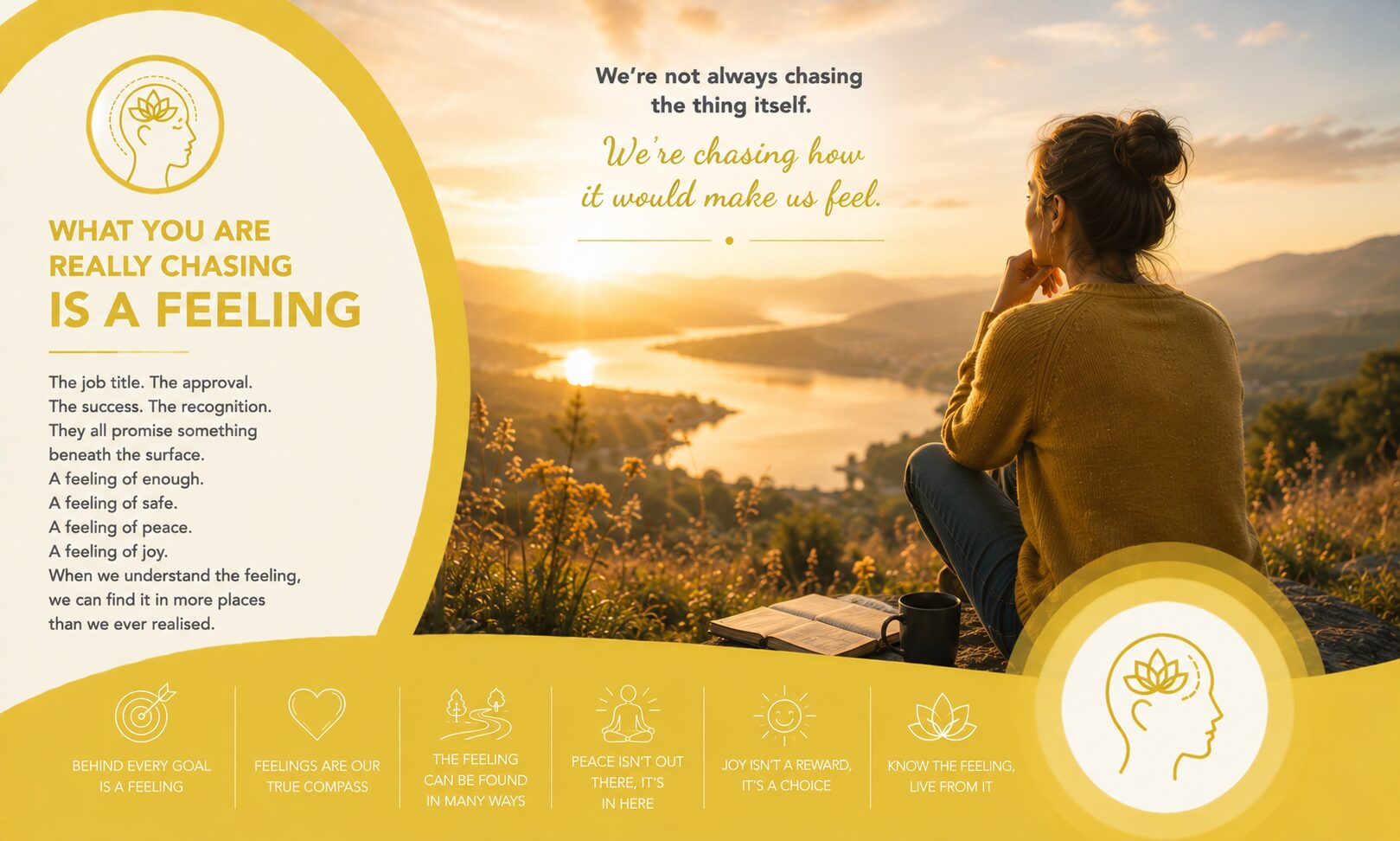
We tell ourselves we want the job, the house, the money, the qualification or even the number on the scales. But underneath, we may actually want to feel secure, valued, free, successful or more at peace.
We can become so focused on the outcome that we never ask what we expected it to give us. Then we achieve it and wonder why something still feels missing.
Once we know what we are really looking for, we have more choices. The goal may still be exactly right, but it stops being the only route to the feeling we hoped it would provide.
Finding What a New Job Needed to Provide
A client once came to me because she was deeply unhappy in her job. She was highly qualified and had plenty of options, but she had lost confidence in her judgement and could not decide what to do next.
Rather than focusing on which job to apply for, I asked her what she wanted a new job to give her. We kept asking the same question of each answer until we got beneath the job itself.
What emerged surprised her. She wanted to feel trusted, have more freedom and feel that what she was doing mattered. Looking for the right job became much easier because she knew what she was actually looking for. She had genuinely outgrown her role, so this was not about finding a different way to appreciate what she already had. It was about choosing what came next for the right reasons.
Instead of concentrating mainly on job descriptions, she began looking at the organisation, its culture, how people were treated and how much freedom she would really have. Most importantly, she began trusting her own judgement again. Her goal barely changed, but she now knew why she wanted it.
When We Turn What We Love into a Goal
Someone in my family loved music. He and a friend bought a couple of inexpensive mixing desks, taught themselves music production and had a great time doing it. He loved it so much that he decided he wanted a music career.
So he went to university to study it. Music production turned out to be a small part of the course, and most of his time went on assignments and academic work, which he had never enjoyed. Added to that was the expectation that the degree would lead to a career in an industry notoriously difficult to get into.
He was not lazy or lacking ambition. He struggled to motivate himself to do a great deal of work he disliked for something that no longer felt much like the thing he had loved in the first place.
Psychologists have described a related phenomenon, the overjustification effect: in some circumstances, adding external rewards or pressures to an activity we already enjoy can reduce our intrinsic motivation. That does not happen in every situation, but I recognised something of that in what had happened to him.
Eventually, he realised that what he really loved was not the idea of a music career. It was how making music made him feel. Once he understood that, he no longer needed music to be his career for it to have a place in his life. He is finding that same feeling in other areas too, alongside a job he is perfectly happy to be motivated to do because it pays the bills.
When Competing Takes the Enjoyment Away
A colleague loved dancing simply because she enjoyed it. Then she entered a competition. She wanted to win, and gradually she began to enjoy dancing less.
Nothing about the dancing had changed, only her reason for doing it. Something she had done purely for love had become something she was measuring and trying to succeed at.
The competition was not the problem, and plenty of people love competing. For her, comparison had taken the place of enjoyment. Fortunately, the enjoyment had not disappeared. She just needed to stop measuring herself against everyone else and rediscover why she loved dancing in the first place.
This was when something clicked for me. There are things we do because we love them and things we do because they need doing. Life contains plenty of both. The problem comes when we turn something we love and feel inspired to do into something we have to measure, achieve or succeed at.
Before You Start Climbing the Ladder
Looking back on my career, the old analogy about putting your ladder against the wrong wall captures my progression. Only when I discovered coaching did I realise there had been another ladder, with far fewer rungs, that could have taken me much more directly to the work I wanted to do.
I do not regret the route I took, and everything I learned along the way has been useful. I made the best decision I could with what I knew at the time, which is all any of us can do. What I did not know to ask was what I expected HR to give me.
When we make decisions about our future, we research the practical things: the qualifications, the money, the opportunities it might create and how long it will take. Those things matter, but they are only half the research.
The other half is questioning what we assume the outcome will give us. If I get this job, earn this amount or achieve this goal, how do I imagine I will feel? And what evidence do I have that it will actually give me that?
We cannot know how any choice will turn out. But we can talk to people who are already there, find out what the day-to-day reality is like, and test our assumptions about ourselves as carefully as we test the practical facts.
Sometimes the ladder will still be the right one. But it is worth checking the wall before we spend years climbing it.
Asking How We Want to Feel
Perhaps the most useful question, then, is not What do I want? but How do I want this to feel? That does not mean abandoning goals or ambition. It means understanding what underlies them, and it opens up possibilities, because there is usually more than one way to find what we are really looking for.
For me, this is another place where the Higher Self becomes practical. Beneath all the things I believe I should want, there is usually a quieter answer about what actually matters. I’ve learned to take that answer more seriously.
“Beneath all the things I believe I should want, there is usually a quieter answer about what actually matters.”


Try This: How Do I Want to Feel?
Think of something you are currently working towards and ask yourself a simple question:
How do I expect to feel when I get there?
Once you have your answer, ask what else could give you some of that feeling now. Do not dismiss the smaller things, because they may reveal more about what you actually want than the goal itself.
Then come back to the original goal. Does it still feel right? It probably will. The difference is that you are no longer expecting one achievement to provide something that may be available to you in many other ways.
Most of us have known somebody whose presence made us think differently, or see more possibility in ourselves. So what is it about some people that makes them inspiring to be around? That is what we look at next.
Articles In Inspiring Self and Others
Inspiring Self and Others: Living in a Way That Calls Forth the Best in Everyone
- The Difference Between Motivation and Inspiration
- What You Are Really Chasing Is a Feeling
- Characteristics of Inspirational People
- Why Trying to Inspire Never Works
- What Happens When Nobody Needs To Win
Enjoyed this article? Add People Development Magazine as a preferred source on Google:
Enjoyed This? . This Essential Guide brings the whole framework together in one place, free to download.
