


I was working with a coaching client who was explaining why she had moved on from a group of people and felt guilty about it. I listened, asked a few questions and reassured her that she had nothing to feel guilty about. She went quiet. She then changed the subject, and we spent the rest of the session elsewhere entirely.
It took me a while to work out what had gone wrong, because nothing I had said was untrue or unkind. The problem was that I had decided, without asking her, where she ought to end up.
In doing so, I had cut short the process she needed to go through for herself. I had given her my conclusion before she had reached her own. And although we might have arrived at the same place, I had robbed her of the relief that would have come from discovering for herself that she had nothing to feel guilty about.
I have thought about that conversation many times since. It changed my coaching practice for the better and taught me something important about inspiration. We cannot shortcut somebody else’s way to it.
Why We Cannot Make Someone Feel Inspired
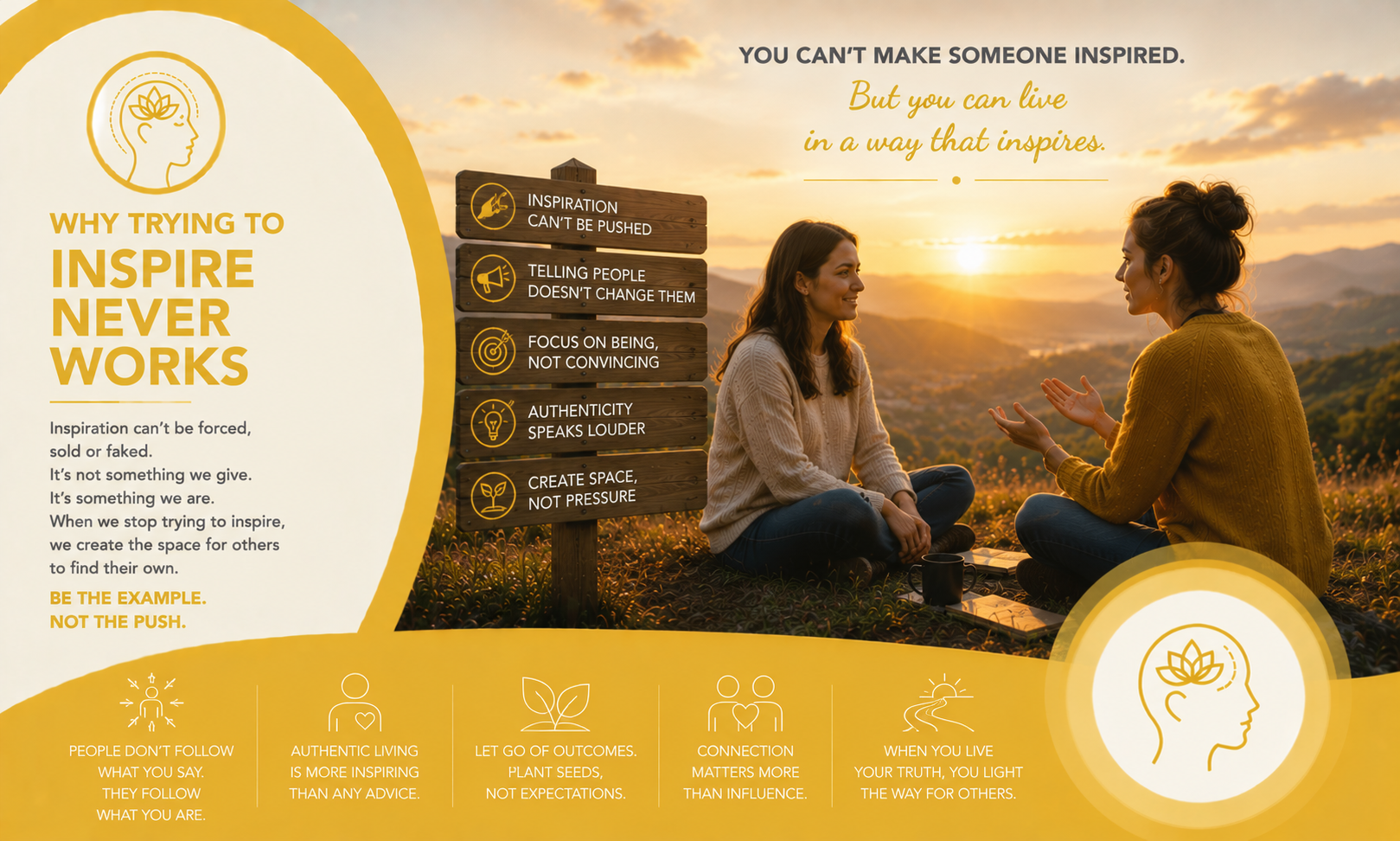
After coaching hundreds of people, I have come to believe that inspiring others is not something we can aim for. The moment we set out to be inspiring, we risk performing. We are trying to create a reaction in someone else, and that reaction isn’t ours to control. Something I say may inspire one person, irritate another and leave a third completely unmoved.
This is another important difference between motivation and inspiration. External rewards, consequences, encouragement and goals can all motivate behaviour, although their effects vary from person to person and situation to situation. Inspiration is not a stronger version of motivation.
Whatever happens ultimately belongs to the other person. We may help things along. We may ask the question that opens something up, share an idea that stays with them, or give them enough space to hear themselves think. But the inspiration itself is theirs. We are not the ones doing it.
What People Pick Up from Us
Tell someone to take their time while glancing at your watch, and they will believe the glance.
This is why trying too hard to appear encouraging or inspiring can work against us. People often pick up on the effort as well as the words.
When Helping Gets in the Way
I am a fixer, and with my children especially, I rush in with advice on what to do next. Over the years, I realised I was disempowering them. The uncomfortable truth was that I didn’t know the best next step for them. They needed to find their own answer, not simply take mine. I’m still working on it.
A much better starting point, I’ve found, both for myself and for others, is: What is actually going on here? Sometimes I have to sit on my hands, metaphorically, while I wait for the answer.
When We Feel Uninspired Ourselves
The same principle applies when we try to inspire ourselves.
When something that used to matter no longer does, our instinct may be to find a new goal, make a plan or look for something that will give us a boost. There is nothing wrong with doing that, and sometimes it helps. But if we keep having to persuade ourselves to care, it may be worth asking whether we are trying to motivate ourselves towards something we no longer really want.
I have done this myself. As I described earlier, for years I kept working towards the next stage of my career because I believed it was what I wanted. I had good reasons to keep going, particularly to provide for my children, but I had not fully recognised that the work itself was not giving me what I had originally hoped for.
I could not have solved that by finding a better motivational technique. I needed to understand what was missing.
This is why I no longer believe feeling uninspired is necessarily a problem to solve. Sometimes it is information. Perhaps we are tired. Perhaps life has other priorities at the moment. Or perhaps something we once wanted doesn’t matter to us any more. It is worth finding out which before trying to motivate ourselves back into it.
Noticing What We Bring to a Conversation
Unity Consciousness helps us recognise when we make someone else wrong to feel right ourselves. If we are determined to win an argument or prove our point, we are unlikely to listen properly to the other person.
Self-Awareness helps us notice when we are reacting from fear, insecurity or an old belief. Instead of acting on that reaction, we can consider whether it is the response we really want to make.
Our Higher Self offers another way of looking at the situation. We can ask what would be helpful, what would honour everyone involved and whether we are trying to help or simply make ourselves feel better.
All four foundations come together here in a practical way. Can I notice my own reaction? Can I stop making the other person wrong simply because I disagree with them? Can I listen for what would genuinely help rather than what would prove my point? And can I do that without needing the conversation to end exactly where I want it to?
None of that guarantees inspiration. It simply makes me more aware of my own part in the conversation.
If I am anxious for my coaching client to reach a particular conclusion, she may feel that pressure. If I am trying to convince my children that I know what is best for them, they may become defensive. If I am genuinely interested in understanding them, the conversation is likely to be different.
The important question is not: How can I inspire this person? It is: Am I helping them find their own way, or am I trying to get them to see things my way?
Giving People Room to Find Their Own Answers
Looking back at the client who was feeling guilty, I can see exactly what I could have done differently. I could have stayed curious for longer. What did she believe she had done wrong? What did she feel responsible for? Would she judge someone else as harshly in the same circumstances? She might eventually have reached the same conclusion as me, but it would have been hers.
This is an important distinction in coaching, but it applies to ordinary relationships too. We can share our experience, offer advice when it is wanted, and help people think through their options. We do not have to withhold everything we know. But we need to recognise when we are helping someone explore and when we are trying to direct them towards the answer we prefer.
I am still learning this, particularly with my children. My instinct is often to solve the problem because I care about them and want things to be easier. But I cannot know every answer for their lives. Sometimes the most helpful thing I can do is listen, ask a question and trust them to find their own way.
That does not mean standing back when practical help is needed. It means not taking over a decision that belongs to somebody else.
Seeing a Child With Difficulties, Not a Difficult Child
I remember a neighbour’s son who always seemed to be getting into trouble. I had begun to think of him as a difficult boy, and that definitely coloured my attitude to him.
At some point, I realised I was doing something I had seen so often when I was growing up. I was taking somebody’s behaviour and making it who they were.
I began to look at him differently. Instead of seeing a difficult boy, I tried to see a child who was having difficulties. I did not know everything that was going on in his life, and I decided not to fill in the gaps with my own story about him.
That change in perspective made me kinder towards him. I became less inclined to judge him and more willing to give him the benefit of the doubt. His behaviour towards me changed as a result.
I cannot say his behaviour generally changed, and that was not the point. What changed was my relationship with him. I had stopped responding to the label I had given him and started responding to the person in front of me.
I did not set out to inspire him. I recognised that my own judgement was getting in the way of treating him as I would want to treat any child.
We don’t always need to change someone. Sometimes the most useful thing we can do is change how we see them. We may then find that the relationship changes too.
Meeting People Where They Are
This, for me, is the important point. I can want the best for somebody, encourage them and share what I have learned. What I can’t do is decide that they ought to be inspired by it.
If I decide I am going to inspire somebody, I have already assumed what they need and where I want them to end up. I may then become disappointed, frustrated or more persuasive when they do not respond as I hoped.
That is not the same as helping them.
The more useful approach is to meet people where they are, understand what matters to them and offer what we can without needing to control the outcome. Sometimes that may lead to a moment of inspiration. Sometimes it may simply help them feel understood, make a practical decision or get through a difficult day. All of those things have value.
The same applies to us. We do not have to feel inspired all the time. Sometimes we need rest, sometimes we need to deal with practical responsibilities, and sometimes we need to question whether the direction we are pursuing is still right for us.
We don’t need to manufacture inspiration in ourselves or in anybody else. We can pay attention, be curious and give whatever is there room to come out.
“I can want the best for somebody, encourage them and share what I have learned. What I can’t do is decide that they ought to be inspired by it.”


Try This: Stay a Little Longer
The next time someone tells you about something difficult, resist the urge to make it better. Do not advise, reassure or look for the positive. Just stay with them a little longer. If you need to say something, ask about what you do not yet understand.
Notice what happens in you, too. Often, it is our own discomfort with someone else’s distress that makes us want to fix it.
Then try the same with yourself. The next time you feel flat, do not immediately decide that you need more discipline, a better plan or something to motivate you. Stay with it long enough to ask what is really going on.
So far, we have looked mainly at inspiration within individuals and between people. Something interesting happens in groups too: the conditions that help people bring their best can spread, and that is especially true when nobody needs to win. That is where we go next.
Articles In Inspiring Self and Others
Inspiring Self and Others: Living in a Way That Calls Forth the Best in Everyone
- The Difference Between Motivation and Inspiration
- What You Are Really Chasing Is a Feeling
- Characteristics of Inspirational People
- Why Trying to Inspire Never Works
- What Happens When Nobody Needs To Win
Enjoyed this article? Add People Development Magazine as a preferred source on Google:
Enjoyed This? . This Essential Guide brings the whole framework together in one place, free to download.
