


When I was a new and relatively inexperienced manager, one of my team returned from a very long lunch and swore at me in front of everyone. He was popular and influential with his colleagues, but the managers I spoke to saw him as difficult. I had already put off dealing with his behaviour for several weeks, but this time I had no choice and dealt with it formally.
Once that was over, I asked him a different question. I asked what he wanted for himself in the longer term. It took him a while to answer, but eventually he told me. I then asked him to consider whether his current behaviour was likely to help him get there. He agreed that it wasn’t.
After that conversation, his behaviour changed. Several years later, long after we had lost touch, I saw that he had been appointed to the kind of role he had described to me that day.
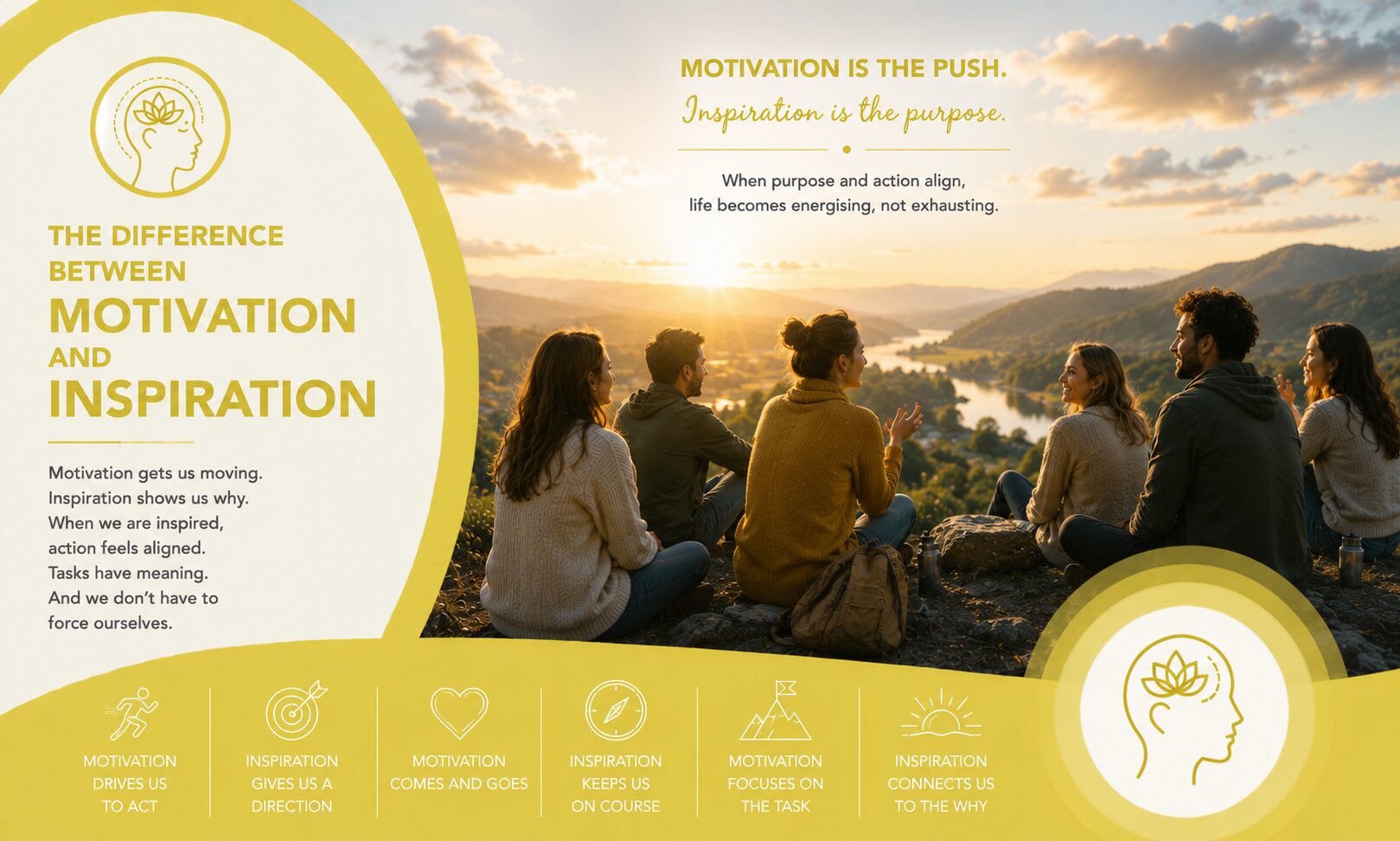
I had spent weeks trying to motivate him and getting nowhere. What helped was asking him to think about what he actually wanted and whether his behaviour was helping him get there. At the time, I didn’t think of it as the difference between motivation and inspiration, but that is how I see it now.
When Motivation Came From Providing for My Children
For years, I got up every morning and went to a job I did not always enjoy because I had children to provide for. That was enough of a reason for me. I did not need to love the work. I knew why I was doing it.
There were plenty of mornings when I would rather have been doing anything else, but that did not really matter. That motivation held for many years because the reason behind it was strong.
When my children became independent and no longer needed me in the same way, something changed. The reason that had kept me going was no longer as strong, and I began to realise that motivation on its own was not enough.
Moving Away From Problems or Towards Goals
One useful way to think about motivation is that it often works in one of two directions. We are either trying to get away from something we do not want, such as debt, poor health or an unhappy situation, or we are moving towards something we do want, such as a qualification, a promotion or a better life. Both work, and both can be powerful reasons to act.
Moving away from something can be particularly effective because it usually involves discomfort. We want the situation to change, which gives us the push to do something about it. The problem is that we can become so focused on what we are trying to get away from that we never really think about where we want to go instead.
Moving towards something gives us a goal to aim for, but it has its own limitation. We get the qualification, the promotion or whatever else we were working towards, and then what? We need another goal.
This is what both forms of motivation have in common. They need something to keep them going: a problem we want to solve or an outcome we want to achieve. Once that reason disappears, the motivation often disappears with it. Of course, human motivation is more complicated than two neat categories. I find the distinction useful because it makes me ask: am I moving towards something I want, or mainly trying to get away from something I don’t?
Inspiration feels different to me. I don’t need to talk myself into caring about something that inspires me. I already care.
The Idea I Kept Coming Back to for Years
Years ago, I began a long road of self-discovery, which I am still on today. I began to understand how differently we might experience life if we were less driven by fear and learned to listen to the wiser part of ourselves. What I was learning changed my life, and I knew I wanted to write about it and share it with as many people as might find it useful. However, for a very long time, I did little about it.
Life got in the way. Relationships broke down, people I loved passed away, I had three children, a demanding career, a business to build and all the other ups and downs life brings. There were years when writing about any of this was nowhere near the top of my list. Now and again, I would come back to it, write a little more or think about what I wanted to say, and then life would take over again. But the idea itself never went away.
What was lacking was not inspiration but capacity. I did not always have the time or energy to turn that inspiration into action, and that affected my motivation to sit down and write. What I never lacked was motivation to care about it. Nobody was waiting for it; there was no deadline, and for much of that time there was no obvious outcome to aim for. I kept coming back to it because it mattered to me.
That, for me, is what inspiration feels like. Motivation helped me do the work. Inspiration was the reason I kept wanting to.
How Inspiration and Motivation Work Together
This is the distinction that has proved useful to me. Motivation often gives me the push to act. Inspiration is why I care about doing it in the first place. And, of course, I often need both.
Being inspired does not mean the work is always easy. I can feel inspired to write something and still need motivation to sit down and finish it.
This is also where I see the connection with the Higher Self. It is easy to spend years pursuing what we think we ought to want. Listening within helps us separate some of that noise from what actually matters to us.
Reconnecting With Why Something Matters
That is also what happened with the young man on my team. I had spent weeks trying to give him reasons to change his behaviour. In the end, I asked him what he wanted. Once he could see the connection between the person he wanted to become and the choices he was making, I no longer had to persuade him.
I saw something similar with a coaching client who told me she hated most of her job. The parts she loved were those where she could see she was making a difference to someone’s life; everything else felt like routine. When we looked more closely, much of that routine work was making a difference too. She had lost sight of the connection. Her job did not change, but the way she saw it did, and the work became much easier to do.
This is where we sometimes ask too much of motivation. We use it to push ourselves through things without pausing to ask what they are in aid of. Sometimes there is no deeper meaning. Houses need cleaning, forms need filling in, and deadlines need meeting. But sometimes the meaning is already there, and we have lost sight of it. Finding the connection to something we genuinely care about can be enough to bring the inspiration back.
“Finding the connection to something we genuinely care about can be enough to bring the inspiration back.”


Try This: Ask What It Is in Aid Of
Think of something you need to do but don’t particularly want to do.
Ask yourself: What is it in aid of?
Maybe you’re working to provide for your family, exercising to feel healthier, or doing something tedious to make life easier later.
Sometimes remembering why it matters is enough to make it feel a little easier.
But what happens when we get what we were working towards, and it doesn’t feel as good as we expected? Sometimes what we were really chasing was not the thing itself, but how we thought it would make us feel, which is where we go next.
Articles In Inspiring Self and Others
Inspiring Self and Others: Living in a Way That Calls Forth the Best in Everyone
- The Difference Between Motivation and Inspiration
- What You Are Really Chasing Is a Feeling
- Characteristics of Inspirational People
- Why Trying to Inspire Never Works
- What Happens When Nobody Needs To Win
Enjoyed this article? Add People Development Magazine as a preferred source on Google:
Enjoyed This? . This Essential Guide brings the whole framework together in one place, free to download.
