


Most of us have probably been part of a group where everything worked well. People shared ideas, built on each other’s thinking and achieved more together than they could have done individually.
We have probably experienced the opposite too: a group of intelligent, capable people who somehow achieve very little together.
I used to think the difference was simply about getting the right people together. But I have seen excellent people struggle to work well as a group, while others bring out the best in each other. I began to realise that there was more to it than the abilities of the people involved.
What Combined Inspired Action Created
I was tasked with developing a people strategy for a large organisation I had worked with for several years. I was given the freedom to choose the team who would develop it with me.
I chose people who had impressed me: people with vision, who knew their stuff and were not afraid to say what they thought. Bringing them together was inspiring in itself. There was a sense that we had the right people in the room and could create something genuinely different.
Early on, we agreed not to be constrained by what was currently possible. We wanted to think outside the box. We were then able to focus on what would truly benefit the organisation rather than the problems we might encounter. The strategy that emerged received resounding support and, over the years that followed, helped create a much stronger culture.
What I found most inspiring was not the strategy we produced. It was what happened when a group of people brought their best thinking to something they genuinely believed mattered.
I didn’t think about Higher Selves or Unity Consciousness. I didn’t have that language then. Looking back, though, I can see some of the same principles at work. Nobody needed to have all the answers. We listened, challenged each other and gradually created something none of us would have produced alone.
When Inspiration Becomes Collective
Looking back at that team, it was not only the quality of the people that made the difference. The difference was that we were all committed to what we were trying to create, and somewhere along the way our individual positions became less important than that.
Groups can easily become places where we protect our ideas, demonstrate our expertise or worry about how our contribution will be received. Something different happens when people feel able to let those things go. An idea can be challenged without anyone needing to defend it. Someone can change their mind because another suggestion is better. A half-formed thought can be offered without knowing where it will lead.
In this group, we didn’t strike an agreement about how to work; it just emerged as we respected each other and were focused on making a difference. The team’s unity naturally became more important.
It Begins with One Person
It can begin with one person. Someone is willing to let go of their own idea, acknowledge that another suggestion is better, or admit they may have got something wrong. When others see that nothing terrible happens as a result, they may feel more able to do the same. It may be the leader who sets that example, but it can just as easily be someone else in the room.
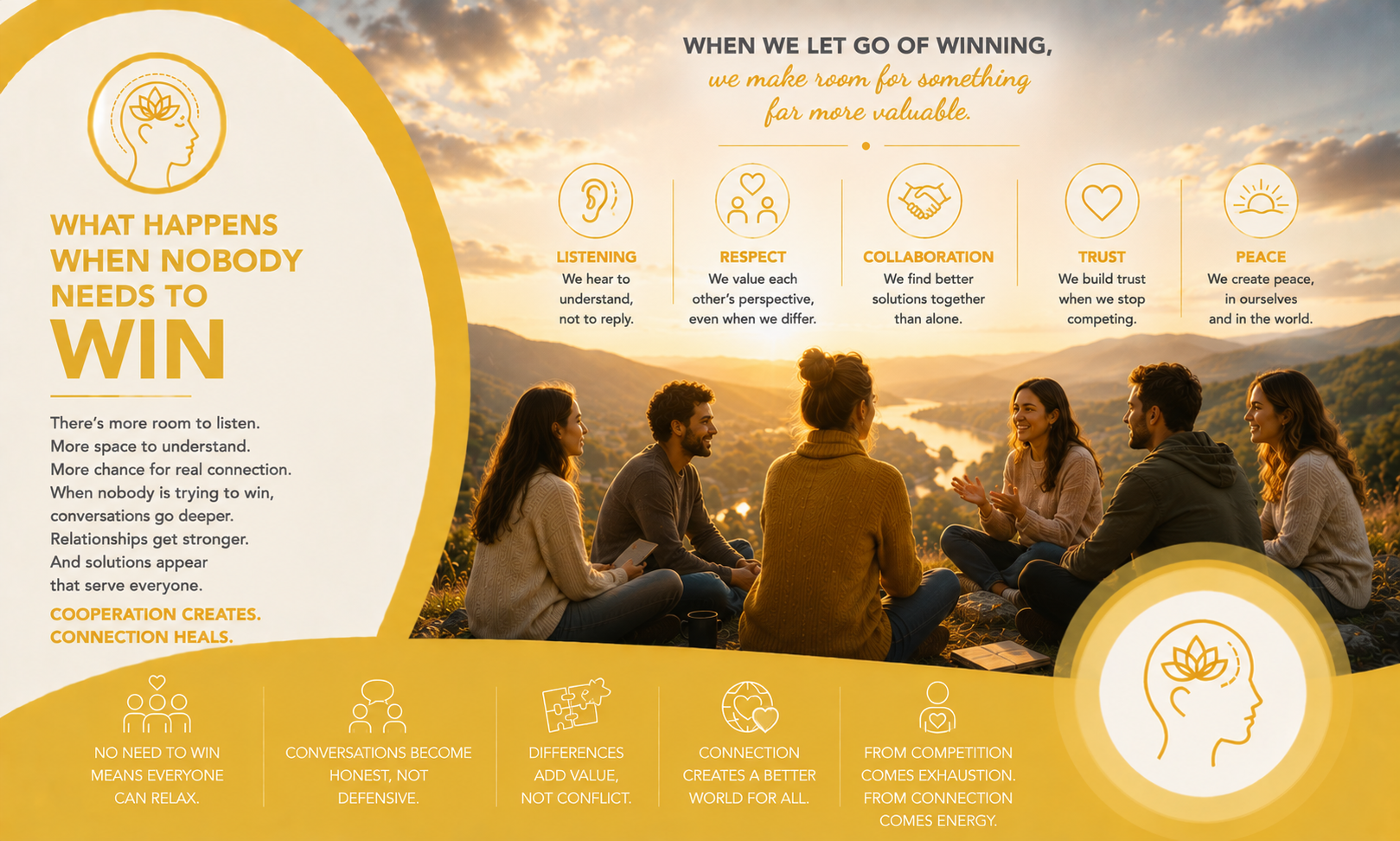
When people are no longer concerned with defending their own position, they can focus more on the work and on what others are contributing. They become more willing to listen, question their assumptions and build on each other’s ideas. The conversation changes because people are no longer trying to prove who is right.
This is when genuine collaboration becomes possible. One person suggests something, another sees how it could be improved, and someone else takes it further. The final result may be something none of them would have arrived at alone.
Inspiration can emerge in the same way. We cannot make it happen, but when people feel safe enough to contribute freely and are willing to learn from one another, we create better conditions for it.
How Permission Spreads Through a Group
One established term for part of this is psychological safety: people are more likely to contribute when they know they can speak up, ask questions and occasionally get things wrong without being humiliated. But what I notice spreading in effective groups is something simpler: permission.
One person admits they do not know, and it becomes easier for someone else to do the same. Someone offers an unfinished idea, and another builds on it. Someone changes their mind without losing face. Gradually, people become less concerned with protecting themselves and more interested in what they might create together.
Trust grows with it. As people realise they can disagree, experiment and sometimes get things wrong without it becoming personal, they say more of what they really think.
Fear Can Unite Us Too
Fear can bring people together remarkably quickly. A shared threat creates energy, focus and action. Anyone who has worked in a fear-based organisation will know how much can be achieved when people are worried about what might happen. Fear is not always dysfunctional; in a genuine crisis, it can focus attention and prompt necessary action. The problem arises when fear ceases to be a short-term response to a real problem and becomes the normal way of getting things done.
But fear needs something to fear. It tends to organise us around what we are against, what might go wrong or who is to blame. When one threat disappears, another often takes its place.
Inspiration gives us something different to organise ourselves around: what we are trying to create. That changes the conversation. Instead of concentrating only on what might go wrong or who is responsible, we have room to ask what might actually work.
And this brings us straight back to Unity Consciousness. If nobody has to be made wrong or lose for somebody else to win, another question becomes possible: What would a good outcome for everyone concerned actually look like?
We may not find one. Some situations genuinely require difficult choices. But unless we ask the question, we can easily miss an answer that nobody had thought of before.
What Am I Bringing into the Room?
We do not need to lead a team for any of this to matter. It happens in families, friendships, workplaces and ordinary conversations. How we enter those conversations shapes what happens next. If I arrive defensive and determined to win, I am likely to have a very different conversation from the one I have when I am genuinely open to another answer. That does not mean we are responsible for making everyone else positive, hopeful or inspired. Trying to manage other people’s feelings usually has the opposite effect.
Our part is much simpler. We can notice what we are bringing into the situation. Are we protecting, blaming and trying to win, or are we open to an outcome we may not yet be able to see?
For me, this is what inspired action looks like in practice. I don’t have to know the answer before the conversation begins. I have to be willing to believe there may be an answer that doesn’t require me to win at somebody else’s expense.
“When people are no longer concerned with defending their own position, they can give more attention to the work and to what others are contributing.”


Try This: Notice What You Bring
The next time you are part of a difficult conversation, meeting or family discussion, notice what you are bringing to it.
Are you already defending a position? Are you trying to prove something, avoid something or get somebody else to agree with you?
You do not have to do anything about it. Just notice.
Then, if you can, let go of the outcome you have already decided is best and ask yourself a different question: what might be possible here if nobody had to lose?
You may not have an answer immediately. That is fine. The point is to make room for one.
We have explored the life we are actually living, the Higher Self, self-awareness, Unity Consciousness and, finally, what happens when we begin to bring those ideas into the way we inspire ourselves and others.
What comes next is about putting all of this into practice. We begin with Life School and a different way of looking at the things that happen to us.
Articles In Inspiring Self and Others
Inspiring Self and Others: Living in a Way That Calls Forth the Best in Everyone
- The Difference Between Motivation and Inspiration
- What You Are Really Chasing Is a Feeling
- Characteristics of Inspirational People
- Why Trying to Inspire Never Works
- What Happens When Nobody Needs To Win
Enjoyed this article? Add People Development Magazine as a preferred source on Google:
Enjoyed This? . This Essential Guide brings the whole framework together in one place, free to download.
