

One of the first questions people ask when they begin to understand Unity Consciousness is, “Does this mean I have to accept whatever other people do?” The answer is no.
Seeing the best in someone does not mean overlooking harmful behaviour, avoiding difficult conversations or staying in unhealthy situations. In fact, I have found the opposite. The more I stopped conflating people with their behaviour, the easier it became to address that behaviour calmly and directly.
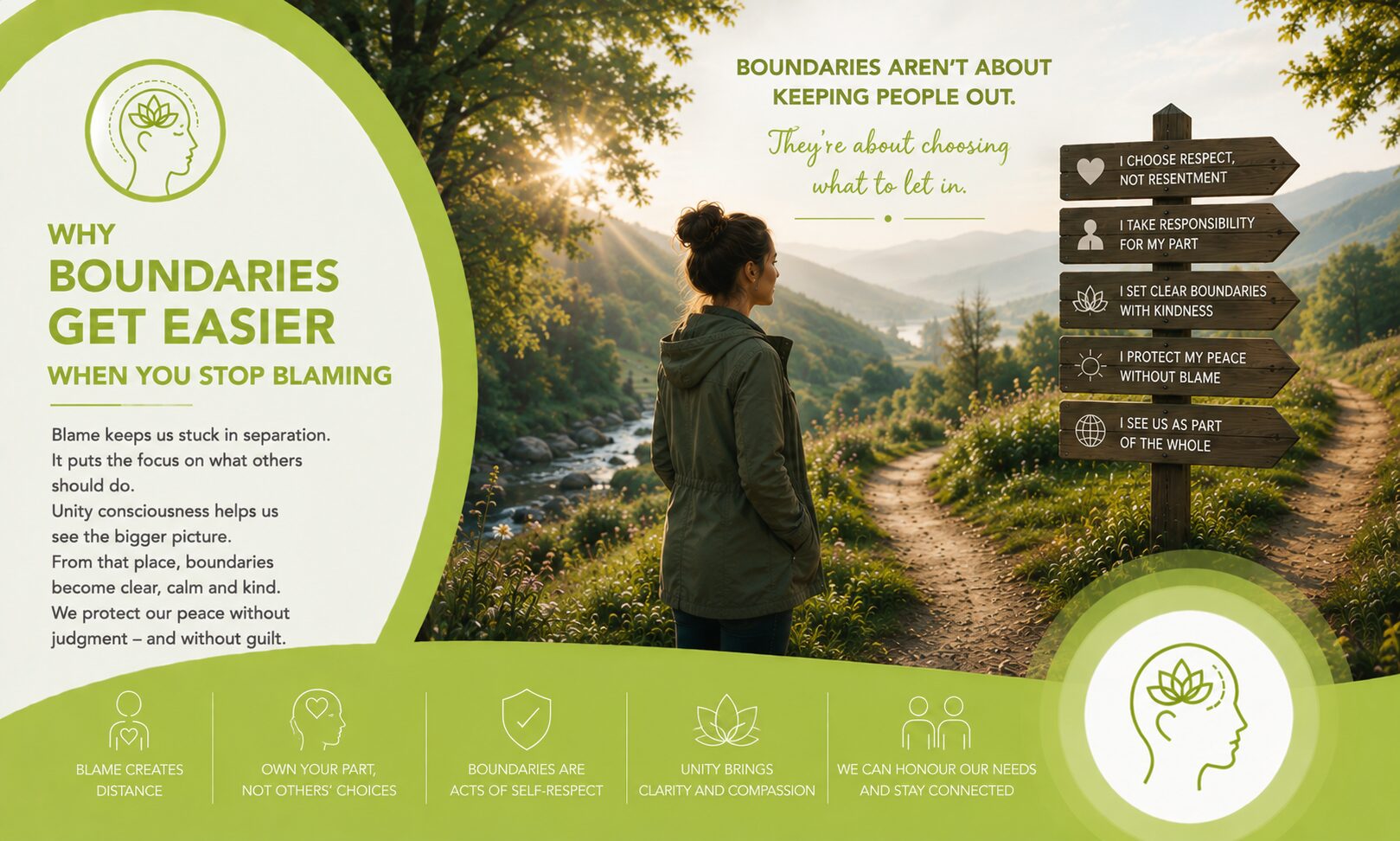
This is because a boundary is not a judgement of another person’s worth. Once we stop using boundaries as punishment or rejection, they become much easier to set and maintain.
What a Boundary Really Is
A boundary is simply a decision about what we will do if a situation arises. It is not a judgement of another person’s character, nor is it a way of punishing them. “If the shouting starts, I will leave the room” is a boundary. “You’re impossible to talk to” is a judgement. We often confuse the two, but they are very different.
When we see ourselves as separate, it is easy to feel we have to justify our boundaries. We explain why the other person is wrong, list all the times they have behaved badly, and try to prove we are entitled to say no. Before long, the conversation is no longer about the boundary at all. It has become an argument about who is right.
Unity Consciousness offers a simpler approach. I do not need you to agree that my boundary is reasonable before I keep it. I only need to be clear about what I will and will not do. That takes far less energy because I am no longer trying to change your mind. I am simply taking responsibility for my own actions.
When We Put Our Walls Up
There is another consequence of living in separation that took me a long time to notice. When we do not feel safe, we can stop protecting ourselves from one particular person or situation and start protecting ourselves from everyone.
We become more guarded, less trusting and quicker to assume the worst. We tell ourselves we are just being careful, but over time those protective walls become our normal way of relating to people.
The difficulty with protecting ourselves generally rather than specifically is that it cannot be selective. It keeps out the person who would hurt us, and it keeps out the person who would understand us, because we are no longer making a judgement about either of them. It blocks criticism we do not need, and it blocks kindness, encouragement and the closeness we were hoping to find in the first place.
A boundary works very differently because it is specific. It is about one behaviour, one relationship or one situation. It allows us to say no where we need to without closing ourselves off from everyone else. This is why healthy boundaries create more connection, not less.
Three Reasons Boundaries Get Easier
Once we stop needing the other person to be wrong, three things can change, and each of them makes the boundary easier to hold.
We don’t need to collect evidence. We do not need proof that somebody is a bad person, only clarity about what we are willing to do. This removes the need to interpret why the other person might behave the way they do.
There is no argument to win. The boundary does not depend on the other person agreeing with it, which is fortunate, because they often will not. We can state what we will do and let them think whatever they like about it.
There is often far less guilt afterwards. Some of the guilt that follows a boundary does not come from the boundary itself. It comes from what we said to justify it, because to make ourselves reasonable we made somebody else unreasonable, and some part of us knew it was not the whole truth.
None of this makes the conversation pleasant; what it does is make it shorter, clearer, and a good deal easier to get through.
Forgiveness Is Not Excusing
A Course in Miracles takes forgiveness further than we usually do. At its deepest level, it suggests that what another person does cannot change who we are and that nothing truly happened in the world beyond separation. For most of us, that’s a difficult concept, and we must address how we currently see the world.
To me, forgiveness can be practical. It means being willing to let go of the resentment, judgement or grievance I am holding on to, rather than allowing someone else’s behaviour to affect me long after it happened.
That does not mean saying what they did was acceptable. It does not mean trusting them again, staying in the relationship or giving them another chance to hurt us. Forgiveness is about what we let go of. Boundaries are what we set to distance ourselves from behaviours that do not work for us.
We can understand why someone behaved as they did and still say no. We can have compassion for what shaped them and still decide that their behaviour is not something we will accept. Unity Consciousness does not mean abandoning our standards or boundaries. It means recognising the person behind the behaviour while still protecting ourselves when we need to.
Setting Boundaries Around Personal Values
I mentioned earlier the colleague who noticed a sudden change in my mood after someone said something that clashed with values I hold very strongly. What I noticed was not only the reaction itself but also what it revealed. I had been expecting other people to share my values, and I became frustrated when they did not.
Over time, I learned to be much clearer about what I would accept, what I could tolerate occasionally and what had no place in my life. I have close friends whose values are very similar to mine, and I also have friends who see some things quite differently. Those relationships work because neither of us is trying to convince the other that we are right. We can disagree, respect one another and move on.
Some values matter so much to me that I choose not to build close relationships with people who consistently disregard them. I do not need to judge their worth to recognise that we are unlikely to fit comfortably in each other’s lives. I can understand why people see the world differently, wish them well, and still decide they are not people I want to share my life with.
Breaking an On-Off Relationship Cycle
A client once came to me because she was struggling with stress at work. After a couple of sessions, it became clear that her biggest source of stress was her on-and-off relationship.
Her relationship with her partner was a constant rollercoaster. His behaviour was often disrespectful and selfish, and whenever it reached a breaking point, she would ask him to leave. After a while, he would apologise and promise that things would be different. Wanting to believe him, she would take him back, only for the cycle to repeat. It was exhausting her.
The problem was not that she loved him. It was that she believed loving him meant she should keep giving him another chance. We explored that love and boundaries are not opposites. We can love someone, understand why they behave as they do, and still decide that their behaviour is not something we are willing to live with.
Once she was clear about what she would and would not accept, she calmly explained her boundaries. The choice was then his. He could respect them or accept that the relationship would end. In her case, his behaviour did change. That is not always the outcome, of course, but the boundary still put her in a healthier position because it depended on what she would do, not on another promise from him.
“We can understand why someone behaved as they did and still say no.”


Try This: Say the Second Half Only
Think of a boundary you have been meaning to set but have not yet managed.
Write down what you would say, in full, exactly as you have been rehearsing it. Most of us have rehearsed it many times.
Now go through it and cross out every sentence that explains why the other person is at fault. Cross out the examples, the history and the part where you prove it. What remains will be one or two sentences describing what you are going to do.
Read what is left. It will look thin, and it will feel as though it is missing the important part. It is not. The part you crossed out was never the boundary. It was the justification you thought you needed before you were allowed one.
Then try saying the shorter version, without going back to the justification.
Separation does not only run between individuals. If we are all connected, why does the world look the way it does, and what can any one of us realistically do about it?
Articles In Unity Consciousness
What Is Unity Consciousness? How Seeing Beyond Separation Changes Everything
- How Unity Consciousness Changes Our View of Connection
- The World of Separation
- Living From Unity Consciousness: What Changes When You See People Differently
- Why Boundaries Get Easier When You Stop Blaming
- If Everyone Is Connected, Why Is the World Like This?
This article reflects my personal experiences and the Living From Your Higher Self philosophy, and isn't intended as a substitute for professional psychological support. If reading it brings up painful past experiences or causes you significant distress, please seek help or consider working with a qualified therapist.
Enjoyed this article? Add People Development Magazine as a preferred source on Google:
