

The Pygmalion effect shows how much our view of another person can affect how we treat them. In the mid-1960s, researchers told teachers that a randomly selected group of pupils had exceptional academic potential. By the end of the school year, some of those children had made greater gains than their classmates. The study, published in 1968, has been debated ever since, and its measures have been seriously questioned. Still, it helped open decades of research into how our expectations can influence the attention, encouragement and opportunities we give people.
I have already seen the same principle in my experience at work, when I challenged my manager after he recommended someone else for promotion. One reason the conversation ended well was that, although I believed he had been unfair, I never stopped seeing him as a decent and fair-minded man who would want to put things right once he understood. He did exactly that.
I learned the same lesson as a parent. When I labelled my children by their behaviour, they often lived up to the label. When I reflected the person I believed they were capable of being, they wanted to become that version of themselves.
What Unity Consciousness Adds
Unity Consciousness takes this further. It asks us to look beyond someone’s current behaviour and recognise that, like us, they are part of the same whole. From there, we are more likely to meet people from the perspective of our Higher Self, with love rather than judgement. This does not mean excusing harmful behaviour or pretending anyone is perfect. It means refusing to reduce a person to their worst moment or to our first impression of them.
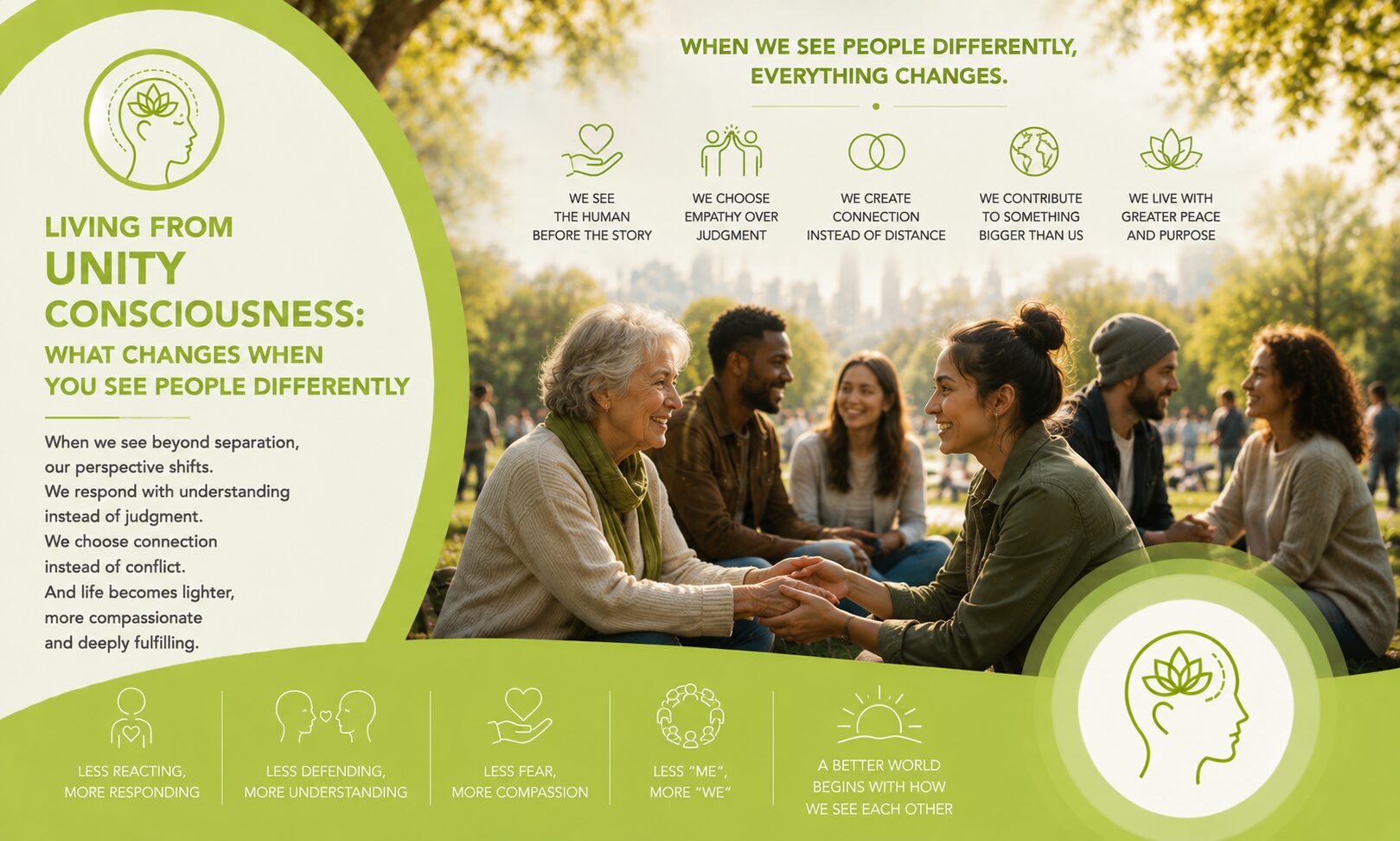
When we see people this way, we speak, listen and respond differently, and they may respond differently too. We cannot control that. What we can change is how we see them.
What Becomes of the Seven Patterns
In the previous article, I described seven patterns that arise when we believe we are separate individuals. These patterns begin to shift as we see ourselves and others differently.
Letting Go of Grievances
When we recognise that people act according to their beliefs, fears and experiences, it becomes easier to separate the person from their behaviour. We can challenge harmful actions without harbouring resentment.
Nations could adopt a similar approach, addressing past injustices and resolving disputes without allowing historical grievances to dictate every future decision.
Feeling Secure Without Needing Recognition
When we feel secure in ourselves, we have less need to prove our worth or seek recognition from others. We can appreciate our achievements without feeling threatened by others’ success.
Nations could focus more on their people’s well-being rather than constantly trying to assert their superiority over others.
Understanding Rather Than Judging Others
We don’t have to agree with someone to understand their point of view. When we make an effort to understand their experiences and beliefs, we are less likely to judge or make assumptions about them.
Between nations, this would mean making more effort to understand cultural differences, recognising shared interests and resolving disagreements through dialogue.
Needing Less Protection
When we feel secure in ourselves, we become less defensive. We no longer need to interpret every disagreement as a personal attack or to compare ourselves constantly with others.
Nations could similarly recognise that cooperation and diplomacy can sometimes achieve more than treating every difference as a threat.
Succeeding Without Someone Else Losing
We can remain ambitious and take pride in our achievements without believing that someone else’s success comes at our expense. We become more willing to cooperate and support others.
Nations could place greater emphasis on working together to solve shared problems, recognising that one country’s progress need not come at another’s expense.
Loving Without Conditions
Healthy relationships allow us to care about others without expecting them to fulfil all our needs or to agree with everything we believe. We can love someone while maintaining our own boundaries. Between nations, this would mean respecting differences, protecting people’s rights and seeking peaceful relationships without requiring everyone to share the same beliefs or values.
Knowing When We Have Enough
When we feel more secure, we become less concerned with accumulating more than we need and more willing to share what we have. We can enjoy what we have without constantly worrying about what we might lose. Nations could adopt a similar approach by balancing their own needs with those of others, cooperating on resources and recognising that greater prosperity and security can benefit everyone.
Seeing from Unity Reduces Suffering, Not Pain
Seeing people differently does not remove life’s pain. We still lose those we love, face disappointment and experience grief. Unity Consciousness is not about escaping any of that.
What changes is what we add to it. Much of our suffering stems from the story we tell ourselves about what happened, what it means and what it says about us. As we begin to see ourselves as connected rather than separate, we add less to it. We still feel life’s pain, but we suffer less.
Seeing People as More Than Their Behaviour
Living from Unity Consciousness means recognising that people are more than their behaviour, even when we strongly disagree with what they have done.
Consider people who volunteer to visit prisoners. They aren’t excusing the prisoners’ crimes or ignoring the harm caused. They choose to treat them as human beings rather than defining them solely by their actions.
We can apply the same principle in everyday life. Think about a difficult colleague, a relative whose opinions we disagree with, or someone we have written off because of their behaviour. We don’t have to like them, agree with them or accept their behaviour. We can maintain our boundaries while recognising that there is more to a person than the behaviour we see.
How Unity Changed Conflicts
I don’t live in Unity Consciousness all the time. I still judge people, get defensive and sometimes slip back into seeing things in terms of them and me. The difference is that I usually notice it more quickly.
One of the biggest changes is that disagreements don’t tend to escalate as they once did. When I stop trying to prove who is right, much of the conflict loses its force. If something does need sorting out, I find it much easier to stick to what has actually happened rather than making the other person the problem.
Another change is that I’m less interested in deciding what kind of person somebody is. I’m more likely to wonder what might be behind how they see things or behave. I didn’t set out to do that as a technique. It has happened gradually as my own way of looking at people has changed.
“Seeing people differently does not remove life’s pain. We still lose people we love, face disappointment and experience grief.”


Try This: Two Accounts of the Same Event
Recall a small grievance you are still carrying. Not the largest one you have. Something ordinary that still tightens a little when you think of it.
Write down the account you have been telling yourself, in full, without tidying it up to sound reasonable.
Now write the same event again, this time allowing for the possibility that the other person was doing the best they could from where they were standing, with information and fears you cannot see from here.
Read both. The question is not which one is true, because you are unlikely to settle that. The question is which one you would rather live with, and what each of them costs you to keep.
Then notice whether the second account makes one small shift possible. It might be something you do towards that person, or simply a decision to stop going over what they did.
Seeing others through Unity Consciousness does not mean putting up with poor behaviour; however, it is easier to build healthy boundaries when you are no longer blaming, which is where we go next.
Articles In Unity Consciousness
What Is Unity Consciousness? How Seeing Beyond Separation Changes Everything
- How Unity Consciousness Changes Our View of Connection
- The World of Separation
- Living From Unity Consciousness: What Changes When You See People Differently
- Why Boundaries Get Easier When You Stop Blaming
- If Everyone Is Connected, Why Is the World Like This?
This article reflects my personal experiences and the Living From Your Higher Self philosophy, and isn't intended as a substitute for professional psychological support. If reading it brings up painful past experiences or causes you significant distress, please seek help or consider working with a qualified therapist.
Enjoyed this article? Add People Development Magazine as a preferred source on Google:
