


Many years ago, I led a project at work that saved my department well over a million pounds, a considerable sum at the time. Once it was approved, an older male colleague was assigned to work with me, and over the next six months we delivered it together. The programme went on to win an award.
At the end of the year, our manager assessed us both for promotion. My colleague was recommended. I was not.
I was angry. My immediate conclusion was that my manager had overlooked me because I was younger and a woman. Women of my generation were frequently overlooked at work, so this was not an unreasonable explanation. Nevertheless, before I had even spoken to him, I had decided what had happened, why it had happened and what it said about how he saw me.
That was my separation response. In my mind, my colleague had been favoured, I had been treated unfairly, and my manager was responsible. There may have been some truth in all of that, but I also knew that if I approached him from that position, I would be entering the conversation ready to prove him wrong rather than allowing him to put things right.
I valued the relationship I had with my manager and wanted it to continue. I also believed he was fundamentally a fair-minded person. So I chose to approach him on that basis. I asked why I had not been recommended and explained the contribution I had made.
To his credit, he listened. He recognised he had underestimated my contribution, and the situation was resolved.
My first reaction came from separation, but I did not have to let it decide what happened next. I could challenge something that felt unfair without deciding my manager was an unfair person. By assuming the best in him, I gave him the opportunity to respond from the best in himself.
The Idea of Separation
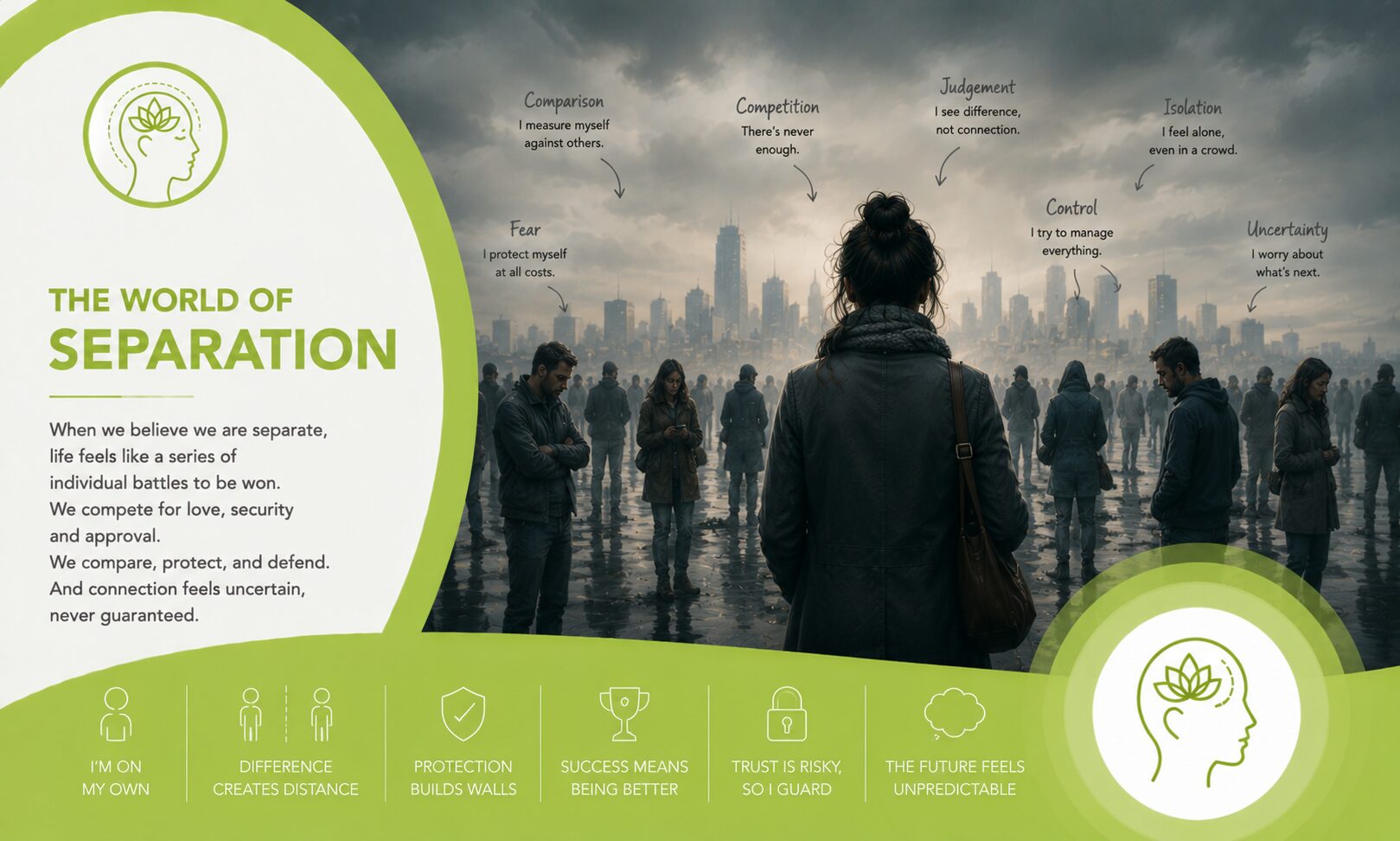
A Course in Miracles suggests that every experience of fear, conflict and suffering begins with one simple belief: that we are separate from one another and from the source of life itself. From this assumption, everything else follows. If I believe I am alone, I must protect myself, prove myself and secure my own safety.
The Course goes a step further. It says separation never actually happened. It is not something that needs repairing but a mistake in perception that can be recognised. Whether you agree with that or not, it offers an interesting way to understand why so many of us experience the world as a place of competition, comparison and conflict. I return to the two thought systems that arise from these perspectives in the articles on Discerning Your Thoughts.
How We Interpret Rather Than Simply See
A well-established finding in psychology is that we don’t simply observe the world as it is. We interpret it. Our beliefs, expectations and past experiences shape what we notice and the meaning we ascribe to it.
This is why the same event can produce completely different experiences for different people. My manager’s decision about promotion was one event. The story I built around it was another. Once I believed I had been overlooked, my mind immediately began looking for evidence to confirm it.
This is how perception works. We don’t just see the world; we see it through what we already believe.
Seven Patterns That Come From Feeling Separate
Whether we approach this through psychology, spirituality or simple observation, one thing is hard to ignore. The moment we assume we are fundamentally separate from one another, an entire way of experiencing life follows. We do not consciously choose every part of it; much of it is built into the assumption.
I frequently see seven patterns of behaviour, both in our everyday lives and in the wider world. What may seem relatively harmless in our personal relationships can have devastating consequences on a much larger scale. Changing our own thinking won’t end a war, but the same patterns that divide nations can also divide us in our everyday relationships.
Holding On to Grievances
If we believe we are separate, we can be offended by something someone else does to us. We replay conversations, hold what they said against them, and build a grievance, often without realising it. We feel justified and believe we are seeing the situation clearly.
Communities do the same, and so do nations. Some have carried old grievances for centuries. The scale changes, but the psychology stays the same.
Needing Recognition to Feel Complete
If I believe something is missing in me, I naturally look for someone or something to fill the gap. I need recognition, admiration, success or the right relationship to feel complete.
The same pattern appears in public life, where being noticed has become something people pursue for its own sake. However much attention people get, it never seems to be enough for long.
Dividing People Into Them and Us
We often divide people into groups without realising it. We see some people as different from us, make assumptions about them and begin to think in terms of us and them.
On a larger scale, this way of thinking can lead to racism, extreme nationalism and religious intolerance. The divisions we see in the world often begin with the same attitudes we develop towards others in everyday life.
Constantly Defending Ourselves
If the world feels unsafe, protecting ourselves becomes an understandable response. We become defensive, controlling, suspicious or desperate to please, and each is an attempt to avoid being hurt again. What makes it so tiring is that we have to keep it up. Once we have defended a position, we have to keep defending it every time someone questions it. It never feels finished, because there is always another situation in which we might be caught out.
Nations do the same thing on a much larger scale, building armies, borders and ever more powerful weapons. The behaviour looks nothing like ours, but the fear beneath it is the same, which is why it is never satisfied by the next defence either.
Believing Someone Else Has to Lose
Comparison becomes the way we judge our worth. We measure our careers, relationships and achievements against others, often without even noticing.
Competition itself is not the problem. It becomes destructive when we believe someone else has to lose for us to win. At a wider level, the same belief can shape how organisations and nations pursue their own advantage, with little thought for the cost to others.
Love With Conditions Attached
Even love becomes something to earn. I’ll love you if… Or, I’ll forgive you when… I’ll stay provided that…
Societies work in much the same way, offering belonging only to those who meet certain conditions. When we believe we are separate, even love can become a transaction.
Seeking Security in Having More
If I believe I am on my own, then having more feels like protection. More money, possessions and influence promise security, yet the feeling rarely lasts because there is always someone with more.
The same pattern creates societies where extraordinary wealth sits alongside real poverty. The damage is done less by wealth itself than by the belief that security comes from accumulating rather than sharing.
Why These Patterns Make Sense, and How They Change
Once we believe we are separate, these patterns make perfect sense. If I am on my own, I need to protect myself, prove myself and make sure I have enough. Comparison, defensiveness and fear are not character flaws. They are understandable responses to believing we live in a world where everyone has to look after themselves.
This is why changing our behaviour alone rarely lasts. Real change begins when we question the belief behind it.
We all experience separation at times. The good news is that a belief can be questioned, and once it is, everything built upon it begins to look different.
“The moment we assume we are fundamentally separate from one another, an entire way of experiencing life follows.”


Try This: Follow the Pattern
Think of one small irritation from the past few days. Perhaps someone ignored your message, criticised you or made a decision you didn’t like.
Ask yourself:
- Which pattern was I in? Grievance, specialness, othering, fear, competition, conditional love or the belief that having more would make me safer?
- What story was my mind beginning to build?
- Where do I see this same pattern playing out in the wider world?
The situations may be different, but the psychology is often the same. Once you recognise the pattern in yourself, you begin to see it everywhere.
If you accept that the world of separation does not work for us, then you can consider what changes when you see people differently; that’s what we look at next.
Articles In Unity Consciousness
What Is Unity Consciousness? How Seeing Beyond Separation Changes Everything
- How Unity Consciousness Changes Our View of Connection
- The World of Separation
- Living From Unity Consciousness: What Changes When You See People Differently
- Why Boundaries Get Easier When You Stop Blaming
- If Everyone Is Connected, Why Is the World Like This?
This article reflects my personal experiences and the Living From Your Higher Self philosophy, and isn't intended as a substitute for professional psychological support. If reading it brings up painful past experiences or causes you significant distress, please seek help or consider working with a qualified therapist.
Enjoyed this article? Add People Development Magazine as a preferred source on Google:
