

Starting a journey of personal growth can be bewildering. We might consider therapy or spirituality, as well as countless books, online resources and teachers who offer help. Knowing where to begin can feel overwhelming.
There isn’t one correct path. We all bring different experiences, beliefs and lessons to learn. What matters is staying open and curious rather than finding the right teacher.
There’s an old saying that when the student is ready, the teacher appears. I’ve found this to be true, with one addition: curiosity helps us recognise the teacher when they appear. When we start asking questions and genuinely want to understand ourselves, we become more likely to notice the answers and opportunities to learn.
Welcome to Life School
Gary Zukav and Linda Francis, whose book The Heart of the Soul became one of my great teachers, describe life on this planet as Earth School. It is a beautiful idea, and the more I have reflected on it, the more I have come to see something very real beneath it: every experience we have, whether joyful or painful, can carry a lesson for our growth. Nothing is wasted. The difficult colleague, the relationship that ended, the opportunity that fell through, the unexpected kindness of a stranger: all of it is curriculum. This is what I call Life School.
By the time I came across Gary’s idea of Earth School, I already knew I was learning from my experiences. What I hadn’t fully understood was where that learning might lead. His ideas confirmed my belief that viewing life as an opportunity to learn made sense.
Life School is based on the idea that we are here to learn, not just to achieve things or avoid difficulties. Psychology explores how we grow through experience and adversity, while neuroscience shows that our brains can change throughout life.
Spiritual traditions have long viewed life as a teacher. Although their explanations differ, they share the idea that we can learn from our experiences.
Once you see life this way, the question changes. It is no longer, Why is this happening to me? It becomes, What is this here to teach me? That sounds like a minor change; in practice, it alters what we notice, what we take from the experience, and who we are prepared to learn from.
Life Is Constantly Teaching You
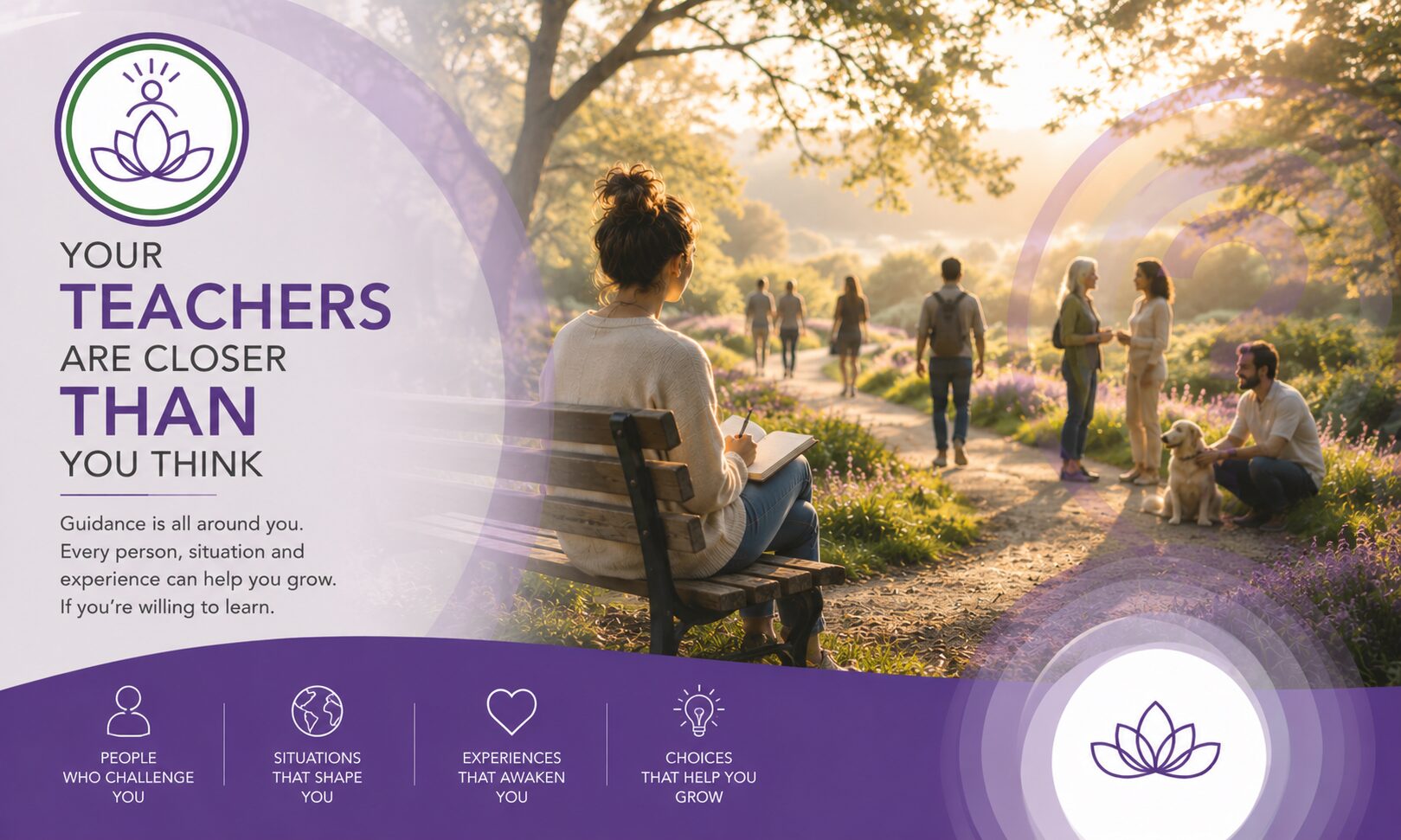
Looking back on my life, I can now see that my greatest teachers rarely announced themselves. Some appeared as inspiring mentors. Others arrived disguised as difficult people or challenging situations. Some lessons came through books that changed how I saw the world. Others emerged in quiet moments of reflection, when an idea suddenly made sense.
When my marriage ended, I was devastated that my family was divided and that the future I had envisaged would not happen. However, that’s when my self-inquiry began. I could no longer blame the marriage or hide from responsibility for my own feelings, worldview and behaviour. I was dealing with me. It dawned on me, painfully, that I had a lot to learn, and taking responsibility for where my life was became a major lesson. What followed were years of painful experiences and the undoing of many of the unhelpful beliefs and assumptions I had been living by.
At the time, these experiences seemed unrelated. Only later did I recognise what they had in common. Each teacher and experience helped me see my life differently.
There was no particular order to it, and much of it didn’t feel like learning at the time. But gradually, I began to understand who I was beneath the personality I had spent a lifetime developing.
We Learn Through Other People
Other people can help us see things we might never recognise on our own. Our beliefs, assumptions and habits become so familiar that we rarely question them. Sometimes it takes another person to challenge our perspective.
Developmental psychologist Robert Kegan describes adult development as learning to step back and examine our own thinking. This is an important part of Self-Awareness. It helps us recognise old patterns and choose how to respond rather than react automatically.
A friend, therapist, mentor or coach can help us see what we have missed. Sometimes a single question is enough to change how we think about something. Here is how it worked for me.
Why Coaching Became One of My Greatest Teachers
Although coaching leaders became a major part of my work, some of my most important lessons came from being coached. Good coaches helped me question my assumptions and see options I hadn’t considered.
During a difficult reorganisation at work, I was struggling with a new boss whose values were very different from mine. I felt completely unsupported and spent much of one coaching session complaining about the situation.
My coach stopped me and said, “Let’s accept you’re not going to get the support you need from your boss. Where are you going to get it from?”
It was a simple question, but it made me realise I was absolving myself of responsibility and completely changed how I saw the situation. I had been so focused on what my boss wasn’t giving me that I hadn’t considered what I could do about it. Once I accepted the situation, I could take responsibility for finding the support I needed elsewhere.
I still return to that conversation whenever I find myself complaining about something I cannot change. It taught me the value of accepting what is happening and deciding what to do next.
Experiences like this also shaped how I coach others. Asking the right questions can open people to their truth. Sometimes another person’s curiosity is all we need to recognise something we couldn’t see for ourselves.
My Teachers Came in Many Forms
Although coaching played a key role in my journey, it was only one of many teachers in my Life School.
Books became lifelong companions, introducing ideas that challenged my assumptions and broadened my understanding. Psychology helped me understand the mind. Neuroscience helped me understand the possibility of change. Philosophy encouraged me to question reality, while spirituality invited me to look beyond the personality and discover a deeper sense of self.
Each offered a different piece of the puzzle. And each, I now realise, arrived in answer to a question I had begun to ask.
The Books That Helped Me
I have read hundreds of books, but these are the ones that shaped this journey most:
- The Road Less Travelled by M. Scott Peck: helping me bridge the gap between psychology and spirituality.
- One Day My Soul Just Opened Up by Iyanla Vanzant: teaching me to listen to the wisdom within.
- The Heart of the Soul by Gary Zukav and Linda Francis: introducing me to emotions as guidance rather than something to fear, and to the idea of life as Earth School.
- The Vortex by Esther and Jerry Hicks: helping me understand the importance of our state of being in relationships.
- A Course in Miracles: challenging almost everything I believed about fear, forgiveness and love.
- The Power of Awareness by Neville Goddard: revealing the creative power of consciousness.
- The Book of Secrets by Deepak Chopra: encouraging me to embrace life’s mystery rather than solve it.
- The Biology of Belief by Bruce Lipton: encouraging me to explore the relationship between science and spirituality.
- Excuse Me, Your Life Is Waiting by Lynn Grabhorn: helping me appreciate the influence of my thoughts and emotions.
- The Untethered Soul by Michael A. Singer: reminding me that peace comes from observing life rather than clinging to it.
None of these books gave me all the answers. Instead, each encouraged me to ask better questions, and those questions gradually formed the foundation of the philosophy in this series.
Trust Your Own Journey
As you read this series, you might find yourself drawn to situations or authors that speak directly to your life. That is exactly how it should be. Life School is never prescriptive; it designs a unique curriculum for everyone who chooses to become a student.
Your path may include a range of teachings. It may be shaped by a conversation, a difficult relationship, an unexpected life event or a book that seems to arrive at exactly the right moment.
Trust what rings true for you. And stay curious. Teachers do not appear on demand; they appear in response to the questions we are brave enough to ask.
Your intuition can guide you towards the people, ideas and experiences that are right for this stage of your journey.
Every genuine teacher has the same purpose. They do not ask us to become someone else. They help us remember who we have always been, beneath the noise of fear, conditioning and old beliefs.
When we begin to look through this lens, we may discover that Life School has been in session all along, and that our greatest teachers have been much closer than we ever imagined.
“What matters is remaining open and curious rather than finding the right teacher.”

Try This: The Most Irritating Person You Know
Bring to mind not the most damaging person in your life, but the most irritating. Ask one question about them: what would I have to believe for this to be a lesson rather than a nuisance? Don’t act on the answer. Let the question sit for a day.
In the next article in this series, The Road Ahead, we’ll look at what happens once you start walking this path, what to expect, where people typically get stuck, and how to keep going when the lessons get harder before they get easier.
Articles in The Journey
Living From Your Higher Self: The Journey to Your True Self; Introduction
- The Question That Changed My Life
- Why Personal Growth Isn’t Enough
- Your Teachers Are Closer Than You Think
- The Road Ahead: What to Expect When You Begin
- What’s Waiting on the Other Side? Discovering the Peace You Already Carry
Enjoyed this article? Add People Development Magazine as a preferred source on Google:
Enjoyed This? . This Essential Guide brings the whole framework together in one place, free to download.
