


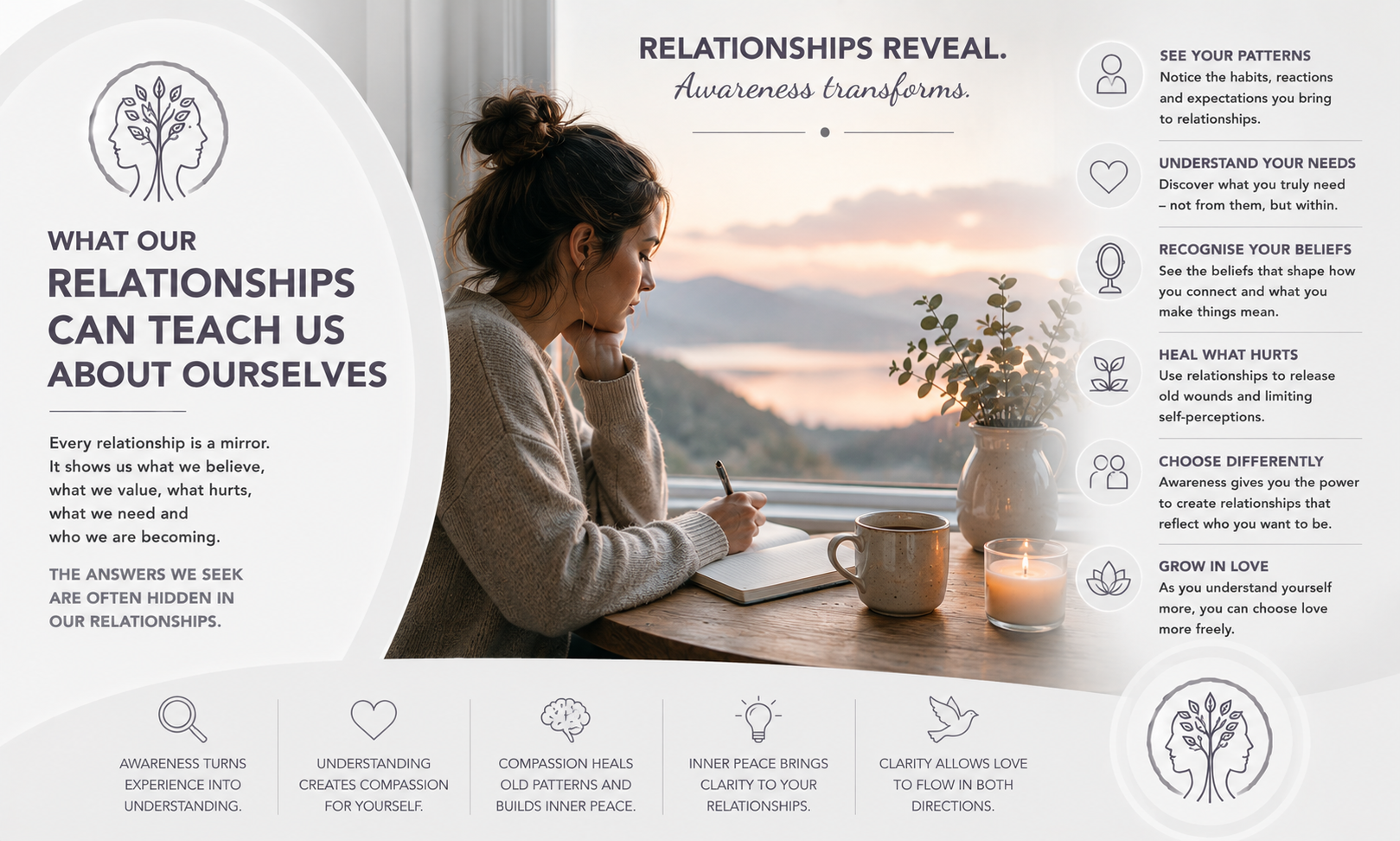
How we react, judge, expect, withdraw, defend or become disappointed often points to beliefs and patterns we might otherwise overlook.
This is one reason relationships can be so important for Self-Awareness. We learn not only about the other person but also about ourselves.
From the perspective of Unity Consciousness, the other person is not simply someone to judge or someone to defend us against. They are another human being with their own fears, beliefs, needs and blind spots, just as we have ours. We still decide what behaviour we will and will not accept, but we also pay attention to what our own reaction reveals.
Looking at Our Own Reaction as Well as Theirs
This shift in focus can be difficult. When something goes wrong, most of us immediately look at what the other person did and what they should do differently. That may be completely justified. But if we stop there, we can miss what the situation is showing us about ourselves.
Looking at our own reaction does not mean excusing bad behaviour or taking responsibility for somebody else’s choices. We may still need to challenge them, set a boundary or leave the relationship. It simply means asking two separate questions: What do I need to do about their behaviour? And what is my reaction telling me about myself? Both can matter at the same time.
Looking at Ourselves Without Blame
There is one important distinction. Looking at ourselves is not about finding another person to blame, only this time making that person us.
If they are wrong, it simply becomes I am wrong; nothing useful has changed. The judgement has just shifted.
As I wrote in the articles on Discerning Your Thoughts, the Higher Self is not trying to decide who is right or wrong. The more useful questions are practical: What is happening within me? What am I believing? What have I made this mean? Is this relationship showing me something I need to notice?
The aim is not to judge ourselves. It is to understand ourselves better.
Seeing Ourselves More Clearly
What Relationships Reveal About Our Beliefs
Relationships can reveal beliefs we don’t even realise we hold. Rejection, criticism or disagreement can expose what we believe about love, trust, worth and how relationships should be.
A coaching client was struggling with his second marriage, despite believing he had married the woman of his dreams. As we talked, he said he was devastated because he believed marriage was forever and that once the bond was made, it should never be broken.
I gently asked how that fitted with leaving his first marriage to be with his second wife. The realisation was immediate. It had never occurred to him that, by holding so tightly to the belief that marriage should last forever, he had also condemned himself for the failure of his first. He had carried that judgement into his second marriage without even knowing it.
When the Same Problem Keeps Appearing
One difficult relationship may not tell us very much. Sometimes we come across someone we do not get on with. But when a similar problem keeps recurring with different people, it can be worth asking whether something more is going on.
A client once told me about her daughter, who had just left her third job in three years. The first two times, her mother had been completely supportive. In both jobs, her daughter felt that a woman manager had taken against her, making work increasingly difficult. From what my client knew, that explanation seemed perfectly reasonable.
When the same thing happened for a third time, though, she began to wonder whether there might be a pattern. That did not mean her daughter was necessarily at fault. She may genuinely have encountered three difficult managers. None of us was in a position to know.
The useful question was whether anything in her own reactions, expectations or behaviour was worth looking at. If the managers were entirely to blame, there was little she could do except keep moving on. But if even a small part of the pattern belonged to her, recognising it would give her something she could understand and perhaps change.
This is the value of noticing repeated patterns. We do not have to decide immediately who is right or wrong. We are asking whether there is something here that we have seen before, and whether looking at our own part might tell us something useful.
Separating What Happened From Our Assumptions
Often, much of the pain lies in what we decided something meant, as well as in what happened.
We do this all the time, usually without realising it. She cancelled because she doesn’t care about me. He didn’t invite me because he doesn’t want me there. They are playing loud music because they have no consideration for anyone else.
Any of those explanations might be true. But unless we know why someone behaved as they did, we have filled in the missing information ourselves.
We don’t need to judge ourselves for doing it, but it helps to notice when we have turned an assumption into a fact, especially when that assumption is causing us pain. Sometimes another person’s behaviour has very little to do with us at all. Unless we know, it is worth separating what actually happened from the meaning we have added to it.
Choosing Differently
We Can Choose a Different Response
Relationship patterns can form very quickly, but they can also shift when one person is willing to act differently.
We often get stuck because we wait for the other person to change first. We want them to listen better, respond differently, understand us more clearly or stop behaving in ways that frustrate us.
The problem is that we can choose only our own response, not theirs.
When we stop playing our usual part in the old pattern, things can change. The other person may or may not change, but the pattern no longer works quite the same way. Sometimes this is enough to shift the whole dynamic.
Choosing What We Focus On in a Relationship
Instead of asking How can I make them behave differently? we can ask, Who do I want to be in this relationship?
A work colleague was questioning whether her partner was really right for her. As she described the good and bad aspects of their relationship, it struck me how much attention she was giving to the things about him that irritated her.
We both knew another couple who seemed to have a particularly happy relationship. I suggested that perhaps the two men weren’t that different. Maybe the difference lay partly in what each woman chose to focus on.
Her face was a picture. The penny dropped immediately, and the conversation shifted from what was wrong with her partner to who she wanted to be in the relationship. The useful question became: did she want to spend the relationship mainly noticing what irritated her, or did she want to bring more appreciation and support to it while still being honest about genuine problems?
Of course, relationships are rarely that simple, and changing our perspective doesn’t mean ignoring genuine problems. But sometimes changing what we focus on changes what we experience, and that can change the relationship too.
Learning to Love
Accepting Someone’s Choices and Making Our Own
Acceptance means recognising who another person is and the choices they are making, even when we wish they would choose differently. It does not require us to like those choices or to stay in a situation that is wrong for us.
A friend was engaged and looking forward to her wedding when, out of the blue, her partner was offered a job three hundred miles away. He decided to take it. She knew she didn’t want to move.
If that had been me at that time in my life, I would have railed against his decision and read all sorts of meanings into it about how much he loved me and what the relationship meant to him. She didn’t.
She told me she loved him, but his decision had shown they wanted different things. She accepted his choice without trying to change it and made her own. They separated. Eighteen months later, she met someone who wanted the same kind of life she did, and they went on to plan their wedding.
Acceptance doesn’t mean a relationship has to end, nor does it mean agreeing with everything another person does. Sometimes it means accepting who they are and what they want, and then deciding what we want to do with that reality.
We Can Develop Compassion and Forgiveness
Sometimes understanding another person’s history, fears or limitations helps us see their behaviour differently, without pretending everything they did was acceptable.
My mother and I had a complicated relationship, as I suspect many mothers and daughters do. I loved her dearly, and she loved me in her own way, though when I was younger I wasn’t always sure of that.
Even at sixteen, I had begun asking the kinds of questions I would later learn to put to my Higher Self. After one particularly difficult exchange with my mother, I remember asking, Why is she like this?
Something came back, and it changed how I saw her. My mother had experienced rejection herself and had received very little emotional support in her own life. What she couldn’t give me came from her own limitations rather than from anything about me. It wasn’t a measure of how lovable I was.
That was only a beginning. A fuller understanding of both my parents and the lives they had lived long before I was born came much later, and I have written about that in the articles on Unity Consciousness.
That understanding did not change what had happened, but it changed what I believed about it. I could see her limitations without making them mean anything about me. Compassion for her made forgiveness much easier.
It also showed me where love and control had been tangled together. There is a difference between loving someone and needing them to behave in a particular way so we can feel all right. Most of us find, when we look honestly, that we have been doing rather more of the second than we realised.
Noticing this isn’t a reason to reproach ourselves; it gives us the chance to separate love from control. We can love someone without approving of everything they do, and without requiring them to behave as we wish before we allow ourselves to choose a loving response.
Other Ways to Use Relationships to Learn
These are only some of the ways we can begin to use relationships differently. When we become curious rather than reactive, we notice many other things. For example:
- Recognise when we project aspects of ourselves onto someone else.
- Follow a strong feeling back to the thought that produced it.
- Notice where we look to another person for our worth, security or happiness.
- See where we try to control someone else to feel safe.
- Pause before reacting and ask whether there is another way to respond.
- Take responsibility for our own feelings without taking responsibility for someone else’s behaviour.
- Give up the need to be right and become more interested in understanding.
- Set boundaries without needing to make someone else wrong.
- Notice when we relate to our history with someone rather than who they are now.
- Recognise our shared humanity and what we have in common, even when we strongly disagree.
- Experience the relationship as an opportunity for connection rather than something we need to defend ourselves against.
We don’t need to do all of these, or even consciously look for them. The important shift is much simpler. Instead of asking only what the other person is doing, we become willing to ask what the relationship might be showing us.
Every time we do that, we create a small gap between what happened and our automatic reaction. This gap is where a different choice becomes possible.
All of these ideas move us in the same direction. We stop using relationships only to assess what other people are giving us or doing to us, and begin using them to understand ourselves. As we change what we bring to a relationship, the relationship itself can change too. Even when it doesn’t, our experience of it can.
“We stop using relationships only to assess what other people are giving us or doing to us and begin using them to understand ourselves.”


Try This: Notice What Makes You Uncomfortable
Think about one relationship and a recent interaction that didn’t feel right.
Look back through the ideas above and notice whether any of them make you slightly uncomfortable. Take three of them to begin with. You may be looking to this person for your worth, security or happiness. You may be trying to exert a little control so you can feel safe. You may be relating to your history with them rather than to who they are now. Is there something you would rather dismiss, or something you immediately want to explain away? That might be worth looking at more closely.
Then ask yourself: What could this be showing me about me?
Write down whatever comes up. You are not looking for what you did wrong or trying to prove that the other person was right. You are becoming curious about your own thoughts, beliefs and reactions.
And if the exercise turns into a list of things that are wrong with you, stop. Your Higher Self isn’t interested in judging you either. Come back to curiosity and try again.
This also points towards the final article of the series. As we become less interested in blame, defence and changing other people, we make more room for love. Next, we look at love, which is the true nature of your Higher Self.
Articles in Transformational Relationships
Transformational Relationships: How Every Connection Reflects and Refines You
- Experiencing Relationship From The Perspective Of Separation
- What Our Relationships Can Teach Us About Ourselves
This article reflects my personal experiences and the Living From Your Higher Self philosophy, and isn't intended as a substitute for professional psychological support. If reading it brings up painful past experiences or causes you significant distress, please seek help or consider working with a qualified therapist.
Enjoyed this article? Add People Development Magazine as a preferred source on Google:
