


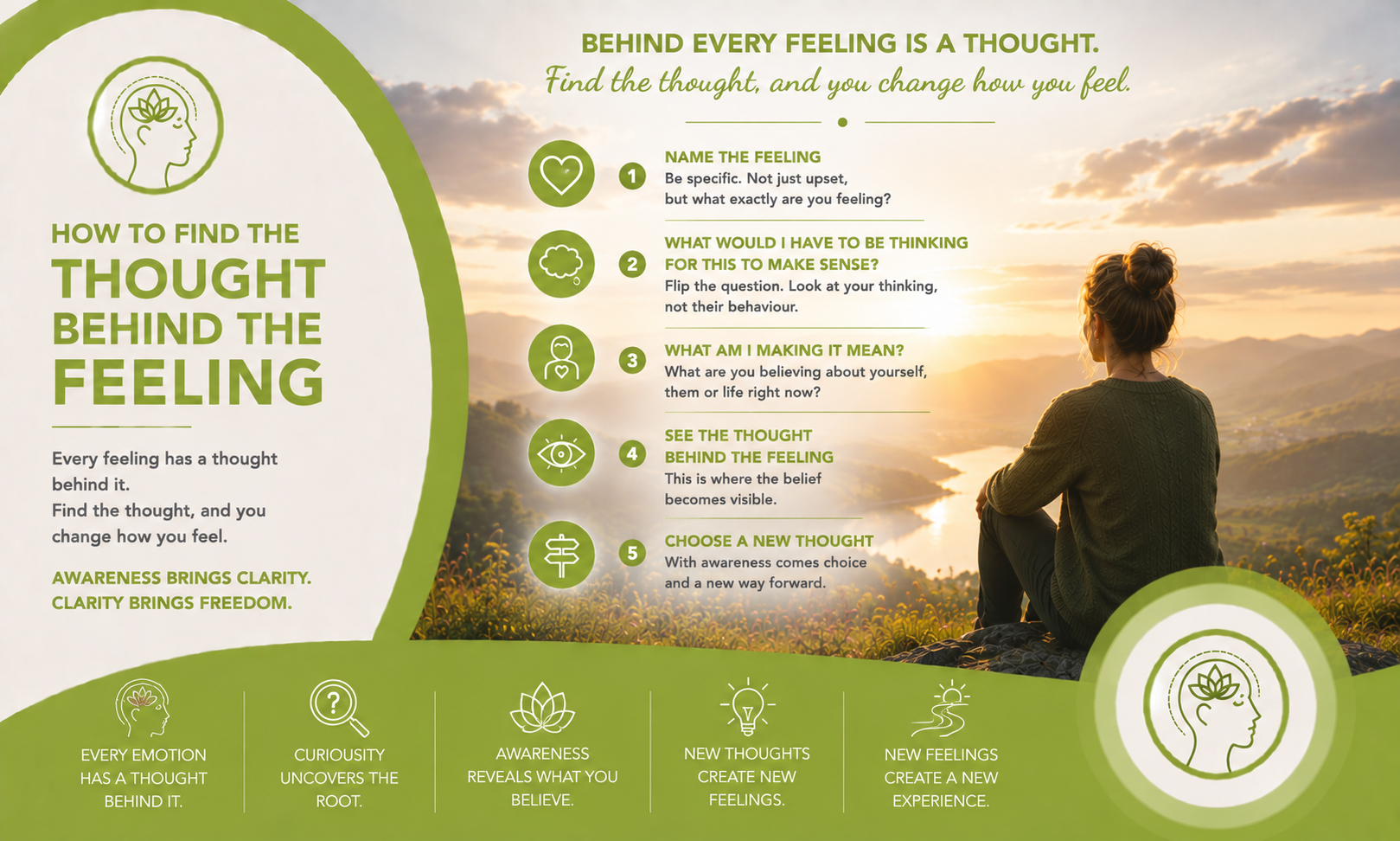
Our feelings about a situation stem from the thoughts, ideas and beliefs through which we interpret it. We are taught to regulate our feelings, yet it is often our thoughts, ideas and beliefs that need our attention.
This matters because if we focus only on the feeling, we can miss the information it gives us. The feeling alerts us, and the thought behind it is what we can learn from.
The Interpretation Between an Event and a Feeling
Something happens, and we react. Someone says something hurtful, and we feel wounded. A message goes unanswered, and we become anxious. It seems obvious that the event made us feel that way. But there is usually something in between.
Something happens. We interpret what it means. Then we feel something.
This interpretation is shaped by beliefs, expectations and perceptions already in place. It happens so quickly that we rarely notice it, and by the time we become aware of anything, what we notice is the feeling. We can see this when our feelings change even though the event has not. We might spend hours believing a remark was aimed at us, only to discover we misunderstood. The event has not changed, but the feeling can disappear in seconds because what we believe it means has changed.
The same is true between people. A friend does not reply to a message. One person thinks, I have upset her, and feels anxious. Another thinks, She is so inconsiderate, and becomes irritated. A third assumes she is busy and gets on with the day. The unanswered message is the same for all three; only the meaning is different.
Even our own interpretations change over time. Something that devastated us in early life may not affect us at all in later life, even though the facts are the same, because what they mean to us has changed.
This does not mean events do not matter. People can behave badly. We can be treated unfairly. Frightening and painful things happen. It means our emotions are not necessarily giving us objective information about what happened. They are telling us what we currently believe it means, and this is precisely why they are useful.
Finding the Belief Behind a Feeling
Once we understand this, we can ask a different question. Instead of asking only what is wrong with the situation, we can ask what we are thinking or believing about it that is making us feel this way.
If being overlooked makes us feel worthless, we may believe our worth depends on being recognised. When disagreement makes us furious, we may interpret it as disrespect. If someone else’s success leaves us feeling diminished, we may believe there is only so much success to go around.
The difficulty is that these beliefs rarely feel like beliefs. Many have been with us for so long that they feel true, and we do not think to question them. Our emotions help us find them. The feeling alerts us to the thought, and the thought can reveal the belief behind it. This is why I find our emotions so useful.
The Letter That Made Me Furious
When my son was about fifteen, he was knocked down by a car while running for the school bus. Thankfully, he was not seriously hurt. The police were clear that although the driver was not speeding, there were many children milling about waiting for the bus, and he should have been more cautious. In effect, the driver was at fault if I had wanted to take things further.
I told the police I did not blame him. He had not set out that morning to hurt anyone. My son had run into the road without looking, as any boy running for a bus might, and I could see how easily it could have happened. So I let it go, and I meant it at the time.
A week later, the driver’s wife wrote, demanding payment for the damage to their car and threatening court action. I was furious, and the fury was out of all proportion to a letter.
The Old Belief Behind My Anger
As my anger subsided, I realised why the letter had infuriated me. It had made me question my original decision not to hold the driver responsible. I thought I was being kind, but had I just been people-pleasing? Had I given up my right to hold someone responsible when it was justified?
I recognised an old belief that being kind meant being weak. Now that I could see it, I could question it.
I realised I could be compassionate without being a pushover. I didn’t have to change my view of the driver or regret my decision simply because I disagreed with what was happening now.
Once I understood that, I could deal calmly with the letter and the money, without questioning my original decision.
How to Know Which Interpretation to Trust
But what if our interpretation is right? We may genuinely have been treated unfairly, rejected or hurt. Why question it just because it makes us feel bad?
It matters because when our emotions are tied to blame, judgement or criticism of ourselves or others, they can signal that we are thinking through the ego thought system rather than through our Higher Self. I have written about the two thought systems in the previous articles. If we want to clear what blocks our own nature, our emotions show us where to look.
The Higher Self is naturally peaceful and loving. To know which interpretation to trust, it helps to look more closely at two things: Unity Consciousness and love.
Starting From Connection Rather Than Separation
If we believe we are separate, fear, comparison, blame and competition can all seem perfectly reasonable. Your success can threaten mine, your rejection can diminish me, and your opinion can determine my worth.
And our emotions appear to confirm this. I feel rejected; therefore, I have been diminished. I feel threatened; therefore, you are a threat.
Unity Consciousness offers another starting point. If we are connected, I can question whether your behaviour really determines my worth or whether your gain has to be my loss. The circumstances may not change, but what I believe they mean about me can.
Asking Whether a Thought Is a Loving One
For me, Unity Consciousness naturally leads to love. If we are connected, diminishing you cannot restore me, and blaming you cannot create my peace. Once we identify the thought behind a difficult feeling, we can ask whether it is a loving way to see it.
Love does not mean being nice, accepting poor behaviour or abandoning boundaries. Love can say no, leave, challenge and hold people accountable. It does not require me to make you less to restore myself.
Together, Unity Consciousness and love make the Emotional Compass much easier to read. Unity gives us our starting point, love gives us our direction, and our emotions show us when our thinking has moved away from either.
When Sadness Simply Needs to Be Felt
Not every painful feeling means our thinking is misaligned. Sometimes life hurts. We experience loss, disappointment and unwanted change, and we can be deeply sad while still aligned with love.
Grief is the clearest example. Sometimes the thought behind the sadness is, I miss him. There is nothing to correct in that; we miss people because we loved them. But other thoughts can become wrapped around the pain. I should have known. I cannot forgive myself. This should not have happened. The grief itself does not need fixing, but the additional suffering created by those thoughts may be worth examining.
The purpose of emotional guidance is not to make ourselves feel better. It is to help us see more clearly, and feeling better tends to follow from that rather than the other way round.
Where to Start When a Feeling Is Out of Proportion
When a difficult emotion feels out of proportion to the situation, or lingers afterwards, start by naming it accurately. Instead of feeling upset, you might be feeling rejected, ashamed, resentful, frightened or powerless. The distinction matters because each feeling can lead us to a different thought.
Then ask: What would I have to be thinking or believing for this feeling to make sense? The wording matters. If we ask why do I feel like this, we can easily end up with a story about what somebody else did. It may be completely accurate, but there is little we can do with it.
Instead, ask what you are making the situation mean about yourself, the other person or life. This is often where the underlying belief appears. It also explains why the same remark can affect one person deeply and barely register with another. Once we can see the thought, we can ask whether it comes from separation or connection, whether there is a more loving way to see it, or whether this is pain that needs to be felt.
We don’t have to change the thought or make the feeling disappear. We only need to be willing to look. Once we can see the thought rather than believe it, another way of seeing becomes possible.
“The purpose of emotional guidance is not to make ourselves feel better. It is to help us see more clearly.”


Try This: Follow the Feeling Backwards
Choose an ordinary emotional reaction rather than something raw or overwhelming, and do so while you can still feel it.
Name the feeling as precisely as you can. Then write down what you would have to be thinking or believing for that feeling to make sense, and leave what comes exactly as it arrives, without correcting it. Then write down what you are making it mean about yourself, the other person, or life.
Read both answers back, and ask whether the thought is coming from separation or from connection, whether there is a more loving way to see it, or whether this is pain that needs to be felt.
You do not need to change anything. For now, notice what the feeling has shown you.
Now we have established how to find the thought behind the feeling and why that’s important; we can next look at how to use the Emotional Compass.
Articles in Emotional Compass
Emotional Compass: What Your Emotions Are Really Telling You
- How to Find the Thought Behind the Feeling
- How to Use Your Emotional Compass
Enjoyed this article? Add People Development Magazine as a preferred source on Google:
Enjoyed This? . This Essential Guide brings the whole framework together in one place, free to download.
