

When I was a child and life felt overwhelming, I sometimes experienced what felt like a loving presence. At other times, when I was questioning life, loving, reassuring answers came that were wiser than my usual thinking.
I didn’t know what it was. For a while, I thought it was God; later I came to see it as a loving, wiser part of myself. I knew I could reach for its comfort, but it never occurred to me to ask it to help me see a particular problem differently.
That changed when I came across A Course in Miracles, which I mentioned at the start of these articles. At a time when I felt completely blocked, one idea in it helped. I could take the situation I was struggling with and become willing to see it in another way.
When I did, the perspective felt familiar. There was no blame, fear or judgement, and it didn’t tell me what I wanted to hear. It came from the same place I had known since childhood.
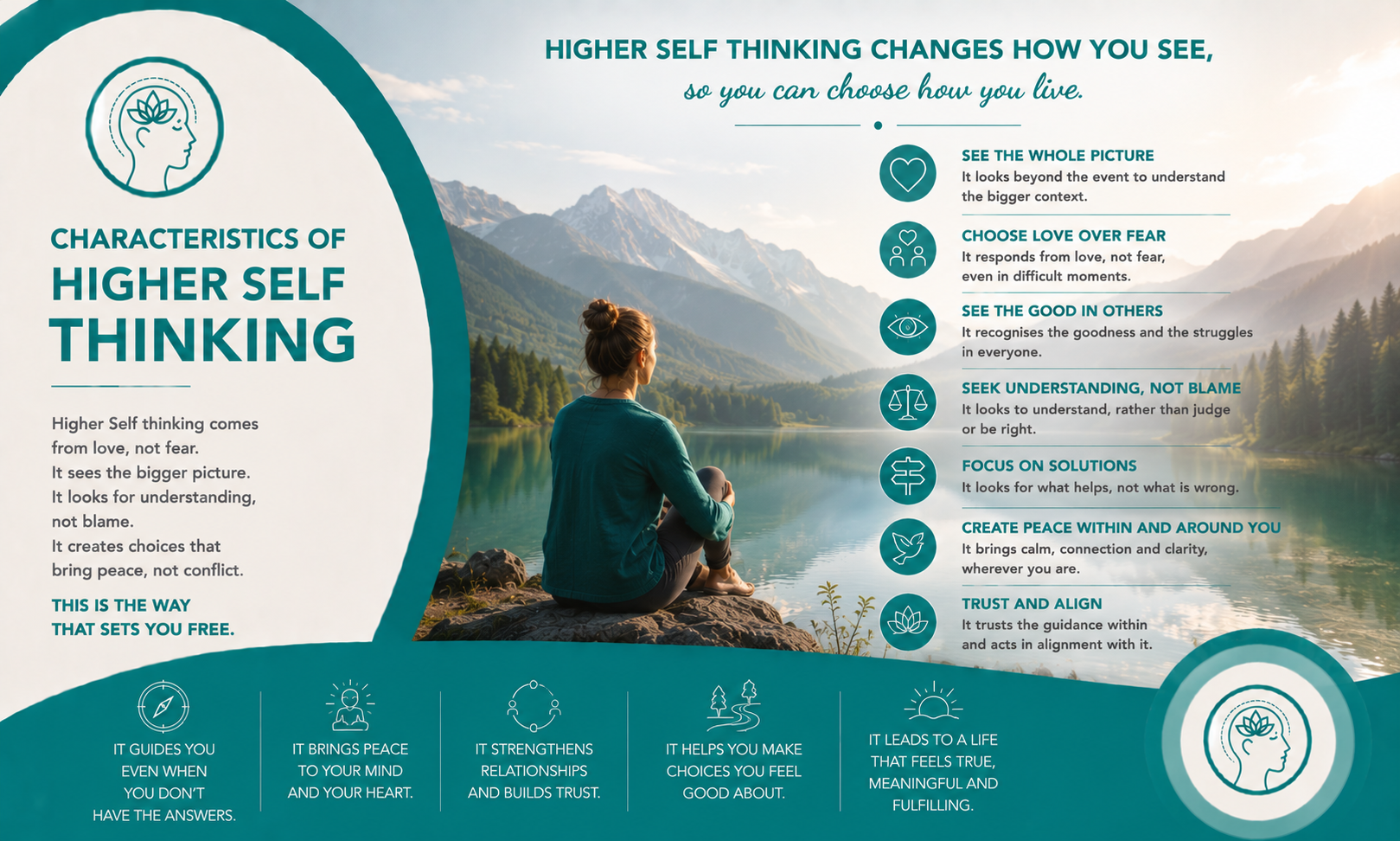
Over time, I came to understand this through the idea of two thought systems. One begins with separation and fear. The other begins with connection and love, and with the understanding that our fundamental worth is never at stake. This second way of thinking is what I call the Higher Self thought system.
What Is the Higher Self Thought System?
As we saw in the last article, the ego thought system begins with separation.
The Higher Self thought system begins elsewhere. It starts with the understanding that we are connected and that our fundamental worth does not change with what happens or what somebody else does. This understanding is part of Unity Consciousness, which we explored earlier in the series.
Both thought systems interpret what happens, but they do so through very different beliefs.
If I see myself as separate, vulnerable or lacking, I am likely to interpret events from that position. If I begin with the understanding that my worth is intact and that other people are also acting through their own fears, beliefs and experiences, the same situation can look very different.
This is why recognising the two thought systems matters. We are always making sense of what happens. Once we realise there is more than one way to see it, we have a choice about which perspective to use.
Signs Our Thinking Has Shifted
These are the signs I have learned to recognise when I ask to see things differently. They help me notice when my thinking has shifted.
It Doesn’t Make Everything About You
The ego can turn almost anything into a verdict about us. Someone criticises, overlooks or disappoints us, and suddenly it feels like a verdict on our worth.
Higher Self thinking doesn’t treat my worth as something to be judged, kindly or otherwise. Instead of asking what this says about me, it asks what is actually happening here and what is needed now.
It Doesn’t Need Anybody to Be Wrong
Higher Self thinking isn’t interested in deciding who is right and who is wrong. That doesn’t mean ignoring harmful behaviour or losing our judgement.
We can recognise when something isn’t working, set a boundary, say no or leave without making anyone bad. For me, this difference between discernment and condemnation is one of its clearest characteristics.
It Doesn’t Need to Prove Anything
The ego loves evidence. Once it has decided what something means, it starts recalling everything that proves it.
Higher Self thinking doesn’t need to prove anything. It stays open to information that might change the picture. When I find myself gathering evidence, replaying past offences or rehearsing my argument, that is usually a good indication of which thought system I am using.
It Doesn’t Fill in the Blanks
When we don’t understand someone’s behaviour, the ego is quick to supply a motive. Higher Self thinking is comfortable with I don’t know why they did that.
This doesn’t stop us from responding to what actually happened or from setting boundaries where necessary. It means we don’t need to invent the missing parts of the story before deciding what to do.
It Remembers There Is Another Person
Ego thinking can make everything about our experience: what they did to us, what it means and how it made us feel. Higher Self thinking sees more than that.
The other person has their own history, fears, pressures and beliefs, much of which may have nothing to do with us. We don’t have to excuse their behaviour to remember that their internal world exists too.
It Is Usually Quieter and Slower
My automatic thinking is quick. It reacts, judges and explains almost immediately. When I pause and genuinely ask whether there might be another way of seeing something, the answer is usually quieter.
It does not argue or keep repeating itself if I ignore it. This is why I have learned not to assume the strongest thought is the wisest. I wrote about distinguishing the two in the articles on the Higher Self.
It Takes the Drama Out
The moments of joy in my life have come when I have been connected to my Higher Self, yet this way of thinking can be remarkably unimpressive. The answer is never dramatic. You’re tired. Don’t answer today. This probably won’t matter in a year.
The ego usually has a much better story, complete with motives, injustices and someone to blame. More of us are attached to this story than we would care to admit, because it makes us feel significant and gives us a part to play. The Higher Self takes most of that away. What feels flat at first will eventually lead to peace and, at the very least, glimpses of inner joy.
It Doesn’t Require You to Feel Loving
Higher Self thinking is not a mood. I don’t have to feel peaceful, forgiving or loving before I can ask to see something differently.
In my experience, the shift in perspective often comes first, and the feeling follows. Sometimes all I can manage is willingness. I don’t see this differently yet, but I’m willing to consider that I could. That is enough.
It Doesn’t Excuse Anything
Seeing things differently doesn’t mean pretending that everything people do is acceptable. We can say no, leave, set boundaries and recognise harmful behaviour for what it is.
This took me years to understand. The Higher Self was never asking me to accept being treated poorly, only not to use somebody else’s behaviour to draw a conclusion about myself that wasn’t true.
Why We Don’t Choose It More Often
If this way of thinking is always available, why don’t we choose it more often? Ken Wapnick, one of the major teachers of A Course in Miracles, wrote extensively about our resistance to choosing differently. At the heart of his teaching is our attachment to the separate self we have created. From this arise guilt, fear and judgement, along with resistance to anything that seems to threaten the identity we have built.
I recognise all of this, and I also see it showing up in much more ordinary ways. We become invested in our version of events. We have decided we are right and perhaps had other people agree with us. We don’t want to let somebody off, or we aren’t ready to see things differently. And sometimes there is no great barrier at all. It is just habit, the familiar way we have learned to think.
You Don’t Have to Choose It
We are free not to choose the Higher Self. Nobody is keeping score, and there is no failure. We can stay angry, frightened or convinced of our position for as long as we need. The other way of seeing remains available whenever we are ready for it.
The same permission applies to the past. I can look at things I did years ago and know I would respond very differently now, without condemning the person I was then. I acted from what I understood at the time. As we saw with Life School, we don’t need to judge our past selves by the standards of our present awareness. If learning about the Higher Self leaves us with a long list of things to feel ashamed of, we have found another way to judge ourselves.
Why Seeing Differently Takes Practice
Knowing there is another way to see something does not mean we can immediately see it that way. Some thoughts shift quite easily, while others are tied to beliefs we have repeated for years.
This is why practice matters. I wrote about this in the articles on Self-Awareness, particularly in the article on moving from observing to choosing. A Course in Miracles also uses 365 daily lessons to practise changing how we see things. I am not offering this as scientific evidence, and it is certainly not the only way to do it. Either way, the more often we make a different choice, the easier it becomes.
This is the difference between understanding the two thought systems and gradually learning to live from the one we want to follow.
“Higher Self thinking is not a mood. I don’t have to feel peaceful, forgiving or loving before I can ask to see something differently.”

Try This: Write It Again Without Making It About You
Take something that is bothering you and write down what happened, including everything that feels unfair.
Then write it again with one rule: nothing that happened is allowed to say anything about your worth. You don’t have to make the other person right, excuse what happened or find a kinder explanation. Take yourself out of judgement.
Now look at what is left to deal with. There usually is something, but it is often smaller and more practical than the original story suggested. That is the part you can do something about.
And if you don’t want to do this today, don’t. The choice will still be there tomorrow.
Knowing which thought system you are in is not always obvious in the moment. Your feelings will tell you before your thinking does, and that is what the Emotional Compass is for.
Articles in Discerning Your Thoughts
Discerning Your Thoughts – Choosing Between the Ego and Your Higher Self
- The Thought System That Has Been Running Your Life
- Characteristics of Higher Self Thinking
Enjoyed this article? Add People Development Magazine as a preferred source on Google:
Enjoyed This? . This Essential Guide brings the whole framework together in one place, free to download.
