


A client of mine took on a substantial amount of extra work. He had asked for the opportunity and done it well, but when his review came round, there was no increase in pay and little explanation.
He was furious. He stopped going the extra mile, did only what was required and started looking elsewhere. His reaction was understandable. He had been treated poorly. But not everything he felt came from the event itself; a thought arrived with it.
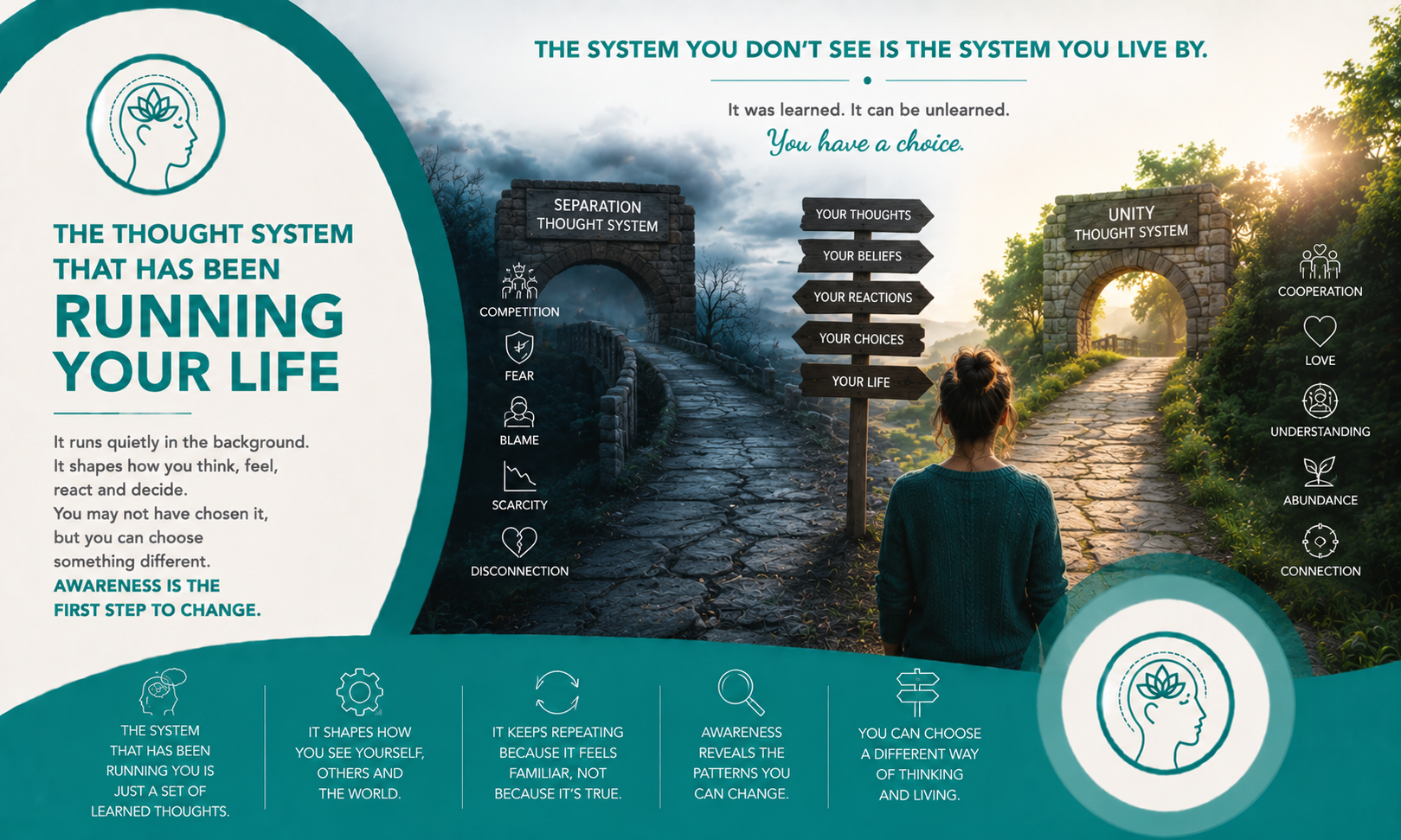
They don’t value me. And behind that thought was something deeper. Perhaps I’m not worth very much. This is the ego thought system at work. Something happens; we filter it through what we already believe about ourselves and the world, and give it meaning. That meaning creates the emotional reaction. It happens so quickly that we experience it as the truth rather than as a thought.
Pause Before You Act
You will probably recognise this in your own life. An email lands badly, someone says something that stings, or you feel criticised, dismissed or taken for granted. Within seconds, you have decided what it means and how to respond.
When this happens, do one thing: don’t act yet. Don’t send the email. Don’t make the decision. Don’t say what you may later wish you hadn’t. Give yourself some space.
Your first reaction may not be wrong, but while the ego is the only voice you can hear, you can’t know what else you might see.
What I Mean by the Ego
When I use the word ego, I don’t mean arrogance or an inflated opinion of ourselves. I mean a way of thinking built on fear, separation and the need to protect ourselves. From there, comparison, competition, judgement and defences make perfect sense. Someone else’s success can threaten ours, rejection can feel like a verdict on our worth, and criticism can become an attack.
The difficulty is that the ego never announces itself as fear. It sounds like us, and it sounds perfectly reasonable. If I believe my worth depends on what others think of me, rejection really does feel threatening. If I believe I need to protect myself, criticism requires a defence. If life is a competition, somebody else’s gain can feel like my loss.
These thoughts make sense because of the beliefs beneath them. This is why replacing them with nicer thoughts rarely works for long. Most of us have lived through this thought system for so long that we don’t even recognise it as a system. We call it thinking.
You Are Not Your Thoughts
We tend to identify closely with our thoughts. I think this; therefore, it must be true. This is how I feel. This is who I am. But our thoughts are not who we are. They arise constantly, often from beliefs formed long ago. One thought triggers another, and before we know it, we are angry, frightened, defensive or hurt, without questioning the thought that started it.
The emotion then seems to prove the thought. I feel threatened, so something must be threatening me. I feel rejected, so I must have been rejected. I feel angry, so somebody must have done something to me. The whole loop can happen in seconds, with the feeling becoming evidence that our thinking is true.
If we believe we are our thoughts, there is nothing to choose. Living differently becomes possible when we notice a thought without automatically believing it.
Separating the Facts From Their Meaning
This was what eventually changed for my client. His employer had given him considerably more responsibility without increasing his salary. That was the fact. They don’t value me, and this proves what I’m worth was the meaning he attached to it. They were not the same thing.
Eventually, he could see why it had landed so painfully. It had found something already there. We tend to accept other people’s judgements when they touch something we already half believe about ourselves. A judgement with nothing to attach to has far less power.
His employer’s behaviour was still unacceptable, but he no longer saw their decision as a judgement of his worth. He still raised the issue and eventually left, but the burn had gone. He could deal with what had happened without needing them to change their decision before he could feel differently about himself.
Six Ways the Ego Thinks
Once we recognise the ego as a particular way of thinking, its patterns become easier to notice.
It Makes Everything Personal
One of my clients was considering asking her adult son to leave home. He complained constantly about the house, about her and about how things were done. She felt criticised all the time. Each complaint seemed to confirm the same message: He is ungrateful. He is criticising me. I must have somehow failed as his mother.
Eventually, she began to see that his unhappiness did not necessarily have to be about her. He was struggling with his own life, and his behaviour reflected that. She didn’t have to approve of his behaviour or tolerate it. She simply stopped taking it personally. As a result, her responses to him changed, and so did the dynamic between them.
It Looks for Evidence
Once the ego decides what something means, it looks for evidence that it is right. They don’t respect me, and suddenly we remember every time they didn’t listen. She doesn’t care, and every unanswered message becomes proof. He’s undermining me, and every disagreement confirms it.
The thought triggers an emotional reaction, which shapes what we notice, remember and do next. Our behaviour can then change the other person’s behaviour, giving us even more evidence for the belief we started with. The ego can become very good at proving itself right.
It Keeps Talking
When I first learned to pause, I assumed a wiser answer would appear straight away. Often it doesn’t.
Instead, the first thought is followed by another that supports it, then another. Before long, we can build a very convincing argument for why we are right.
Anyone who has lain awake in the middle of the night replaying what someone said knows how easily this happens.
The pause is still useful because it stops us from reacting immediately. But pausing alone does not always change the thinking behind the reaction. We may need to question that thinking as well.
It Fills in the Blanks
The ego doesn’t like gaps. When we don’t understand why somebody has done something, the ego likes to supply a reason. They’re looking for attention. They’re deliberately ignoring me. I know why they’ve done that. Before long, an assumption has become part of what we believe happened.
The problem is that we then react to the story as though it were true. We become angry, withdraw, confront someone or change how we behave towards them, sometimes creating a very real problem from something we never actually knew. One of the simplest ways to notice when we are doing this is to ask: What do I actually know, and what have I assumed?
It Can Be Right About the Facts
None of this means pretending that bad behaviour did not happen.
People can lie, betray us, treat us unfairly or behave badly. Relationships may need to end. We may need to leave a job or set a firm boundary.
The problem is not necessarily in recognising what happened. It often lies in what we add to it afterwards: what it means about us, what it means about the other person, and what it means about the world.
That is where resentment, blame and fear can persist long after the event itself.
We can acknowledge what happened and decide how to respond without allowing it to define the other person or us completely.
Why the Ego Seems Normal
The ego thought system is difficult to discern because it is everywhere. We grow up seeing competition, blame, status, scarcity, retaliation and the need to win in families, workplaces, politics and between countries. It is easy to assume this is how life works.
My own experience was slightly different. As a child, I had a strong sense that people were connected and that love mattered more than most things. I couldn’t explain it, and I often felt different because of it.
As I grew older, I saw plenty of evidence of the ego thought system at work that seemed to suggest I was wrong. Over time, I trusted that original sense less and less.
It has taken me much of my adult life to come full circle and question the learned ego behaviour that steered me off course.
This Is Not Something to Blame Yourself For
If you recognise yourself in this, don’t turn it into another reason for self-criticism. Most of us absorbed this way of thinking before we could question it. We lived by it because it was what we knew.
Forgiving ourselves for this matters. Otherwise, we use a new understanding to repeat the old pattern and judge ourselves again. We cannot learn another way while attacking ourselves for the one we learned first.
Three Things That Make Another Choice Possible
Three things make another choice possible, and they are all discussed in this series.
The first is Self-Awareness: the ability to observe our thinking rather than live inside it.
The second is knowing we have access to a Higher Self. If the ego is the only thought system we know of, there is nothing to choose between.
The third is Unity Consciousness, which is fundamental. If we really are separate, much of the ego’s logic makes sense. We need to protect ourselves, compete for what we need and defend against threats. It is only when we begin to question separation itself that another way of thinking becomes possible.
This is why Unity Consciousness matters so much here: it challenges the belief on which the ego thought system is built.
Noticing a Thought Without Becoming It
For much of my life, I thought my thoughts were my own. I didn’t realise they were arising from beliefs about myself, other people and the world.
For me, freedom begins with recognising that I am having this thought. I am not the thought. We don’t need to control our thoughts, suppress difficult emotions or pretend that things haven’t happened to get there.
This gives us enough space to ask where the thought came from and what belief is feeding it. It is the difference between knowing about the two thought systems and consciously choosing between them.
“The difficulty is that the ego never announces itself as fear. It sounds like us, and it sounds perfectly reasonable.”


Try This: Catch the Thought Before You Believe It
Think of something that has annoyed, hurt or unsettled you recently. Choose something for which your emotional reaction felt particularly strong.
Start with what actually happened. Just the facts, without what you think the other person meant or why they did it. Then notice the thought that came with it. They don’t value me. She doesn’t care. He’s trying to make me look inadequate. I’m being taken for granted.
Now ask yourself what you would have to believe about yourself, other people or the world for this thought to feel true. Don’t try to replace it with a better thought. Don’t argue with it or tell yourself you shouldn’t feel as you do. Just notice the sequence. Something happened. A thought appeared. The thought created a feeling. Because I felt it, the thought seemed true.
Then add one final sentence.
I am having this thought. I am not the thought.
For now, that’s enough. You don’t have to change the thought. You are beginning to recognise the thought system it came from.
Eventually, the question becomes: Is this the thought system I want to live my life through? The ego will usually answer first, but it is not the only answer available, and that is where we go next.
Articles in Discerning Your Thoughts
Discerning Your Thoughts – Choosing Between the Ego and Your Higher Self
- The Thought System That Has Been Running Your Life
- Characteristics of Higher Self Thinking
Enjoyed this article? Add People Development Magazine as a preferred source on Google:
Enjoyed This? . This Essential Guide brings the whole framework together in one place, free to download.
