

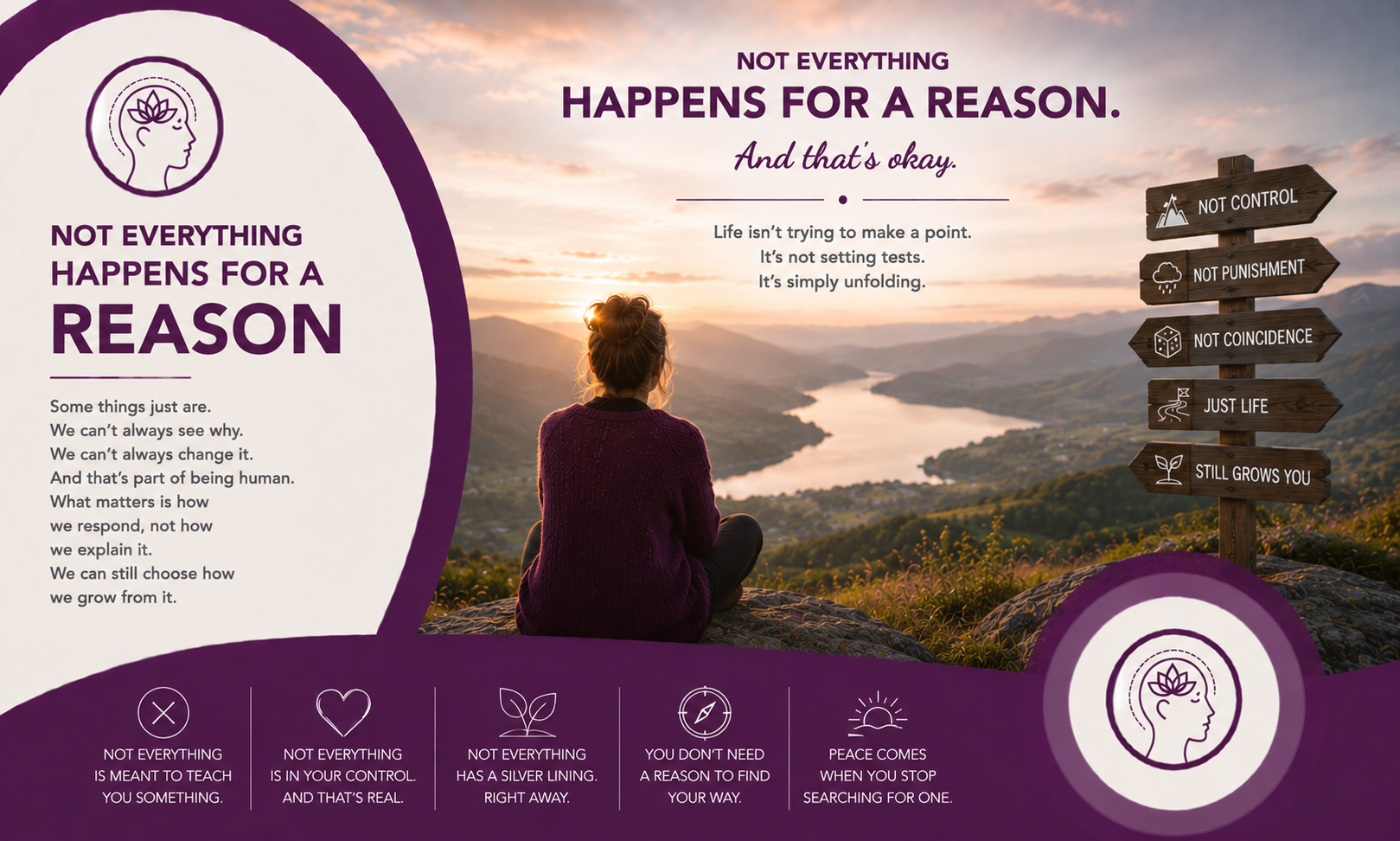
When something painful happens, we naturally want to know why. We can blame ourselves, someone else, fate or life itself, because having an explanation can feel easier than having none at all. But sometimes the most truthful answer is that we don’t know.
I don’t have a problem with the saying that everything happens for a reason when it helps us make peace with one of life’s unexpected turns. The job we didn’t get leads somewhere else. A plan falls through, and another possibility opens up. Looking back, we sometimes realise that something we thought was a setback changed our direction in ways we are ultimately glad about.
But I would never use this phrase to explain bereavement, serious illness or anything that changes a person’s life in ways they would never have chosen. The death of a child is not a lesson. We cannot know why these things happen, and I don’t believe we should try to explain them for somebody else.
I have experienced losses that were expected and others that came without warning. I don’t know why they happened. Eventually, I stopped trying to find an explanation and realised I didn’t need one before I could begin to live with what had happened.
That is an important part of what I mean by Life School. It is not a belief that everything happens to teach us something. It is simply a way of noticing what life shows us when there is something useful to learn.
Learning From the Past Without Blaming Ourselves
There are many ordinary situations we can learn from: our relationships, choices, reactions, beliefs and the patterns that keep repeating.
Sometimes, looking back, I can see that I ignored my intuition, stayed too long in a situation, or made a choice based on a belief I would question now. That is useful information.
However, it doesn’t mean I should blame myself. At the time, I chose from what I understood then. If I had seen things as clearly as I do now, I might have chosen differently, but I didn’t have that understanding yet.
For me, this is an important distinction. I can take responsibility for what I see now without blaming myself for what I couldn’t see then. Once I know better, I have the opportunity to choose differently.
Learning from an experience is not the same as saying we caused it. Something painful may change us or teach us later, but that does not mean it happened in order to teach us.
What I Need to Own
One of the most useful questions I ask myself is: what part of this is mine?
There may be something I can take responsibility for. Perhaps I can recognise a pattern, a belief, a decision I would make differently now, or a familiar way I react when frightened.
If it is mine, I can do something with it.
But other people’s choices are not mine. Neither are circumstances I could not control, nor are events I could not reasonably have predicted.
Psychologists sometimes describe this in terms of our locus of control: understanding what is and is not within our influence. Taking responsibility for what is ours can help us make different choices. Taking responsibility for things that were never within our control usually leads to guilt and self-blame. The task is to tell the difference.
When Grief Needs Feeling, Not Explaining
I lost my beloved cat after eighteen years together. Afterwards, I went over everything repeatedly. Had I made the right decision to end his suffering? Had I waited too long? Should I have given him more time? Why did it have to happen then? Was there something I was supposed to learn?
After about a week, I realised I wasn’t discovering anything new. I was asking the same questions and making myself more miserable, so I stopped trying to find an answer.
I missed him terribly and was deeply sad. That was what was happening. There wasn’t an explanation I needed to find or a lesson that would make the loss easier. I needed to grieve.
Reflection can be useful when it helps us see things differently. But there comes a point when we are simply going over the same ground. Some questions may never have an answer. I have become much more comfortable with saying I don’t know. Sometimes that really is the most truthful answer.
What Acceptance Actually Asks
Acceptance does not mean deciding that what happened was right, fair or meant to be. It does not mean we wanted it, deserved it or have to be grateful for it.
It means recognising that it happened and that we cannot go back and change it.
Even that can be too much when something is very painful or recent. At those times, we don’t have to force ourselves to accept anything.
We don’t have to find a lesson. We don’t have to understand why it happened. We don’t even have to be ready to move forward.
Sometimes all we can do is allow ourselves to feel what we feel and be willing to believe that we will not always feel exactly as we do today.
When Remorse Turns Into Punishing Ourselves
Remorse can be useful because it helps us take responsibility. We can apologise, make amends where possible and choose differently in future.
Guilt stops being useful when we keep using it to punish ourselves for something we can no longer change. If I have genuinely learned from something, continuing to condemn the person I was does not help anyone. I would rather ask: what do I understand now that I did not understand then, and what will I do differently because of it? That gives me something to act on.
For me, the aim is to take responsibility where it belongs, learn what I can and eventually forgive myself and other people. Life School should help us reduce suffering, not give us more pain to feel.
Finding Meaning Without Believing It Was Meant to Happen
Not knowing why something happened doesn’t mean nothing meaningful can come from it. Viktor Frankl, who survived the concentration camps, wrote about our capacity to find meaning even in suffering. There is an important difference between finding meaning in what happened and believing it happened to give us meaning.
Someone may emerge from a terrible experience with greater compassion, a different sense of what matters, or a completely changed direction in life. They took something they would never have chosen and, over time, made something meaningful from it. The meaning is theirs because they made it.
There is one thing to be careful of. Meaning must not become another route back to self-blame. If what we arrive at is I deserved this, I caused this or I should have known better, we have not found meaning at all; we have returned to guilt.
What Is Available to Me Now?
I find this a more useful question than Why did this happen?
What is available to me now?
Sometimes there is something important I can do. I may need to make a decision, change a pattern, forgive someone or ask for help.
Sometimes the answer is much smaller. Eat something. Go for a walk. Tell someone I am struggling. Get through today.
The point is not to force ourselves to find meaning or take action before we are ready. It is simply to bring our attention back to what we can do now, rather than staying stuck trying to change or explain what has already happened.
“I can take responsibility for what I see now without blaming myself for what I couldn’t see then.”


Try This: Only When There Is Room
If something is still raw, leave it for now. There is no timetable for learning, accepting or finding meaning in anything.
When there is a little more room, take one difficulty that has left you asking why and ask something different instead.
- What did I understand then, and what do I understand now that I couldn’t see before?
- What part of this is genuinely mine to take responsibility for?
- Is there anything I am carrying that was never mine?
- What would I choose differently now?
- And what is available to me now?
Don’t force an answer or go looking for a lesson. Write down whatever comes, even if it is very small. And if the answer today is I don’t know, let that be enough too.
Life School is not about judging our past selves with what we know today, but about learning from our experiences and choosing differently when we understand more. In the next article, we will explore the two thought systems that shape how we see those experiences and how we can begin to recognise which one we are using.
Articles in The Life School
Life School: Why Life Is Your Greatest Teacher
What Is Life Trying to Tell Me?
Not Everything Happens for a Reason
Enjoyed this article? Add People Development Magazine as a preferred source on Google:
Enjoyed This? . This Essential Guide brings the whole framework together in one place, free to download.
