

For most of my early life, learning meant acquiring something I didn’t already know. I picked up skills, gathered knowledge and worked out how to do things better. Learning helped me in my career or made life run more smoothly. That life itself might be teaching me something about myself was not an idea I had ever entertained.
The Problem That Changed My Life
What changed was a serious back problem that left me unable to work and eventually contributed to my losing the house. I could not understand how the successful, happy life I thought I was building had brought me there. For about six months, I cried, raged at what had happened and wondered why life had dealt me such a hand. When I had exhausted most of the grief and anger, I began to listen.
Reading The Road Less Travelled had given me a eureka moment, as I described in the articles on the Higher Self. The trouble was that I had the insight and then carried on much as before. I had invited my Higher Self into my life while continuing to think, choose and react through the same old beliefs.
Six months after losing the house, something shifted. I saw that life was not something to conquer on the way to the life I wanted. I had it back to front. My own thinking and choices had consequences, and those consequences had been showing me things I hadn’t known how to see. I had carried on down the same road until the results became impossible to ignore. This was when I began to understand life as a school.
Using What Happens to Learn About Ourselves
A Course in Miracles goes much further than I do here. It teaches that the ego thought system creates the world we experience, and that what happens here can help us see differently. What I took from it was simple and practical: whatever the world is, we can use what happens in it to learn about ourselves.
You do not need to believe any philosophy to use the ideas in this series. I am still exploring some of it myself. What I am sharing is what I have found helpful when I have applied these ideas to my own life, alongside everything else I have learned over the years.
I had already asked for another way. What I hadn’t understood was that part of the answer would be to pay attention to what my life was already showing me.
Consequences, Not Punishment
Seeing life as a school is a choice. It has helped me enormously, but that does not make it the right or the only way.
We are all working things out in our own way. What helps me may not help you, and you may see things very differently. All I can do is share what I have experienced and what I have learned from it.
I do not believe there is a cosmic teacher sending us harder lessons because we missed earlier ones, or that we have to learn something before life will let us move on. What I have noticed is that if I keep ignoring what I know about a relationship, for example, I stay in it. If I keep explaining away my reactions, I keep making choices based on the same thinking. If I do not recognise a pattern, I continue to use it. Eventually, the consequences become harder to ignore.
There is no punishment, just living with the consequences, which either work for you or don’t. I see choices, experiences and consequences, and the chance to notice what they may be showing us.
The change for me came when I realised I did not have to wait until something hurt before paying attention. Sometimes the signs are there much earlier.
Where to Look for What Life Is Showing Us
If our lives are part of a Life School, there is no syllabus or manual telling us what comes next. The learning opportunities lie in what happens as we go about our lives, and these are the places where I have found them.
Our Choices and What Follows Them
We can learn a lot from the choices we make. Sometimes a decision doesn’t work out as we hoped. Something we thought would make us happy doesn’t. A conversation goes wrong. We get what we wanted and realise it wasn’t what we wanted after all.
We don’t have to turn everything into a lesson. Sometimes it is enough to notice what worked, what didn’t and what we might do differently next time. The same applies when things go well. What did I do differently? What felt right? What helped me be at my best?
Looking back without judging ourselves can tell us a lot about what matters to us and how we want to live.
The Patterns That Keep Repeating
If I keep ending up in similar relationships, having the same arguments, feeling overlooked, becoming resentful or finding myself in situations I don’t want to be in, then finding out why is useful.
When things don’t work out, it doesn’t mean I have done anything wrong. It simply gives me something to look at. I can ask: what am I thinking, believing or choosing that might be contributing to this?
Our Reactions, and What Stays with Us
If something small makes me unusually angry, defensive, frightened or upset, I take notice. Often the situation has touched on an existing belief or fear, so I am reacting to more than what is happening in front of me.
I also pay attention to what stays with me: a dream I still remember the next morning, a comment I can’t stop thinking about, or a thought I keep pushing away because it doesn’t fit with what I have already decided. Not everything needs interpreting, but I don’t want to dismiss it automatically.
What We Avoid
It might be a conversation we keep putting off, a decision we won’t make, something we know isn’t working, or something we keep finding reasons to avoid.
Avoidance doesn’t necessarily mean we should act immediately. Sometimes there are very good reasons to wait. But if the same issue keeps coming back, it is worth asking why I am so reluctant to face it.
What Our Body Is Telling Us
An illness is not a lesson, and physical symptoms should not be treated as messages. But it’s useful to notice the ordinary reactions most of us recognise: a clenched jaw, tight shoulders or that feeling in our stomach before a particular conversation.
Our minds can tell us everything is fine while our bodies are reacting very differently. If I notice the same physical response around a particular person, situation or thought, I become curious about it. It doesn’t necessarily mean anything is wrong, but it is another piece of information worth noting.
What Other People Reflect Back to Us
One person disagreeing with me is just their opinion. But if several people who know me well and genuinely care about me are independently saying something similar, I’ve learned to pay attention. That doesn’t mean they are right or that I have to change my mind. But I may need to ask why they are seeing something I am not.
Sometimes they can see the situation more clearly because they are not caught up in it. I may have spent months thinking something through, explaining it to myself and becoming more convinced of my position. Someone outside it may notice something I have stopped seeing.
My first instinct can still be to explain why they are wrong. What I now notice is how hard I am working to convince them. If I desperately need everyone else to agree with me, I sometimes need to ask whether I am also trying to convince myself.
Other people still don’t get to make our decisions. They bring their own beliefs, fears and experiences, and they only see part of the picture. We can listen to them and still make our own choice.
What Draws Us Towards Something
Sometimes we keep feeling drawn to something. It might be a subject we keep reading about, an idea that won’t go away, someone we keep thinking about contacting, or something that gives us energy whenever we return to it.
My writing has been like that, as I described in the articles on Inspiring Self and Others: the ideas stayed with me for years while everything else, quite reasonably, came first.
That didn’t mean I should have dropped everything and written a book twenty years ago. Much of the time, that would not have been practical. I knew it mattered to me, and I kept coming back to it.
I don’t treat inner prompts as instructions. I see them as worth noticing. The same applies to the things that bring us peace, enjoyment or a sense of being completely ourselves. Personal growth can become too focused on problems and what needs fixing. We can also learn from what is already working.
Why do I do well in one environment and struggle in another? Why do I feel completely comfortable with some people? What gives me energy? What drains it? What do I become so absorbed in that I lose track of time?
Life School is not only about learning from what goes wrong. We can also learn from what brings out the best in us, what gives us joy and what feels right for us.
Telling Intuition From Fear or Wishful Thinking
Not everything we feel is a signal or a lesson. Fear issues convincing warnings, and enthusiasm makes something feel right because we want it to be.
I explore this more fully in the articles on the Higher Self, where I discuss recognising intuition. The distinction I find most useful is that fear is urgent and demanding, whereas intuition is quieter and can wait. If something still feels true once the emotion has passed, I am far more inclined to listen. Even then, I weigh it up before acting.
Noticing What Has Been There All Along
None of this comes with a label saying LEARNING OPPORTUNITY, and none of it necessarily means anything. We don’t have to analyse every dream, emotion and coincidence for hidden messages; we only need to become more interested in our own experience.
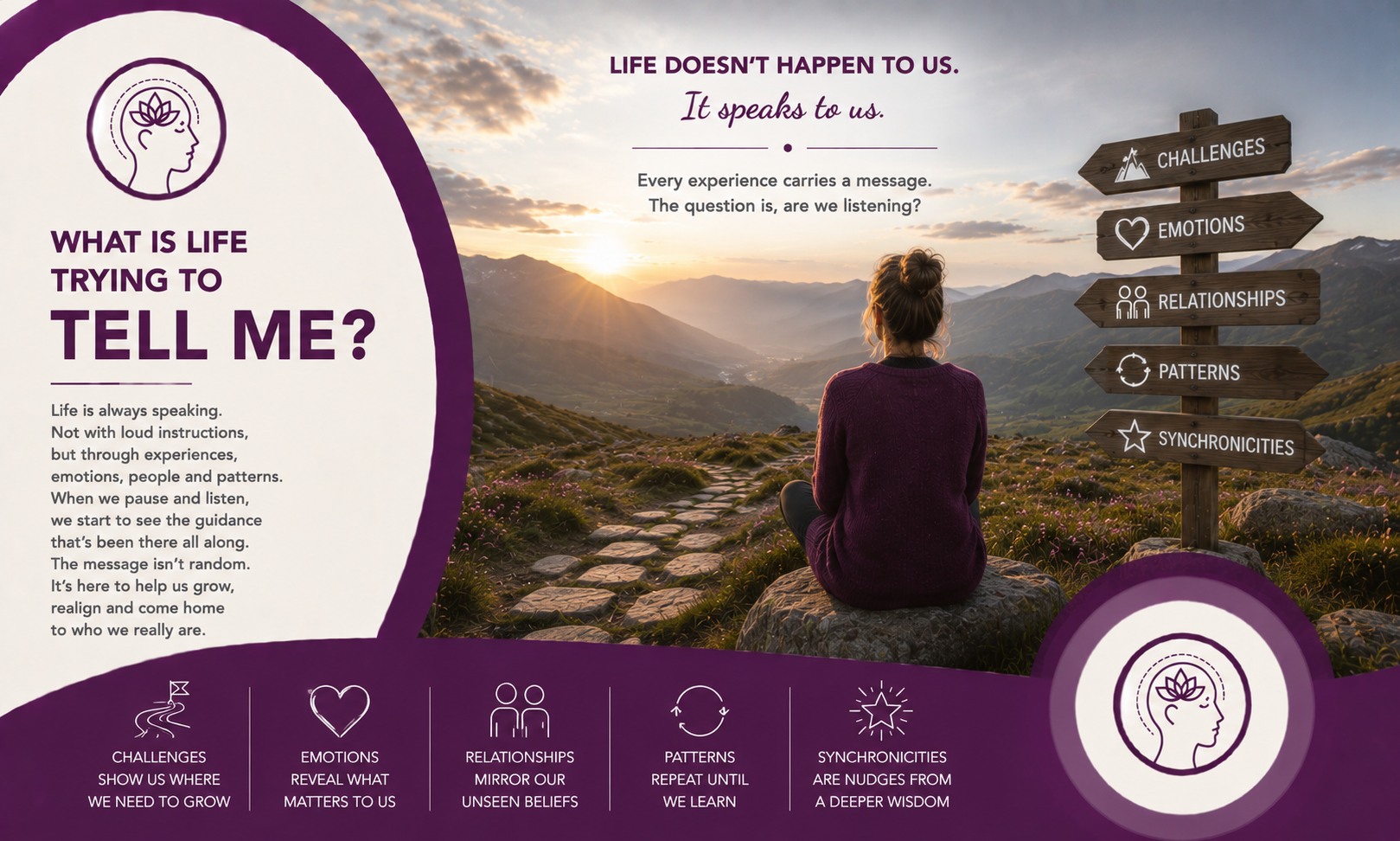
We start to notice what repeats, what triggers us, what we avoid, what works, what other people reflect back, what brings us joy and what keeps drawing our attention. Then we ask one question: is there anything here that helps me understand myself better?
Sometimes the answer is no. Sometimes we find we already knew it but were not quite ready to admit it. And occasionally something we had dismissed turns out to be useful.
Once I became willing to look, I noticed what had been there all along, even though my circumstances were no different. There is nothing mysterious about it. We notice what we are looking for, and I had not been looking until something became impossible to ignore.
“The learning opportunities are in what happens as we go about our lives.”


Try This: Notice Before You Interpret
For the next week, don’t try to work out what life is teaching you. Just notice what repeats.
Write down the thought that keeps returning, the dream you still remember the next morning, the reaction that was disproportionate to the event, the conversation you keep avoiding, the advice you have now heard from more than one person, and the idea that gives you a small lift every time it crosses your mind.
Collect them without deciding what any of them mean.
At the end of the week, look at what you have gathered and ask one question:
Is there anything here I already know but have not quite been willing to know yet?
Then ask the other one, the one we forget:
Is there anything here I keep feeling drawn towards?
You may find there is nothing at all, and that is a perfectly good result. You may also find that life has been showing you more than you realised.
Deciding to look at your life from the perspective of learning something can be hugely rewarding, but you also have to understand that not everything happens for a reason, and that is where we go next.
Articles in The Life School
Life School: Why Life Is Your Greatest Teacher
What Is Life Trying to Tell Me?
Not Everything Happens for a Reason
Enjoyed this article? Add People Development Magazine as a preferred source on Google:
Enjoyed This? . This Essential Guide brings the whole framework together in one place, free to download.
