

Thousands of thoughts may pass through your mind before you sleep tonight. Only a handful will be worth following.
The observer we met in the previous section can watch them all go by. The question now is how we decide which deserve our attention.
Almost everyone has experienced an answer arriving without effort. You wrestle with a decision for days and then wake one morning simply knowing. You’re driving home, standing in the shower or halfway up a hill, and clarity turns up unannounced. No debate. No analysis. Just a quiet sense of knowing.
I stopped automatically dismissing those moments as coincidence a long time ago. But neither do I believe every instinct, feeling or unexpected thought should automatically be labelled guidance.
The useful question is: How do we learn the difference?
When Head and Heart Agree
For me, and for many people I’ve discussed this with, one of the clearest signs is when your head and your heart agree. You may have been going back and forth over a decision, but then something settles. You know what feels right, and you no longer feel the need to argue with yourself about it.
It can be difficult to describe, but once you’ve experienced it, you begin to recognise it. There is a sense of peace and knowing. That does not mean you know how things will turn out, or that everything will be easy. You may still have doubts about the outcome. But underneath those doubts, you know which direction you want to take.
Your Own Dialect
How that knowing arrives varies enormously from person to person. For some it comes as a feeling: a warmth or ease around one option that the others don’t have. For others it’s a thought that appears whole and unforced, perhaps about something they weren’t consciously working on at all. Sometimes there are no words, just a quiet certainty.
You may already recognise one of these in yourself. The important thing isn’t to label every unusual feeling as your Higher Self. It’s to become curious about how your own deeper knowing tends to communicate and then test it through experience.
The House That Wasn’t Ready
I wanted to move house. I viewed one that was, on the face of it, perfect, and I loved it. But I couldn’t settle on it. My heart was entirely sold; my head kept pointing at the location, which was impractical. I was frustrated because I wanted to just jump into buying it, but by then I knew enough to recognise that my heart and head weren’t agreeing. So I waited, without much grace.
Some months later, I noticed the same builder working on a site closer to home, and the style of house I’d fallen for was part of the plan. I was thrilled, right up until I viewed the one available in that style and found it sat too close to the main road. Disappointment doesn’t quite cover it.
I explained the dilemma to the salesperson, mostly to account for my face, which must have looked so miserable. She lit up. There was another house in that style, not yet released, and she thought the position would be exactly what I’d been describing. And there it was. The right house, in the right place, and this time my head and heart arrived at the same conclusion together.
What I drew from that experience is the importance of timing. The first house seemed right in one respect and wrong in another. Had I overridden that discomfort, I’d have owned a house I loved in a location that didn’t work for my life.
Sometimes guidance appears to say not yet. And not yet can be one of the hardest answers to accept.
Urgency Is Not Intuition
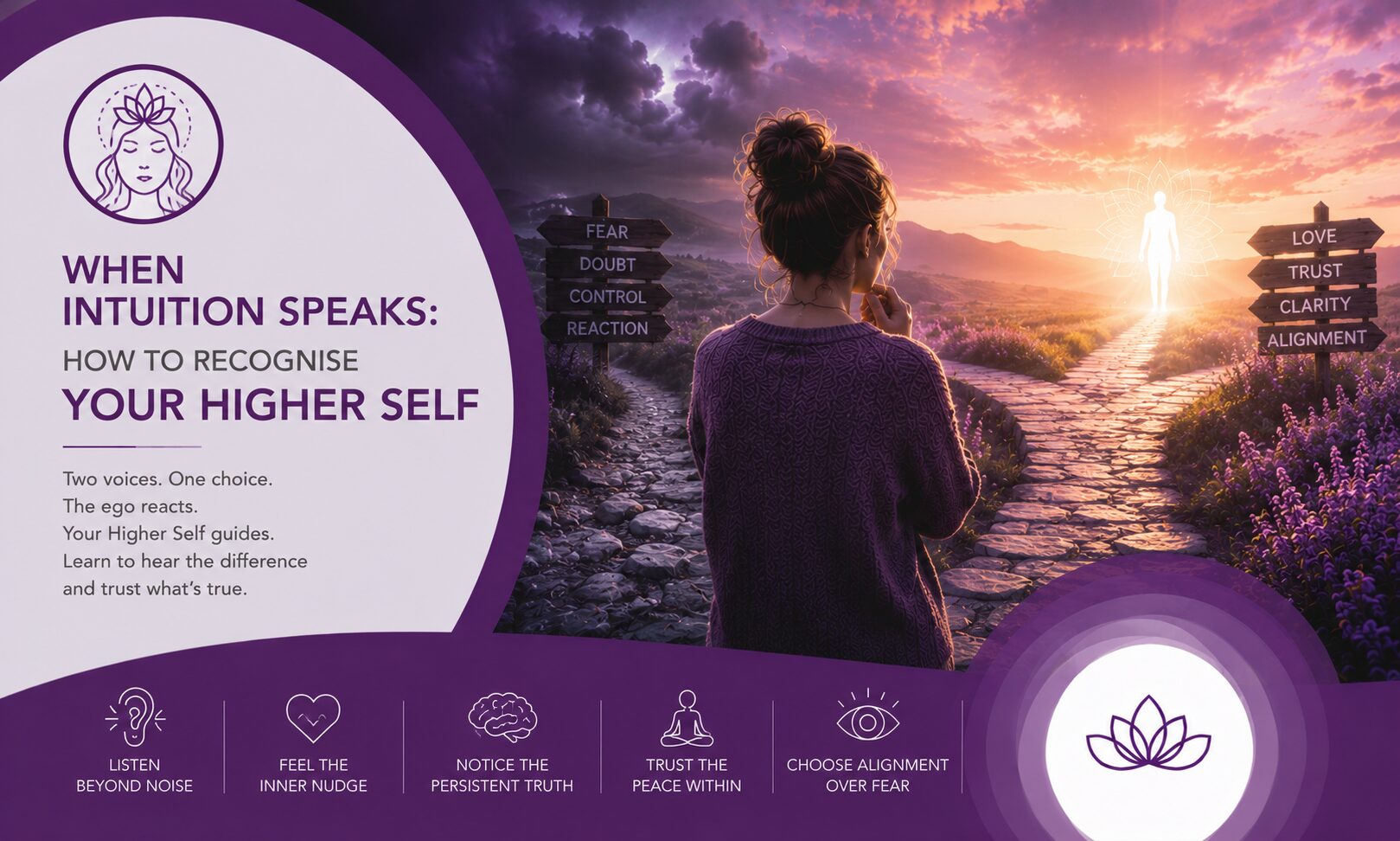
There is another voice that can sound very convincing. It is quick to make judgements, worries about what other people think, compares you with others, and often wants an answer immediately. Because it can be so strong, it is easy to mistake it for intuition.
One distinction I have found particularly useful is that your Higher Self rarely needs to rush you. If you feel you must make a decision this minute, it is worth asking yourself where that pressure is coming from. Are you afraid of missing out, disappointing someone or making the wrong choice? Once you recognise what is driving the urgency, you can give yourself the space to consider what you really want to do.
Direction, Applied
Instead of obsessing over whether a thought definitely came from your Higher Self, ask where it is taking you. Is it towards peace or further into conflict? Towards understanding or judgement? Towards courage or deeper into fear? Towards owning your part or handing responsibility to somebody else? Towards connection or separation?
Is this definitely my Higher Self? That may be impossible to answer. Where is this thought taking me? That is something you can examine today.
And remember peace does not mean softness. Guidance may ask you to have the difficult conversation, admit you were wrong or wait while everything in you wants to move. The answer may be uncomfortable without being unloving.
You wrestle with a decision for days and then wake one morning simply knowing


Try This: Keep a Ledger of the Quiet Voice
The next time an answer arrives quietly, in the shower, on a walk, apparently out of nowhere, don’t dismiss it. But don’t automatically obey it either. Record it.
Write down what came and add two questions: Do my head and heart agree on this? Is there peace underneath it, or urgency?
Then return to your entry later and see how it held up.
This is how trust is built. Not by believing every nudge, but by testing your experience gently and discovering your own patterns over time.
Recognising the voice is one thing. Hearing it at all, in a life of noise, notifications and a to-do list that never empties, is another. Next, we discover how to quiet your mind so you can hear your Higher Self.
Articles in The Higher Self
Connecting to Your Higher Self: Discovering the Wisest Part of Who You Are
- The Quiet Voice You Keep Talking Over
- You Are More Than Your Busy Mind
- When Intuition Speaks: How to Recognise Your Higher Self
- How To Quiet Your Mind So Your Higher Self Can Be Heard
- Living a Guided Life
Enjoyed This? . This Essential Guide brings the whole framework together in one place, free to download.
