

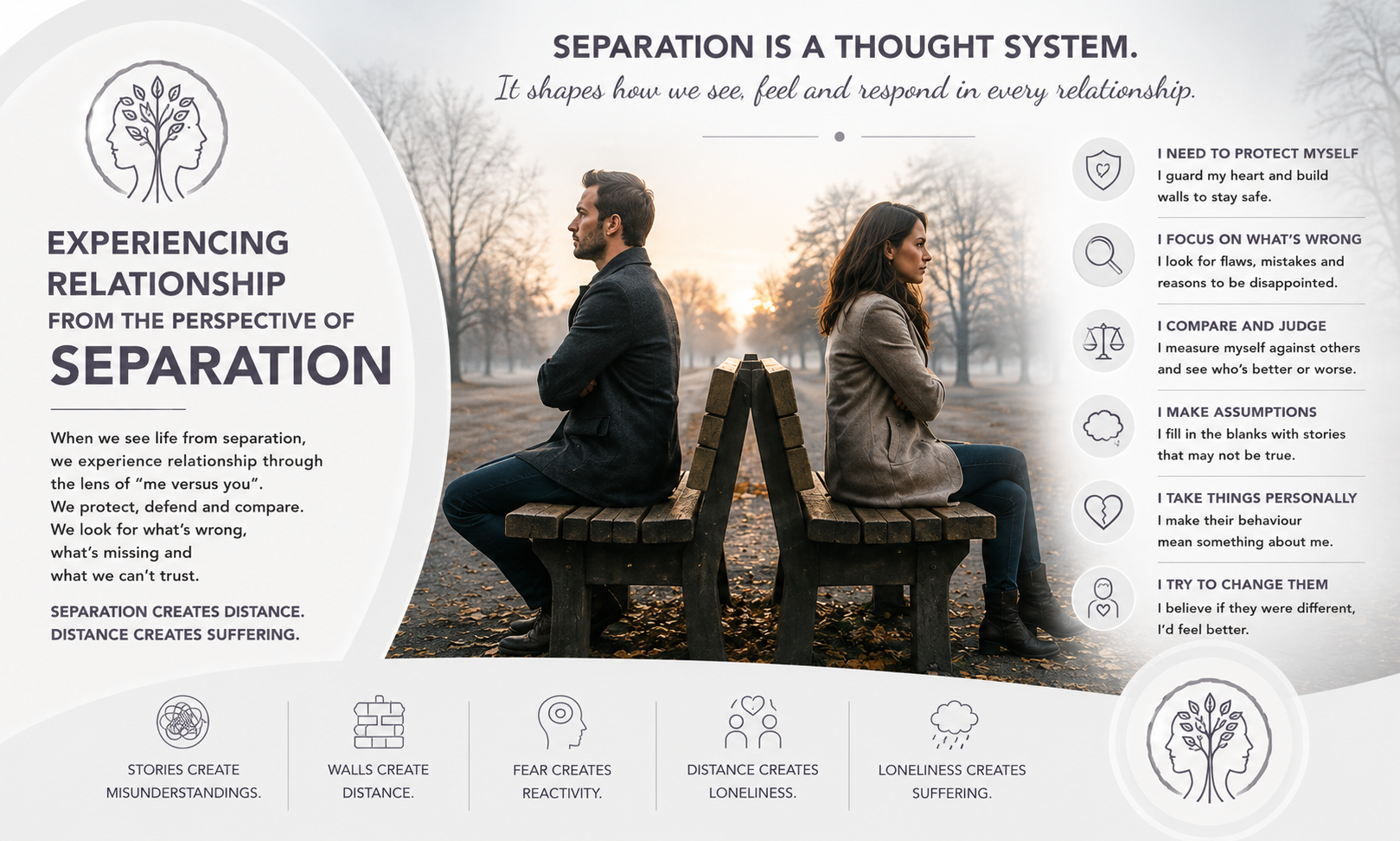
I sent a message to a friend one morning, and she did not reply. It was a message that warranted a prompt reply. By the afternoon, I was curious. By the evening, I had checked twice more, and somewhere in between I had decided she was too busy to reply and was likely ignoring me. She replied the following morning. She had her hands full with a personal crisis and had not looked at her phone for a day and a half. Nothing I had spent the previous evening being certain about had happened at all.
Looking back, I noticed how quickly I told myself a reason for the lack of reply. I also didn’t challenge the ego’s version of events. This is what happens when we relate to people from a perspective of separation, and it is not confined to friendships. We have relationships with our partner, children, family, friends and colleagues, as well as with work, money, our body, ageing, food, our home and the world around us. We also have relationships with our past, our future and, most importantly, ourselves.
To relate means, at its simplest, to make or recognise a connection. We don’t simply encounter people, things and events. We think about them, decide what they mean and develop feelings and behaviours around them. Our thoughts, beliefs and experiences all shape how we relate.
How Much of a Relationship Happens Inside Us
My relationship with money isn’t the money itself, just as my relationship with work isn’t my job, and my relationship with another person isn’t that person.
The relationship we experience is made up of what we think and believe about them, our memories of what has happened, what we expect from them and what we think their behaviour means. The other person and their behaviour still matter, but much of the relationship happens within us.
I saw this clearly with the coaching client I discussed earlier, who had a difficult relationship with her boss. She couldn’t understand why a colleague got on with him so much better. When she changed her attitude towards her boss, she didn’t need him to change first. She changed how she related to him, and that changed the relationship.
Why Relationships Matter So Much to Us
Most of my learning has come directly from my relationships or from challenging situations with other people. How we see these relationships matters, because it shapes how we deal with them. In the world of separation, we experience ourselves as individuals making our own way through life.
Relationships therefore become enormously important. We need other people for love, belonging, cooperation, safety and support. From our earliest relationships, we learn who we can trust, what earns approval, what risks rejection and how to get our needs met. There is nothing wrong with any of this. It is part of being human. But it means we learn to look to our relationships for many different things.
What We Are Looking For in Relationships
Because we look to relationships for what we need, we are constantly assessing them. Is this safe? Do I trust this person? Do they value me? Is this working for me? Am I giving too much? Do I want more of this or less?
Most of this happens without us consciously thinking about it. And it doesn’t only apply to people. We make similar assessments about work, money, our bodies, our homes and life itself. Not every relationship is transactional, but often, without realising it, we notice whether a relationship feels safe, supportive, rewarding or threatening, and respond accordingly. We are usually looking for several things.
Survival, Safety and Security
We need each other. Humans have always depended on one another for survival, protection, care and cooperation.
We also seek emotional and practical security. We want people we can trust, enough money to live on, and somewhere safe to call home.
Love, Connection and Belonging
We want to love and be loved. We want friendship, intimacy, companionship and a sense of belonging.
The difficulty arises when belonging starts to mean I matter, and rejection starts to mean I don’t.
Validation and Worth
Relationships can also serve as evidence that we are good enough. Being chosen can make us feel desirable. A promotion can make us feel successful. Someone’s approval can reassure us that we have done the right thing.
There is nothing wrong with enjoying approval, success or being chosen. The problem arises when we use them as proof of our worth, because anything we rely on to give us worth can also seem to take it away.
Predictability and Control
We like to know what to expect. We get used to how people behave, how our routines work and what helps make life manageable. Predictability gives us a sense of security.
We notice this most when something changes. A familiar colleague leaves. A routine breaks down. Someone we rely on becomes less available. Nothing major may have happened, but we can still feel unsettled because part of our sense of safety came from knowing what was likely to happen next.
Comparison and Confirmation
We use other people as reference points, comparing careers, relationships, bodies, homes, money and achievements.
Relationships can also confirm what we already believe. If I believe people eventually let me down, I will notice when they do. The relationship then becomes evidence that I was right all along.
One of my coaching clients told me that problems in his relationship were beginning to affect his business. He described his partner as unreliable and said he found it difficult to trust her.
As we talked, it became clear that much of his distrust stemmed from a previous relationship in which his partner had been unfaithful. Without really realising it, he was bringing what he had learned from that experience into his current relationship.
His distrust was understandable. He had been badly hurt before. But a conclusion that had helped him protect himself after one relationship was now affecting a different one.
The Search for Completeness
Perhaps the greatest expectation we place on relationships in the world of separation is that something outside us will finally make us feel complete.
It might be the right partner, enough money, success, security or someone’s approval. The promise beneath is the same: when I have that, I will be all right.
This is when we begin to expect more from relationships than they can give. We ask something outside ourselves to provide a lasting sense of completeness, worth or safety, and we depend on that external thing remaining exactly as we need it to be.
In the articles on Unity Consciousness, I wrote that we sometimes ask another person to provide something we first need to find within ourselves. When they cannot, we usually conclude that we have the wrong people rather than the wrong expectation.
When a Relationship Comes to Mean More
This is how a relationship can come to mean much more than the relationship itself. A friendship can mean I belong. A career can mean I am somebody. A marriage can mean I haven’t repeated my parents’ mistakes. Someone’s approval can mean I am good enough after all.
Then ordinary events can take on much greater meaning. The unanswered message I began this article with is small in itself. But if that friendship means I am loved and wanted, an unanswered message can suddenly feel like evidence that I am not. We respond to what we think it means as well as to what happened.
So a useful question is: What has this relationship come to mean about me?
Why We Are Drawn to Some People and Not to Others
We rarely build relationships consciously. Sometimes we meet someone and like them immediately. At other times, someone makes us uncomfortable or irritated, even when very little has happened to explain why.
We tend to assume those reactions tell us something about the other person. Sometimes they do. At other times, they reveal a quality we recognise, admire, reject or wish we possessed ourselves.
Carl Jung’s work on projection, which I touched on earlier, helps explain why particular qualities in others can attract or repel us so strongly. Relationships don’t begin with a blank sheet. We bring ourselves.
An introverted friend of mine fell for a lively, extraverted woman. At a party, we watched her talk easily with everyone and hold the room. He said to me, “That’s what I love about her. I wish I could be more like that.”
What struck me was that he may not have been admiring something completely absent in himself. He may have been recognising a part of himself he had stopped expressing a long time ago and had come to see as belonging to other people.
That can happen in relationships. Sometimes we are drawn to qualities in someone else because they remind us of something in ourselves that we have lost touch with.
When a Relationship Becomes Part of Who We Are
Some relationships are important to us without becoming part of how we see ourselves. Others become closely tied to our identity. We may think of ourselves as someone’s mother, best friend, successful colleague or dependable daughter. The same can happen with our career, home, income or appearance.
In the articles on Self-Awareness, I wrote about levels of attachment. The key point is the moment something that matters to us becomes part of who we believe we are. Relationships can do that too.
There is nothing wrong with this. The difficulty arises when we need a relationship or role to remain the same to feel secure in ourselves, because people and circumstances change.
As I described in the articles on the Higher Self, I experienced this when I left the career I had been in for twenty years. I expected to miss the job, but I had not realised how much of my identity had become tied to it. When the role ended, part of how I had understood myself went with it.
When a Relationship Stops Working as It Did
People grow, circumstances and needs change, children become adults, jobs shift and bodies age. Friendships built around a shared stage of life sometimes lose the thing that held them together. People we love change their minds and priorities.
Sometimes a relationship that worked perfectly well for years stops working the same way. That doesn’t necessarily mean anything has gone wrong; life has moved on, and we don’t always move with it.
We can find ourselves wanting things to go back to how they were. We wish they would be the person they used to be, that work would go back to how it was, that our bodies would behave. If only life would cooperate, we think, then we could feel all right again. I have spent much of my own life doing exactly that.
About six years before I wrote this series, I became an “empty nester”, and I had to do considerable work to regain a sense of purpose. After all, if I wasn’t providing for and looking after my children daily, who was I? It wasn’t so much that I wanted my children to return home; on the contrary, I was very proud they were forging their own way. What I needed was a new source of purpose that did not depend on the role I had occupied for so long.
From the perspective of separation, wanting things to go back makes sense. If I believe the problem is outside me, changing what is outside me appears to be the obvious solution. Sometimes something outside us does need to change. We may need a conversation, a boundary, a renegotiation or even to leave.
But there is another possibility we often miss. Sometimes the relationship or circumstance has changed, and the most useful thing we can change is the meaning we give it and how we now relate to it.
Relationships Are Messy
None of this happens neatly. We can love someone and be furious with them. We can be attached to a relationship we no longer enjoy. We can want someone closer while also wanting more space. We can know something needs to change and desperately wish it didn’t.
Relationships contain love, memories, needs, disappointments, hopes, fears and expectations, often all at once. We shouldn’t expect looking at them to yield a single, simple answer.
In the world of separation, we spend much of our lives looking to people, things and circumstances outside ourselves for what we believe we need. We assess them, attach meaning to them, sometimes make them part of our identity, and then struggle when they change.
None of this makes us wrong. It shows how much meaning, security and identity we can place in relationships without realising it. Once we can see that, we have another choice.
“Sometimes the relationship or circumstance has changed, and the most useful thing we can change is the meaning we give it.”


Try This: What Does This Relationship Mean?
Choose one relationship. It doesn’t have to be a difficult one.
Write down ten simple things you think or believe about that person. Then look at each one and ask: Is this something I actually know, or something I have concluded?
Finally, ask: What does this relationship say about me?
Don’t try to find the right answer. Just notice what comes up.
So far, we have looked at relationships from the perspective of separation, where they primarily exist to meet our needs. Next, we look at What Our Relationships Can Teach Us About Ourselves.
Articles in Transformational Relationships
Transformational Relationships: How Every Connection Reflects and Refines You
- Experiencing Relationship From The Perspective Of Separation
- What Our Relationships Can Teach Us About Ourselves
This article reflects my personal experiences and the Living From Your Higher Self philosophy, and isn't intended as a substitute for professional psychological support. If reading it brings up painful past experiences or causes you significant distress, please seek help or consider working with a qualified therapist.
Enjoyed this article? Add People Development Magazine as a preferred source on Google:
