



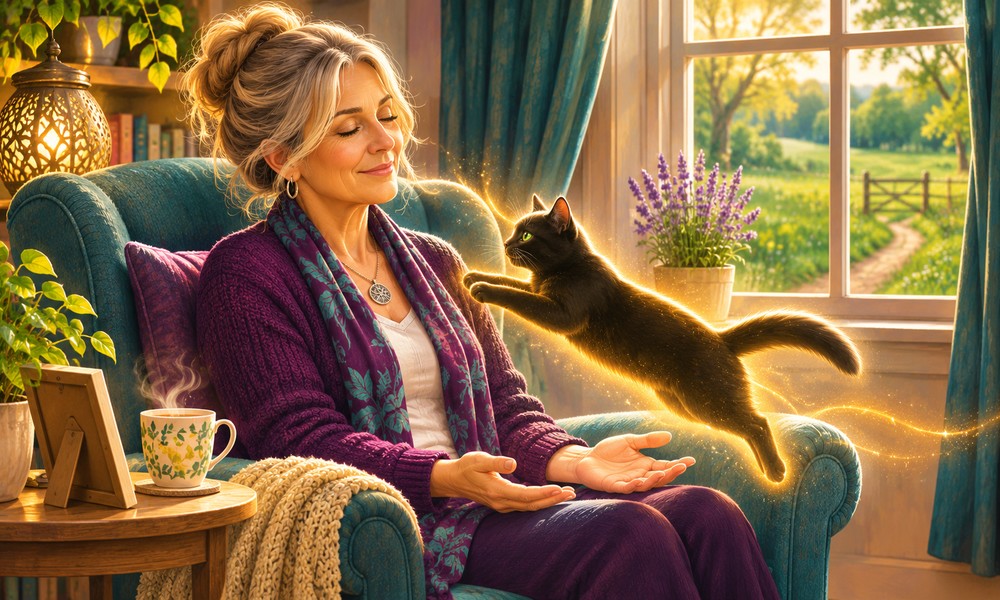
When my cat of eighteen years died, I felt bereft. Seeking comfort, I watched a pet grief specialist on YouTube. She said something I have thought about many times since. Part of the pain, she explained, comes from losing the one who received our love. She suggested closing our eyes, picturing our pet, and simply sending them love.
I closed my eyes and saw him coming towards me, about to jump into my lap. Then I consciously sent him love. I can’t begin to express how much better I felt in that moment. Nothing had changed. He was still gone, and I still missed him. But for a moment I felt the love I had for him rather than the pain of losing him. That moment reminded me that even in the middle of grief, love still has somewhere to go.
I shared my experience with a friend, who nodded and told me that imagining talking to her relative, whom she had unexpectedly lost some years earlier, made her feel better.
I have grieved for people I loved dearly and for animals who shared my life. Living from our Higher Self doesn’t stop us from grieving. What it can do is help us move through grief with more compassion, understanding and love.
Grief Is Wider Than Sadness
Grief often involves sadness, but it can also bring anger, confusion, loneliness, and even relief. It leaves us exhausted and unable to concentrate. We grieve for more than deaths: the end of a relationship, the loss of our health, or a future we imagined. Sometimes we don’t recognise it as grief at all, even when something feels deeply sad.
There is no need to measure our loss against anyone else’s. Our Higher Self doesn’t judge what we feel or question whether we are entitled to feel it.
Making Sense of How We Grieve
Psychologists have offered several ways to understand grief. None can tell us how to grieve, but they can help us recognise what we are going through. The best-known is Elisabeth Kübler-Ross’s five stages: denial, anger, bargaining, depression and acceptance. She first described them in people facing their own death. They are not a sequence we move through in order. We may feel some of them, all of them or none, and we can return to feelings we thought we had left behind. So there is no need to judge ourselves when our grief doesn’t follow the pattern.
Margaret Stroebe and Henk Schut’s dual process model describes two sides of coping that we naturally move between. We face the loss and feel its pain and attend to everyday life. This fits closely with living from our Higher Self. Watching something funny or getting absorbed in an activity isn’t necessarily avoiding our grief. Sometimes it is simply giving ourselves some respite.
Continuing bonds theory recognises that we don’t have to sever our connection with someone who has died. We may talk to them in our minds, keep up traditions that mattered to them, or notice their influence on how we live. That is why the exercise with my cat helped so much. I had found another way to feel the love. Our capacity to love had not changed.
Grieving for What Never Was
Not all grief is for something we once had. As our self-awareness grows, we may see how early experiences and beliefs about ourselves shaped our choices, our relationships and the opportunities we let pass. That realisation can bring a deep sadness.
I felt this when I grieved for the little girl I once was. I could see how much she had misunderstood about herself and how the conclusions she reached had shaped her life. The feeling was sadness for what she went through and for what might have been possible had she known her worth. Living from my Higher Self meant I could look at her with love and understand why she reached those conclusions, without judging her for them. I can’t change what happened to her. But I can change how I see her and the beliefs she adopted, so they no longer determine what happens next. Even when we grieve lost possibilities, other possibilities remain open to us.
Grief Doesn’t Mean We Are Getting It Wrong
When we start living from our Higher Self, it’s easy to believe that every painful emotion needs transforming, or that if we were spiritually aware enough, we wouldn’t grieve at all. I don’t believe that. Our Emotional Compass isn’t there to judge what we feel. It helps us notice what is going on inside us.
There is a difference between the natural sadness of loss and the additional suffering our thoughts can add. Thoughts like “I should have done more,” “I should be coping better than this,” or “I don’t deserve to enjoy life when they can’t” add another layer of pain. Our Higher Self doesn’t ask us to stop missing someone. It invites us to notice where we’re making an already painful experience harder and to gently question those thoughts without trying to get rid of the grief itself.
Allowing Ourselves to Feel Better
Many of us feel guilty the first time we laugh after a loss, as though the depth of our suffering proves the depth of our love. But we don’t have to suffer to show how much we loved someone. Finding joy again doesn’t take anything away from that love.
Equally, we don’t need to force a better-feeling thought before we are ready. Sometimes the most loving thing we can do is let ourselves cry. At other times we may be ready to turn towards something that comforts us. A moment of relief doesn’t have to last to be worth having. When the sadness returns, it doesn’t mean we have gone backwards.
Acceptance Doesn’t Mean Approval
Some losses we would never have chosen, and we can spend a long time wishing things had been different or trying to understand why they happened. Living from our Higher Self doesn’t ask us to believe that everything happens for a reason, or to find a lesson in every painful experience. Some things are very sad. Acceptance means gradually acknowledging what has happened without having to approve of it. We can then ask how we want to care for ourselves now.
Carrying Love Rather Than Only Loss
One of the foundations of living from our Higher Self is Unity Consciousness, and from that perspective, it holds that love isn’t only something we feel because someone is physically with us. It is something within us that we can continue to feel and extend. When someone dies, we lose the familiar ways we expressed our love, and it is entirely natural to grieve that loss. Whatever we believe happens after death, the love itself can stay with us in our memories, in how we live, and in the kindness we show others because of the people we have lost.
Grief and love can coexist, and we don’t have to wait for the sadness to pass before we can feel love again. We may miss someone for the rest of our lives, yet over time, remembering them can bring more warmth than pain. Perhaps healing from grief isn’t so much about letting go of what we loved, but about learning to carry that love differently. If your grief feels too heavy to carry alone, a bereavement service such as Cruse Bereavement Support can help.
This article reflects my personal experiences and the Living From Your Higher Self philosophy, and isn't intended as a substitute for professional psychological support. If reading it brings up painful past experiences or causes you significant distress, please seek help or consider working with a qualified therapist.
Enjoyed this article? Add People Development Magazine as a preferred source on Google:
