

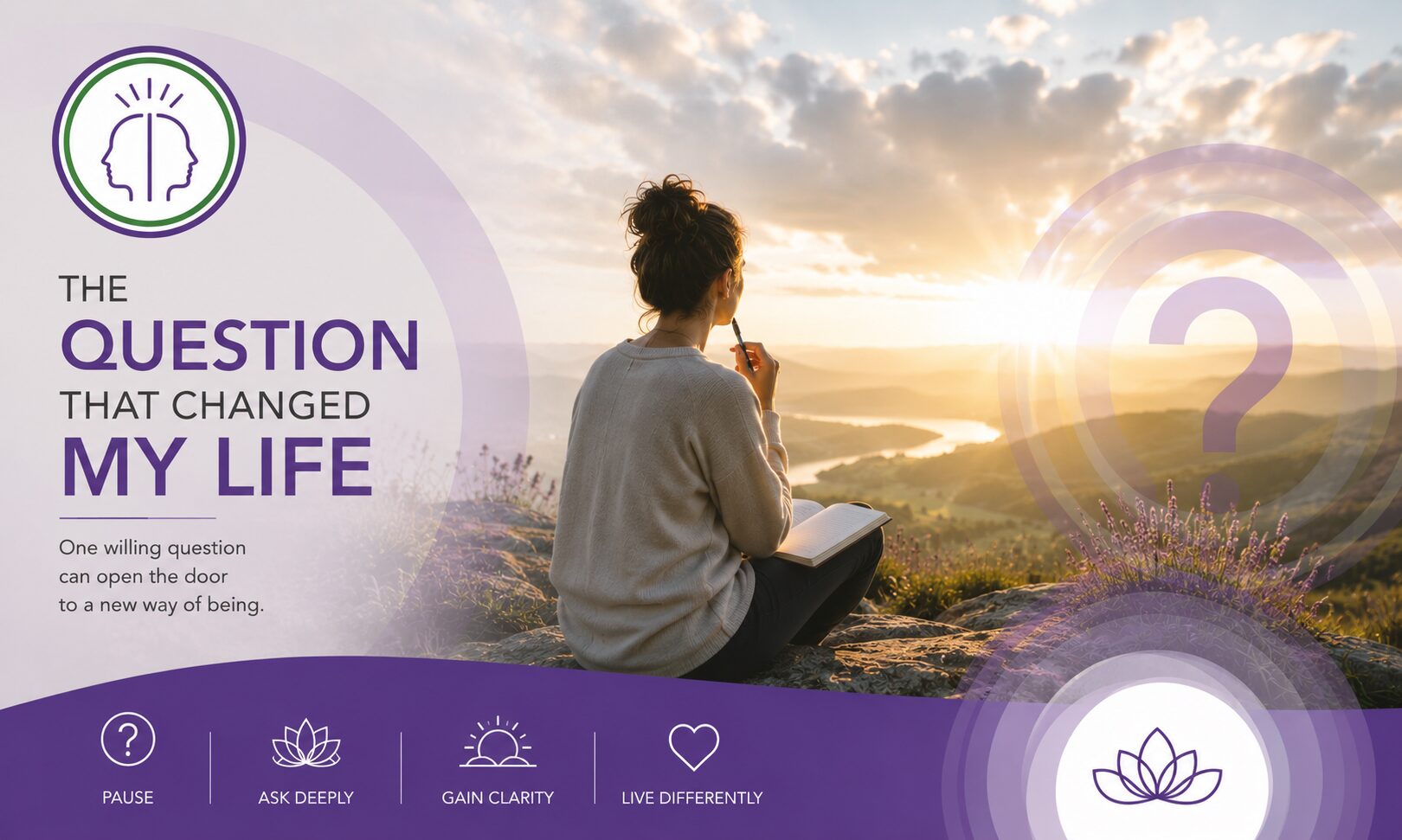
I must have been about eight years old when I first became aware of myself questioning suffering. By then, I had already seen how much pain people I loved could experience through relationships, disappointments and the things that happened in their lives. I was too young to understand all the reasons for it, but I understood the distress.
What bewildered me was why there had to be so much of it. I remember becoming aware of a quiet but insistent thought: Why can’t people just be happy? Surely there must be another way.
I never said it out loud. Eight-year-olds don’t usually make those kinds of observations and expect to be taken seriously. I had no idea what to do with the thought, so I did what most of us do with quiet inner promptings: nothing. But the question never left.
A Question Everyone Hears
I think most of us have moments when we question something we have taken for granted for years. Does it have to be this way? Why do I keep feeling like this? Is this really who I am? The question may only be there for a moment, and it is very easy to ignore it and carry on as before.
For me, the question was not only about the suffering I could see around me. I was unhappy myself, although at that age I could not have explained why. As I grew older, anxiety and sadness became so familiar that I stopped questioning them. I simply assumed they were part of who I was.
That is easily done. If you have felt anxious, unhappy or dissatisfied for long enough, you can begin to treat it as part of your personality rather than something worth looking at.
The question I had asked as a child stayed with me because, somewhere underneath it, was another possibility: perhaps things did not have to stay the way they were.
The Day I Finally Began Investigating
I was always anxious, right up until my early thirties. I bit my nails; my foot tapped whenever I was uncomfortable. I had never questioned any of it; it was just an inescapable part of me. Then one day, without quite meaning to, I asked: Why do I feel this way? For the first time, instead of experiencing the daily anxiety, I looked at it. I really saw it as an entity in its own right.
It doesn’t sound like much. But self-inquiry had never occurred to me before, and that small, honest question set something in motion. I was a voracious reader, hundreds of novels, mostly as escapism, so the library was already my second home. Soon after asking, I found myself drawn to the psychology section, where I picked up a little series about anxiety. It introduced me to a few simple ideas and exercises, and over the following months the constant dread and the physical habits fell away. I stopped biting my nails. I do still feel anxious at times, but it has stopped being a permanent condition and has become an ordinary reaction to particular things.
At the time, it felt like a miracle. Looking back, what mattered was that I could repeat it. I had asked myself an honest question, taken one small step and changed something I had assumed was simply part of me. For the first time, I realised I could look at what I was feeling rather than accept it. I didn’t have the language for it then, but that was my first real exploration into Self-Awareness, and the beginning of learning to listen to the quieter part of myself that I now call my Higher Self.
Why an Ordinary Life Is the Perfect Classroom
I have lived what many would call an ordinary life. I was born in the North East of England to working-class parents, the last of five children. Money was short, and poverty stayed with me as a shadow for years.
I married very young, which I realised later helped me escape an unhappy childhood and find myself, on autopilot, recreating the sadness I had experienced all my life.
I have spent my working life in ordinary jobs, learning these lessons slowly, in real and often difficult circumstances. The question came at eight, the first real inquiry in my early thirties, and I didn’t begin the search in earnest until I turned forty.
I share this not because the details matter, but because the ordinariness does. If peace of mind required a monastery, a windfall or a special gift, most of us would be disqualified before we began. An ordinary life is not an obstacle to this journey. It is the classroom; every challenge, every setback, every difficult relationship turns out to be part of the curriculum.
Pain, Suffering and the Other Path
As a child, I thought the depth of my pain was unique to me. Growing up cured me of that. Everyone is carrying pain of some kind, quietly or openly. We can all suffer, and most of us do.
But somewhere along the way I learned something that changed everything: while pain touches us all, suffering is not required. There is another path, another perspective, which I have come to recognise as truth. It leads from fear to love, from confusion to clarity, and from despair to freedom.
What I can tell you is that choosing that perspective led me towards greater light and joy. This series is the result of that choice in my life: decades of reading, testing, discarding and refining, distilled into four foundations and five practices, arranged in the order I wish someone had handed them to me. It is not about me; it is about what I have learned. If my story holds a mirror to yours, I hope it serves as both mirror and guide.
“An ordinary life is not an obstacle to this journey. It is the classroom.”

Try This: Find Your Question
You have a version of my living-room moment, and probably a version of my library moment waiting to happen. So, this week, do one thing. Find your question, the one that keeps interrupting your ordinary scenes. Does it have to be this way? Why do I feel like this? Take ten minutes and write it down, exactly as it comes. Don’t analyse it, argue with it, or rush to answer it. Just get it on paper and let it sit where you can see it.
That question is the thread. The whole journey is what happens when you pull it. You may have exploredsu healing or personal growth teachings, and nothing lasted. That isn’t because you failed. It’s because self-improvement was never quite the right tool for the job. That’s where we’re going next, when we consider that personal growth isn’t enough.
Articles in The Journey
Living From Your Higher Self: The Journey to Your True Self; Introduction
- The Question That Changed My Life
- Why Personal Growth Isn’t Enough
- Your Teachers Are Closer Than You Think
- The Road Ahead: What to Expect When You Begin
- What’s Waiting on the Other Side? Discovering the Peace You Already Carry
Enjoyed This? . This Essential Guide brings the whole framework together in one place, free to download.
