

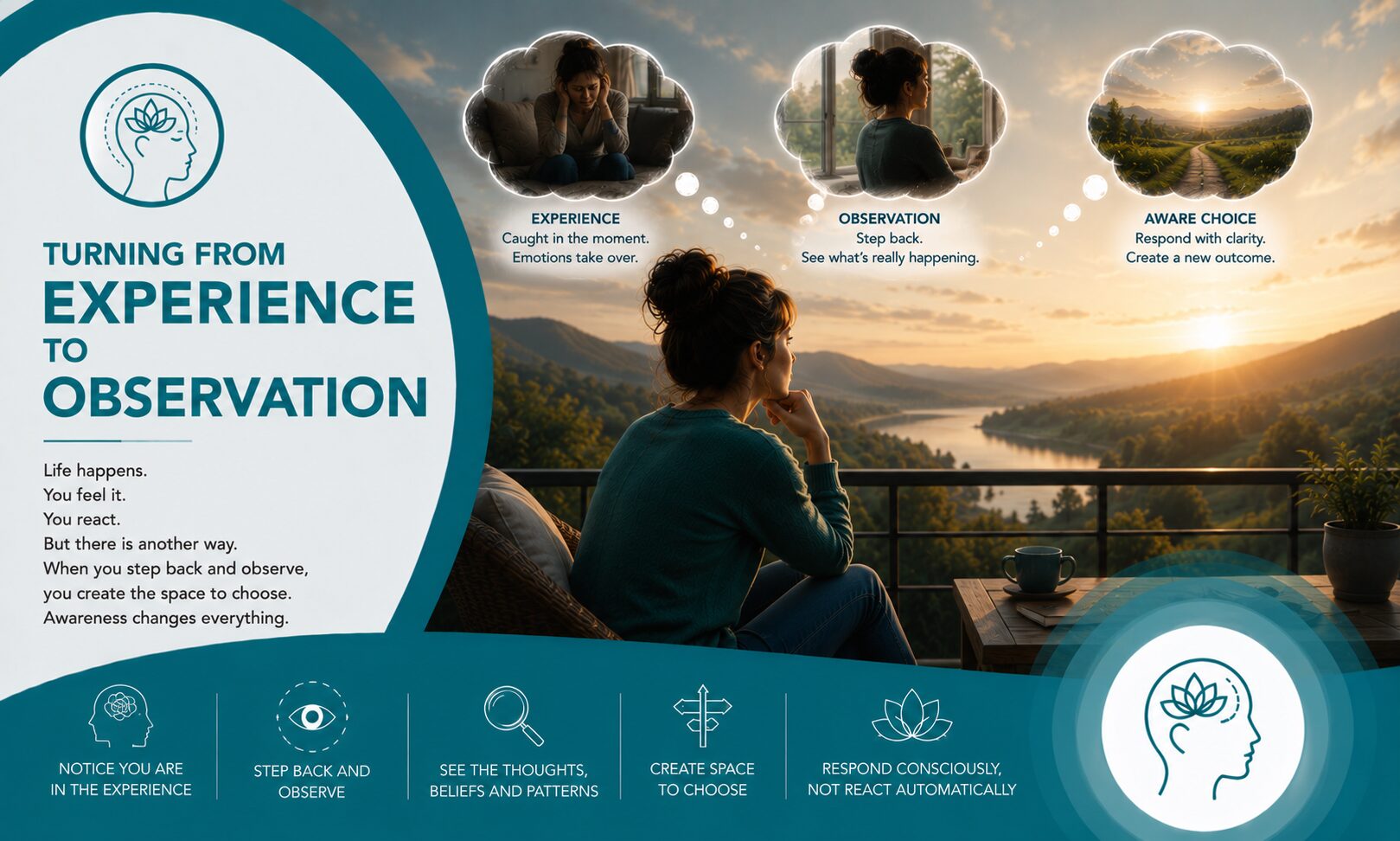
Willingness opens the door. Once we are prepared to look honestly at ourselves, the next step is learning how to look.
Most of the time, we experience life from right inside whatever is happening. If somebody annoys us, we feel annoyed. If we are worried about money, we feel the worry. If we feel rejected, it seems obvious that something has happened to make us feel that way. We are having the experience, and naturally our attention goes to the person or situation in front of us.
There is nothing wrong with that. It is how we live most of our lives. But if we want to understand ourselves better, we need to learn another way of looking. We need to become the observer of our experience as well as the person having it. The difference is quite simple.
When I am experiencing something, I might think, They have made me angry. When I step back and observe what is happening, I can ask, Why has this affected me so strongly? What am I believing about what just happened? Nothing about the situation has changed. I have simply moved my attention from what happened outside me to what is happening inside me. That small shift can tell us a great deal.
The Experience Of Being Poor
If you had asked me years ago what I believed about money, I would probably have said I was careful with it. That was the story I consciously told myself. But underneath it was another belief: money disappears whatever you do.
I could not see that belief by simply asking myself what I thought about money. I found it by looking at my experience: the dread when bills arrived, the way I managed money, the choices I made and the patterns that kept repeating. That is why some of our most influential beliefs are so difficult to spot. We have lived with them for so long that they do not feel like beliefs. They feel like reality.
The observer gives us another place to stand. Instead of immediately believing every thought and reaction, we begin to notice them. I am getting very defensive. Why? That comment has stayed with me all day. Why? I keep making the same choice. What might be underneath it? We do not need to have the answers immediately. The first task is simply to notice.
Paying Attention
This does not mean analysing every thought or constantly examining yourself. It is much simpler than that. It means becoming curious when something catches your attention. Some beliefs become obvious quite quickly. Others reveal themselves gradually. You may notice a reaction first, then a similar reaction a few weeks later, and only afterwards realise they are connected.
There are four particularly useful places to look: your reactions, your patterns, your dreams and your choices. They are already part of your everyday life. The difference is that instead of simply experiencing them, you begin to observe what they may be showing you.
Your Reactions
Reactions are probably the easiest place to begin because life supplies them for us. Most reactions do not require much investigation. If somebody is rude and you feel annoyed, that may simply be a perfectly normal response. What I pay attention to now is when my reaction seems much bigger than the event.
Perhaps somebody makes a passing comment, and you are still thinking about it hours later. You receive a short email and read it four times, trying to work out what they meant. Someone gives you a small piece of feedback, and you find yourself defending yourself in your head that evening. That is a useful moment to step out of the experience and become the observer. Instead of asking, Why did they say that?, try asking, Why did that affect me so much?
Then go one step further: What did I think it meant about me? You may find an answer such as, They don’t respect me, I’m getting it wrong again, I don’t matter or They can see that I’m not good enough. That is when you may have found something worth looking at.
Think back to the football example earlier. To me, the rival fan’s comment was simply banter. To my friend’s partner, it felt personal. The comment itself was the same. What changed was the meaning attached to it. That is the difference between simply having a reaction and observing one.
Your Patterns
A single experience may tell us very little. A pattern tells us much more.
Choose one area of your life: relationships, work, money, friendships or anything else where you seem to keep finding yourself in similar situations. Then look back without judging yourself. Do relationships tend to end in similar ways? Do you repeatedly end up overworked? Do you often find yourself rescuing other people? Do you keep avoiding opportunities you say you want?
Instead of asking, Why does this keep happening to me?, try asking, What am I doing, expecting or believing that might be playing a part in this? That does not mean everything that happens is our fault. Other people make their own choices, and circumstances are sometimes simply difficult. We are looking only for the part that belongs to us, because that is the part we can do something about.
The observer is not a critic. If you find yourself thinking, How could I have been so foolish?, you are judging yourself rather than observing yourself. A more useful response is simply, That’s interesting. I’ve done this before.
Your Dreams
Dreams can sometimes give us another way of noticing what is happening underneath our conscious thoughts. I described one of my own earlier in this series. At the time, I did not understand what it was showing me. Looking back, what mattered was not the detail of the dream but the feeling underneath it. I felt that I did not belong and had not earned my place. That feeling was already present in my waking life. I simply had not recognised it clearly.
If you remember a dream that stays with you, rather than trying to interpret every detail, notice how you felt in it. Then ask yourself, Where else in my life do I feel like this? Sometimes there will be an obvious connection. Sometimes there will not. And if you rarely remember your dreams, it does not matter. There are plenty of other places to look.
Your Choices
Our choices can be particularly revealing because we can look back at what we actually did. We may say that something matters to us, but our choices sometimes tell a different story. Look at the opportunities you turned down, the things you tolerated, the relationships you stayed in, the jobs you did or did not apply for, or the things you repeatedly told yourself you would do and somehow never did. Every decision probably had a perfectly good reason at the time. The observer does not dismiss those reasons. It simply looks for a pattern.
For example, I could have given you a reasonable explanation for every opportunity I did not pursue when I was younger. What I could not see then was that underneath all those different explanations was the same belief: things like that are not for people like me. That belief had made many decisions before I even realised there was a decision to make.
Sometimes what we have accepted also tells us something. If we repeatedly tolerate poor treatment, for example, it may be worth asking what we believe we are entitled to expect. Again, this is not about blame. It is about information.
When Nothing Becomes Clear
Sometimes you will step back and look at something and still have no idea what is going on. That happens to me too. You might recognise that you reacted strongly but not know why. You may notice a pattern but be unable to see what connects it. Or you may think you have understood something and later realise there was more to it. That is all part of the process.
We do not need to force an explanation simply because we have started looking. In fact, forcing an answer can take us straight back into the old habit of trying to think our way through everything. Sometimes observation comes first, and understanding follows much later.
I have also learned to notice when I suddenly do not want to look. I might become irritated with the question, decide I am overthinking it or find something much more urgent that apparently needs doing. That does not automatically mean I have uncovered something important. But it can be worth noticing the resistance too. The observer can observe that as well.
The Beliefs Behind the Problem
My belief about money is a good example of how this worked for me. For years, I experienced the worry without really observing it. A bill arrived, and I felt dread. Money was short, and I felt frightened. I dealt with the feeling as best I could, often by distracting myself, but I did not ask what was underneath it. Eventually, the discomfort became too great to ignore.
One day I wanted to take my son swimming, and I did not have enough money. For me, that crossed a line. I stopped simply experiencing the problem and began seriously asking what was going on. Eventually, something became clear. I realised I saw myself as one of the poor people who watched “the others” having good lives and enough money. They belonged to a world I was not part of. I had never consciously decided to believe that. Yet I had been living as though it were true for most of my adult life. What surprised me was the relief of seeing it.
Once I could observe the belief, it was no longer simply reality. I could see where it had come from: a child growing up in a home where money was frightening and scarce. That did not solve my finances overnight, but it gave me somewhere to begin. One of the first practical things I did was set up a spreadsheet and start managing my money differently. The important change was not the spreadsheet itself. It was that I was beginning to make choices from a different understanding of myself.
Sometimes you will step back and look at something and still have no idea what is going on


Try This: Practising The Observer
For the next week, choose just one of these four areas to notice. Reactions are probably the easiest place to start.
When something happens, allow yourself to have the experience first. You do not need to stop yourself from feeling angry, anxious, hurt or disappointed.
Then, when you feel calmer, step back and look at what happened as though you were observing yourself from the outside.
Ask yourself:
What happened?
How did I react?
What did I believe it meant about me?
You do not need to find a hidden belief every time. The purpose of the exercise is simply to practise moving between the two positions: the person having the experience and the person observing it.
Over time, that small shift gives us another way of understanding ourselves. Instead of being completely caught up in every reaction, thought or pattern, we begin to see what may be driving it.
Once we create the gap between being the experiencer of our lives, we realise we have options; we can choose, which is where we go next.
Articles in Self-Awareness
Self-Awareness: The Gateway to Your Higher Self
- Why You React the Way You Do
- How Beliefs Shape Your Experience
- The Only Thing You Have to Do Is Be Willing
- Turning From Experience To Observation
- From Observing to Choosing
Enjoyed This? . This Essential Guide brings the whole framework together in one place, free to download.
