

We all experience a wide range of emotions. Some feel wonderful. Joy, gratitude and love can make life feel easy, while anger, fear, disappointment and grief can sometimes feel overwhelming.
When difficult emotions show up, our instinct is often to try to get rid of them. We might suppress them, distract ourselves, talk ourselves out of them or try to replace them with more positive thoughts. I know I have done all of those things.
In my experience, though, our emotions are often less of a problem than they seem. They can give us useful information about how we are seeing and experiencing the world.
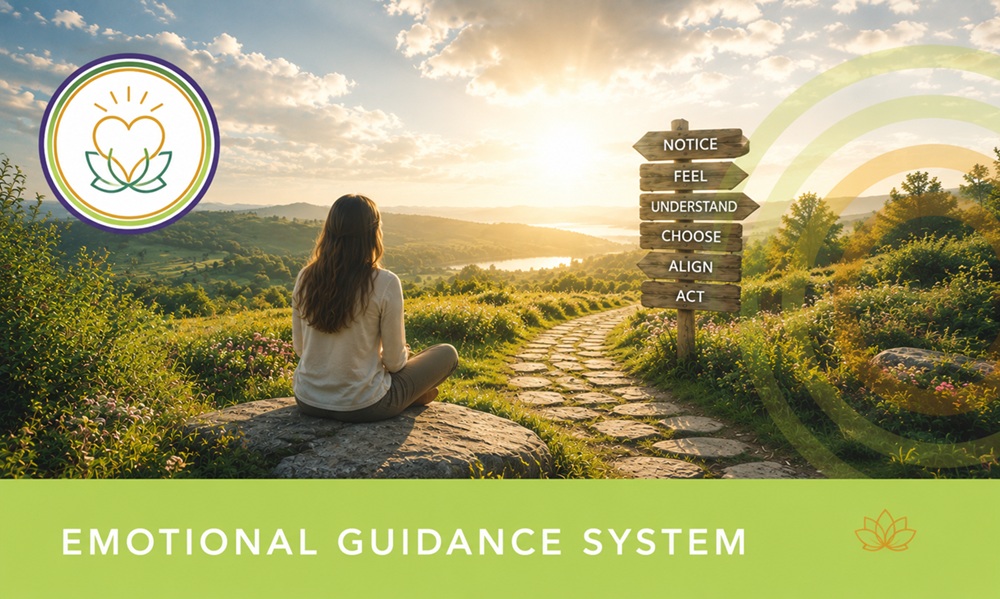
I believe our emotions are an internal compass. They can help us recognise when our thinking is taking us further from peace and when we are moving back towards it.
What Is Your Emotional Compass?
The Emotional Compass makes most sense when we connect it to the two thought systems. One of the central ideas I took from A Course in Miracles is that beneath all our complicated thinking lie two broad directions: fear and love. For me, these are the ego and the Higher Self.
When I am thinking with the ego thought system, my feelings usually reflect that. I may feel angry, resentful, anxious, defensive, fearful or unsettled.
When I am thinking through my Higher Self, I tend to feel different. There is more peace, contentment and a sense of connection. Sometimes that rises into happiness or joy.
This is why I see emotions as information. They do not tell me that I am right or wrong, nor are they instructions to act. They can, however, help me notice which thought system I may be listening to.
If I lose my peace, I can stop and ask what I am thinking about the situation. What have I decided it means? Am I taking it personally, assuming the worst or adding blame or judgement? Then I can ask the question that has helped me more than almost any other: Is there another way I could see this?
That does not mean every painful emotion is a sign that I am thinking with the ego. Sometimes life hurts. Grief, shock, disappointment and fear can be natural responses to what has happened. In those moments, I find it more useful to notice whether I am adding anything to the pain through guilt, blame, judgement or frightening thoughts about what it means.
This is how I use my Emotional Compass. My feelings give me information about what may be going on in my thinking. Sometimes that helps me see something differently. Sometimes it leads me to take action, set a boundary or ask for help. And sometimes there is nothing to change. I simply need to allow myself to feel what I feel without adding more suffering to it.
Your Emotions Are Not Judgements
Before I understood this, I often believed that other people or circumstances were responsible for how I felt. If someone upset me, they had made me feel bad. If something went wrong, the situation was the cause of my distress. I didn’t realise there could be another way to look at it.
One of the first times I consciously used my emotions as information was many years ago, and it taught me something about myself I might otherwise never have seen.
From Victim to Learning Opportunity
One day, a very angry woman knocked on my door and accused my children of bullying her child. She threatened me and made some pretty awful judgements about me, my children and where we lived. As it turned out, she had got the wrong people entirely, but I didn’t know that during the encounter.
By the time she left, I was in tears. I felt ashamed and inadequate, and despite not even knowing this woman, somehow felt as though she had demolished my character.
I was beginning to learn about emotions differently at the time, so once I had calmed down, I tried not to focus solely on what she had done. Instead, I became curious about why the encounter had affected me so deeply.
Eventually, I realised something uncomfortable but useful: part of me agreed with her.
Her words had touched my lack of self-worth and some of the negative beliefs I already held about myself. Had I felt completely secure in who I was, her opinion might still have angered or upset me, but it would not have had the power to diminish me as it did.
Her behaviour was still unacceptable, and I wasn’t responsible for it, but my reaction had shown me something about myself I could now begin to heal. Instead of remaining only a victim of a case of mistaken identity, I could use the experience to uncover beliefs I hadn’t fully realised I was holding. It became one of the early lessons in my own healing.
Pain Is Part of Life; Suffering Doesn’t Have to Be
Living from our Higher Self does not mean we should never experience painful emotions.
Life hurts sometimes. We grieve when someone we love dies. We feel disappointed when something we hoped for doesn’t happen. We can feel frightened when life becomes uncertain, and angry when we witness cruelty or injustice. These are human responses, and there is nothing spiritually superior about pretending we don’t have them.
The Emotional Compass does not ask us to deny how we feel or to immediately turn every painful experience into a lesson. We need to feel what we feel. This is particularly important with grief, shock and significant loss. There may be no different perspective we are ready for today, next week or even next year. The Higher Self does not demand that we hurry.
When we are ready, we can gently become curious about the thoughts surrounding our pain. We can ask again: Is there another way I could see this? Pain may be unavoidable. Much of our additional suffering, however, can come from the meaning we attach to what has happened and the story we continue to tell ourselves about it.
From Managing Emotions to Learning from Them
None of this means emotional regulation isn’t important. Sometimes the first thing we need to do is calm ourselves down.
We might need to walk away from an argument, go for a walk, take slow breaths, sleep on it, or give ourselves time before responding. When we are in the middle of a strong emotional reaction, analysing it on the spot isn’t always helpful.
But once the intensity has passed, there is another question we can ask. Instead of only asking how can I stop feeling this, we can ask what is this feeling showing me? This small shift can turn an uncomfortable emotion into an opportunity for greater Self-Awareness.
It is important, though, that we don’t turn this into another form of judgement. There isn’t a universal dictionary that tells us what every emotion means. Two people can experience the same emotion for entirely different reasons. The point is to become curious about our own thoughts, beliefs and interpretations, without diagnosing ourselves or anyone else.
That was what happened after the encounter with the woman at my door. Before I understood my Emotional Compass, I would probably have dealt with my distress by making her entirely responsible for it. And given her behaviour, I would have had plenty of evidence to support my case!
Blaming her might even have made me feel better temporarily. But I would have missed what the experience was showing me about myself. Once I treated my feelings as information rather than something she had done to me, I had a choice about how to use that information.
When Emotions Get Stuck
Sometimes an earlier experience has never been fully processed, and something in the present brings those old feelings back. We may react more strongly than the situation seems to warrant, avoid certain people or situations, or find ourselves anxious, angry or upset without immediately knowing why.
When that happens, the emotion is still giving us information, but we may need to look a little deeper before deciding what it means or what to do about it. Sometimes reflection is enough. At other times, particularly when the same reaction keeps affecting our lives, a therapist can help us understand what is being triggered and work through what remains unresolved.
What We Learn from Positive Emotions
Positive emotions give us information too. Alignment with the Higher Self doesn’t necessarily feel like permanent happiness or great excitement. More often, in my experience, it feels quieter. It feels like peace, acceptance, compassion, gratitude, clarity or trust. Sometimes nothing outside us has changed at all.
The situation, the other person and the past are all the same, but something in how we see them has shifted, and we feel differently as a result. I have come to recognise those moments as important. They show me what happens when I loosen my grip on fear, judgement or the need for things to be different before I can be at peace.
What Changes When We Listen to Our Feelings
As we begin to work with our emotions rather than against them, several things start to change.
We blame other people less. This doesn’t mean pretending other people’s behaviour doesn’t affect us. Of course it does. But we begin to recognise the difference between what somebody else has done and the meaning we ascribe to it. This gives us more choice about what we do next, and we become less reactive.
Rather than defending ourselves, retaliating or deciding we already know what something means, we can pause. We begin to notice the beliefs, assumptions and stories underlying our reactions. Once we can see them, we have a much better chance of choosing differently. And we begin to see life as a learning experience. Instead of only asking Why is this happening to me? we can sometimes ask, What is this helping me to see?
Not every experience needs to become a lesson immediately. But over time, this way of looking at life can change our relationship with both the good times and the difficult ones.
Your Emotions Are Your Compass
Throughout this series, I have written about Life School: a way of using our experiences to understand ourselves and make different choices. Our emotions are an important part of this learning.
When we realise we have gone down the road of fear again, as we all will, there is no need for guilt or self-judgement. We have another opportunity to choose.
Sometimes an emotion tells us that something hurts and needs to be felt. Sometimes it reveals a belief we didn’t know we held. Sometimes it shows us that we have become caught in fear, judgement or an imagined future. And sometimes the peace we feel tells us that we have found a way of seeing something that is kinder to ourselves and everyone involved.
Life will still bring pain. We will still get angry, frightened, disappointed and sad. Nobody is asking us to stop feeling those things, but we can learn to listen to what we feel without being ruled by it. And when we are ready, we can ask what our emotions are showing us and whether there is another way to see ourselves, another person or the situation.
Then our emotions become one of the ways we find our way back to the Higher Self, as well as something we manage.
“Pain may be unavoidable. Much of our additional suffering, however, can come from the meaning we attach to what has happened”


Try This: Ask What the Feeling Is Showing You
The next time you notice a strong emotion, you don’t need to change it immediately. Give yourself a moment to notice what is happening, and when you are ready, ask:
- What am I feeling?
- What thoughts am I believing right now?
- What meaning am I giving to what has happened?
- Am I seeing this mainly through fear or love?
- How might my Higher Self see this differently?
- Could I see this another way?
You don’t need to force yourself to feel differently or find the “right” answer. The purpose is to listen rather than judge.
Our Emotional Compass only makes sense when we are able to find the thought beneath the feeling, and this is where we go next.
Continue Exploring
Living From Your Higher Self is a journey of understanding and practice. These ten articles are designed to be read in any order, but together they provide a complete framework for living with greater peace, purpose and self-awareness.
Foundations
Living the Philosophy
- The Life School
- Discerning Your Thoughts
- Emotional Compass (Current)
- Transformational Relationships
- Love
Articles in Emotional Compass
Your Emotional Compass: What Your Emotions Are Really Telling You
Enjoyed this article? Add People Development Magazine as a preferred source on Google:
Enjoyed This? . This Essential Guide brings the whole framework together in one place, free to download.
