


Overview
Clinical training methods for corporate learning offer a powerful blueprint for building high-performing teams. This article explores how principles used by nurse educators—such as simulation-based learning, real-time feedback, and competency assessment—can transform corporate L&D into practical, skills-focused development that improves performance, resilience, and long-term organisational capability.
Introduction
In the high-stakes world of healthcare, the margin for error is nonexistent. A nurse educator doesn’t just teach theory; they facilitate survival. When a nursing student transitions into a practising clinician, they are entrusted with lives. Therefore, the stakes of their professional development are incomparably high.
For the average Learning and Development (L&D) professional in corporate, tech, or retail environments, the methods used by nurse educators might seem worlds away. Yet, if you look closely at the framework of clinical education—built on safety, mastery, and immediate application—you will find a blueprint. This blueprint is for building a high-performing, resilient workforce in any industry.
Radical Transparency
In a hospital setting, if a trainee makes a mistake, the feedback loop must be instant and blunt to prevent harm. However, this is balanced by what nurse educators call “psychological safety.” A registered nurse with honed skills must feel safe enough to admit they don’t know how to perform a procedure. The alternative—guessing—could be fatal.
The Lesson for L&D: Many corporate training programmes suffer from a culture of “performance theatre,” where employees are afraid to ask questions for fear of appearing incompetent. To build a skilled workforce, L&D professionals must design environments where admitting a gap in knowledge is rewarded, not penalised.
When you move the goal from “getting the right answer” to “developing the right competency,” you foster an environment where people actually learn, rather than just hide their deficits.
The Power of “See One, Do One, Teach One”
The medical field popularised the “See One, Do One, Teach One” model. It is the gold standard for mastery: watch the expert, perform the action under supervision, and then prove mastery by teaching it to someone else.
Corporate L&D often relies too heavily on passive learning—webinars, slide decks, and e-learning modules. Nurse educators know that knowledge is fleeting until it is operationalised. L&D professionals should shift focus toward “active output” models. Instead of a standard certification quiz, require employees to create a 3-minute video explaining a process they just learned. Alternatively, ask them to host a peer-to-peer coaching session.
By requiring the learner to explain the concept, you guarantee they understand the nuance rather than just the vocabulary.
Simulation-Based Mastery
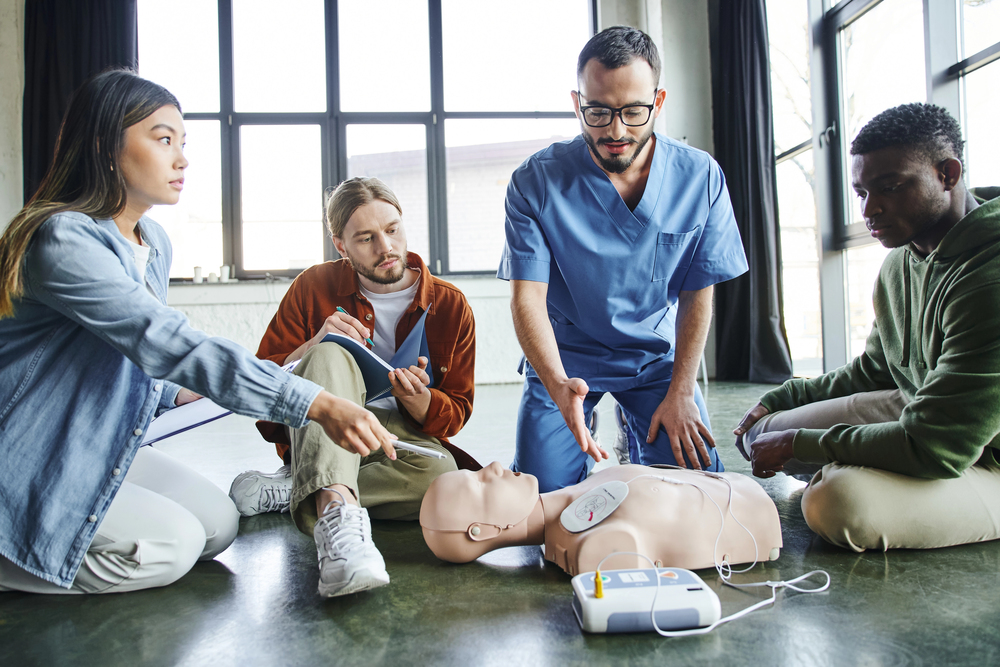
Nurse educators impact the future of nursing by relying heavily on high-fidelity simulation. They use manikins that can simulate cardiac arrest or allergic reactions. In addition, trainees are put through “stress tests” where the simulation forces them to think critically while their adrenaline is spiking.
The Lesson for L&D: How often do we test our employees under pressure? Most corporate training is frictionless. L&D professionals should embrace “Scenario-Based Training” that forces employees to grapple with difficult stakeholders, ambiguous data, or urgent technical failures in a safe, simulated environment. If you want a skilled workforce, you must train them for the “crisis of the day,” not just the ideal workflow.
The “Just-in-Time” Philosophy
In nursing, a clinician doesn’t need to know how to perform an obscure, specialised procedure in May if they aren’t going to use it until November. Information that isn’t applied immediately is forgotten. Therefore, nurse educators prioritise “just-in-time” training, delivering specific, relevant knowledge exactly when the clinician needs it.
The Lesson for L&D: The corporate world is obsessed with “comprehensive training,” often dumping massive amounts of information on employees that they will never use. This is a cognitive overload that leads to low retention. Consequently, L&D professionals should embrace a “pull” rather than “push” strategy.
Build robust knowledge bases, wikis, and micro-learning apps that allow employees to pull the information they need the moment they are about to execute a task.
Assessing for Competency, Not Completion
There is a massive difference between completing a training module and being competent in a skill. In nursing, “passing the class” is irrelevant if you cannot demonstrate the skill in a patient room. Therefore, nurse educators evaluate based on “checkoffs”—objective, observable demonstrations of proficiency.
If your L&D success metrics are tied solely to “completion rates” or “attendance,” you are not measuring workforce development; you are measuring compliance. If you are teaching a team how to use a new software or a new sales framework, the assessment shouldn’t be a 10-question survey. Instead, it should be a simulation or a project where the employee must demonstrate the skill in a real-world scenario.
The Takeaway
The secret of being a nurse educator is simple. They never lose sight of the consequences of poor skill. While corporate L&D professionals may not face life-and-death scenarios, organisational survival still depends on people’s competence.
By shifting from passive content consumption to active, clinical-style mastery, L&D professionals can create truly transformative training environments. We must stop viewing training as a box to tick. Instead, view it as critical infrastructure for organisational excellence.
Enjoyed this article? Add People Development Magazine as a preferred source on Google:
