

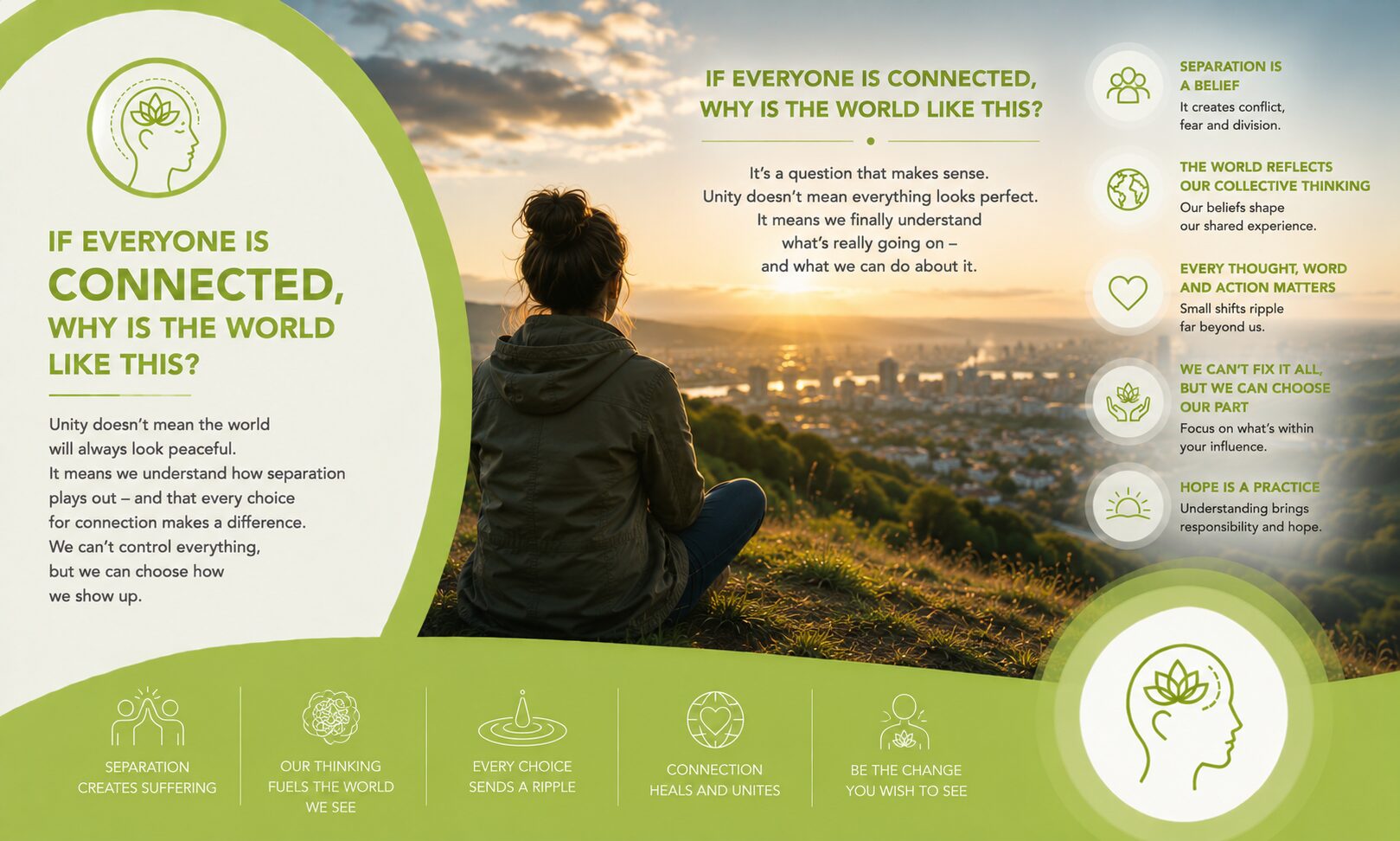
“Be the change you wish to see in the world” is one of those phrases we have heard so often that it risks losing its meaning. It sounds inspiring, but it can also feel disconnected from reality. When there is war, poverty or injustice around us, changing ourselves can seem like a very small response to a very large problem.
So it is worth asking directly. If we really are connected, why does the world look the way it does? And if Unity Consciousness is more than just an interesting idea, what difference can one person really make?
I do not believe any of us can fix the world’s problems on our own. But I do believe we have a choice about whether we add to separation or connection. That may sound like a small thing, yet every conflict, relationship and conversation is affected by the way we see the people in front of us. That is one place real change can begin.
What Separation Costs Us Together
The effects of separation are not difficult to see once we know what we are looking for. Before we can mistreat another person, we first have to stop seeing them as someone like us. We have to believe that, in some way, they matter less, deserve less or are somehow different. Once that happens, saying or doing things we would never normally consider becomes much easier.
The same pattern shows up in everyday life. We compete as though there is not enough success to go around. Then we hold tightly to what we have because we fear there will not be enough. We argue as though proving someone else wrong somehow makes us more right. Most of us have done all of those things at some point. They are not signs that we are bad people. They are simply what happens when we believe we are separate from one another.
Every State of Mind Either Narrows the Circle or Widens It
If there is one idea that runs through Unity Consciousness, it is this: our thoughts, attitudes and actions can either create more distance or make connection more possible.
Fear can separate us. So can judgement, superiority and shame. Curiosity can do the opposite, as can understanding, compassion, forgiveness and love. We can see it happening in an ordinary conversation: one response creates distance, while another creates the possibility of connection.
That is why living from Unity Consciousness is not about changing the whole world overnight. It is about noticing which direction we are moving in every day. Are we creating more separation, or more connection?
Why It Matters to Other People
The way we see the world does not stay inside us. It affects the way we speak, listen and respond to the people around us, and they respond to that in turn.
We have all experienced it. We can walk into a room and immediately sense tension without anyone saying a word. Equally, we know what it feels like to be with someone who is calm, accepting and genuinely interested in us. Their way of being changes the whole interaction.
That is why Unity Consciousness matters in practice. It reaches other people through the way we speak, listen and respond. Every time we choose understanding instead of judgement, or connection instead of separation, we change the quality of the interaction in front of us. We may never know whether the influence travels any further, but every relationship gives us a chance to make our own small part of the world less divided.
What Widening the Circle Feels Like
So far, I have focused on what changes in the way we see other people. The bigger question is what changes in us. In my experience, the shift is gradual rather than dramatic. It is not that life becomes easier overnight. It is that certain habits of mind begin to lose their hold. Four changes stand out for me.
Peace Becomes More Natural
One of the lessons I took from A Course in Miracles was that peace does not depend on life being free of problems. For me, there is a simple truth underneath that idea. Peace is not the absence of problems. It is what remains when we stop adding fear, judgement and resistance to what is already happening.
Life still brings loss, disappointment and uncertainty. What changes is that we spend less time arguing with reality and more time responding to it. That can leave us with far less of the suffering we create for ourselves.
Equality Stops Being an Effort
Most of us would say we believe people are equal. Yet it is surprisingly easy to compare ourselves, feel superior, feel inferior or wonder where we stand. That habit begins to fade when we genuinely experience our connection with other people.
We do not stop recognising differences. People still have different talents, personalities and experiences. What changes is the need to rank those differences. We become interested in learning from one another rather than measuring ourselves against each other.
We Become Less Defensive
We can absolutely maintain strong, healthy boundaries while choosing to be less defensive. For example, if a friend wants you to take an action you don’t feel good about, you can simply refuse without feeling the need to defend your choice. A very powerful reaction would be to say, “I’m sorry, it just doesn’t feel right to me.” And leave it at that, without explaining yourself at all.
What changes is the amount of energy we spend defending ourselves. We stop replaying conversations, preparing arguments and needing the last word. We become less concerned with proving ourselves right and more interested in understanding what is actually happening. That alone can transform our relationships.
Generosity Comes More Easily
When we no longer see life as a competition between separate people, generosity becomes much more natural. It is not just about giving money or possessions. More often it is giving someone the benefit of the doubt, encouraging them when they succeed, listening without interrupting or recognising a quality in them they may not yet see in themselves.
Those moments often seem small, but they have a remarkable effect. Sometimes the most generous thing we can offer another person is to see the best in them until they are able to see it for themselves.
The Sorrow That Comes with Seeing It
There is a part of this that nobody warns you about. When we begin to see how much fear, judgement, competition and conflict grow from a sense of separation, a quiet sadness can come with it. We recognise how much unnecessary suffering it creates. For me, that sorrow was an entirely unexpected part of seeing more clearly.
It is not a sadness born of judgement or superiority. It comes from knowing that much of what people struggle with is not who they really are, but the way they have learned to see themselves and everyone around them. That realisation can be painful, but it also deepens compassion. Instead of asking, “What is wrong with them?” we find ourselves asking, “How can I meet them with more understanding?”
Seeing My Parents Differently
When I was growing up, I often felt emotionally abandoned. As a child, I could only experience what was missing. It was only much later that I began to understand the lives my parents had lived before I was born.
I came to see that they loved us as much as they were able to. Both had grown up with difficult childhoods of their own, carrying feelings of guilt, inadequacy and never quite being enough. They did a lot right, and where the love was not what I needed, I knew it was not because they did not care. They were living from the same sense of separation I have described throughout this article. Their own pain shaped how they saw themselves, the world and, inevitably, us.
That did not make the impact on me any less real, but it changed the way I understood it. I stopped seeing my parents simply as the people who had not loved me as I needed, and started seeing them as two human beings doing the best they could from the understanding they had at the time. For me, that is what Unity Consciousness changes. It does not rewrite the past. It changes the way we see the people who were in it.
What Helps with the Sadness
What helps is accepting that we cannot change another person’s thinking or make them see the world differently before they are ready. We reach understanding in our own time. When I remember that people are acting from beliefs and experiences that make sense to them, it becomes easier to meet them with compassion rather than frustration.
It also helps to remember where my responsibility begins and ends. I cannot change the world on my own, but I can change the way I show up in it. Every conversation, relationship and act of kindness is an opportunity to create a little more connection and a little less separation. That may seem small, but it is something real that each of us can do.
You do not have to accept the idea of Unity Consciousness to recognise that seeing people with more understanding changes the way we relate to them. Whether you see it as psychology or something deeper is entirely up to you. My invitation is simply to try it and notice what changes.
I cannot change the world on my own, but I can change the way I show up in it


Try This: Notice the Direction
At the end of each day this week, ask yourself three simple questions.
- Where today did I create a little more separation?
- Where did I create a little more connection?
- What might I do differently tomorrow?
This is not about judging yourself or trying to be perfect. It is simply about noticing the direction you are travelling. Every one of us moves between separation and a sense of unity. The more aware we become of that, the more choice we have about how we respond next time.
Unity Consciousness is not simply an idea to understand. It is a way of being that quietly influences every person we meet.
If the way we think, speak and relate affects the people around us, how can we use that influence well? That is what Inspiring Self and Others, are all about and where we go next.
Articles In Unity Consciousness
What Is Unity Consciousness? How Seeing Beyond Separation Changes Everything
- How Unity Consciousness Changes Our View of Connection
- The World of Separation
- Living From Unity Consciousness: What Changes When You See People Differently
- Why Boundaries Get Easier When You Stop Blaming
- If Everyone Is Connected, Why Is the World Like This?
Enjoyed This? . This Essential Guide brings the whole framework together in one place, free to download.
