


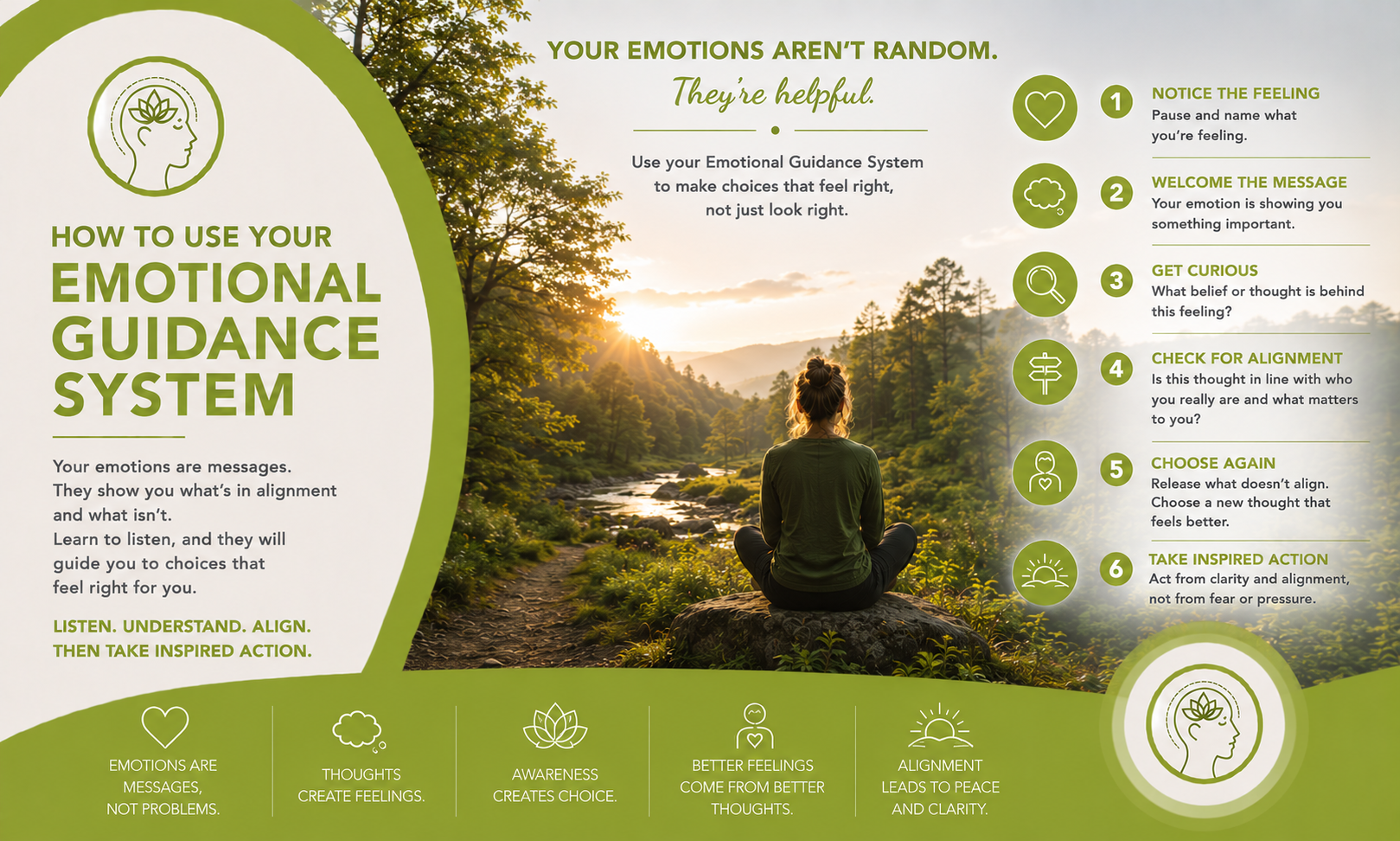
Finding the thought behind a feeling is only the beginning. What we do next depends on what the feeling is showing us.
Sometimes we need to question a belief. Sometimes something needs to change. At other times, we need relief, time to feel what we feel, or help to work through it. Using our Emotional Compass well means recognising what the feeling is asking for, rather than trying to do everything at once.
Where Our Feelings Are Pointing Us
Our emotions do more than reflect our thinking. Once we understand the difference between the ego and the Higher Self thought systems, we can see which direction our thoughts are taking us.
If we are thinking from the ego, our emotions will usually tell us. That gives us a chance to pause, think again, and, if we want to, choose a different way of seeing the situation.
Higher Self thinking leads us towards greater peace, contentment, and connection, and, over time, a more positive way of living. It does not mean life becomes easy or that painful things stop happening. It means we are less likely to add unnecessary suffering to what is already difficult.
Two things make this guidance easier to recognise. The first is Self-Awareness, because we cannot question a thought we have not noticed. The second is understanding that we are not fundamentally separate from one another. From a belief in separation, ego thinking can seem perfectly reasonable.
Using our Emotional Compass helps us notice when that is happening. Little by little, we can question some of the beliefs that create unnecessary suffering and make more room for peace, contentment, joy and love.
When Anxiety Is Guilt, Not Intuition
Sometimes a strong feeling can seem so convincing that we assume it must be telling us the truth.
I worked with someone who had stayed in an unhealthy relationship, partly because every time she tried to end it, she experienced acute anxiety and fear. Initially, she took the intensity of those feelings as intuition telling her she was making the wrong decision.
When she began examining the thoughts and beliefs behind the anxiety, something different emerged. She had developed a deep sense of guilt about the effect leaving might have on her children. Her anxiety was reflecting what she believed leaving would mean, rather than telling her to stay.
That distinction mattered. The feeling was genuine, but the belief producing it was something she could question. Once she could see it, she came to the view that staying would affect her children more than leaving would, and she was able to end the relationship far more calmly than before.
Fear about leaving is not always a belief to be examined. Sometimes it is an accurate reading of a situation that is genuinely unsafe, and then what is needed is action rather than insight. Her situation was not like that.
This is where our emotions become genuinely useful. They can alert us to a belief that may be operating beneath the surface, even when we have never consciously questioned it.
Sometimes We Think We Deserve to Feel Bad
Someone I knew lost two family members within days of each other. As her shock passed and time moved on, she tried to bring some normality back to her life for her children. However, she confessed she was a little worried about the continuing intensity of her feelings. She told me she had been at a social event with her children, and they were having a great time, when she suddenly caught herself laughing and immediately felt guilty. How could she be enjoying herself when her relatives had lost their lives so unexpectedly?
She realised that, somewhere underneath, she believed that being happy meant she was not grieving properly. Enjoying something they could no longer share felt almost disloyal.
Sometimes, without realising it, we believe we should continue to feel bad. We hold on to guilt because letting it go can feel like not caring. We hold on to anger because releasing it can feel like saying what happened did not matter. We refuse to forgive ourselves because it feels like letting ourselves off. And we can resist happiness because it seems to say we did not love enough.
Her grief was completely understandable. What was hurting her was the meaning she had attached to letting any of it go, which was that feeling happy would prove she did not care. It was robbing her of the natural healing that follows loss and making her suffer on top of grieving.
Letting go of suffering does not mean letting go of love or saying that something did not matter. We can let go of punishing ourselves and still love just as much.
Taking Responsibility for a Feeling Without Blame
Taking responsibility for how we feel is not the same as blaming ourselves for it. Much unnecessary guilt stems from confusing the two.
Owning a feeling means acknowledging that this is how I feel and being willing to understand what it is telling me. It does not mean I caused what happened, that somebody else’s behaviour was acceptable, or that I am at fault for feeling as I do.
Owning a feeling gives us somewhere to go, because once we own it, we can do something with it, whether that is examining the thinking behind it, allowing ourselves to feel it properly, or deciding that something needs to change.
If somebody else has to change, apologise or behave differently before we can feel better, our peace remains in their hands. Owning our feelings brings that back to us. We may not have chosen what happened or how we initially felt about it, but we do have some choice about where we go from there.
When a Feeling Means Something Needs to Change
Not every difficult feeling requires a different interpretation. Sometimes something genuinely needs to change. We may need to set a boundary, have a conversation, make a decision or put something right.
For years, when something troubled me, I would write it down and ask how I could see it differently so I could be at peace with it. Sometimes the answer was a different perspective. Sometimes it was something I needed to do, and I could not have told you in advance which. When I felt grief or loss, keeping busy, planning outings and seeing friends genuinely helped, even if only for a while.
Our emotions can point to either. Sometimes peace comes from seeing something differently, and sometimes it comes from acting on what we already know and have been putting off.
Sometimes We Need Relief Before We Need Insight
Sometimes we are too caught up in difficult emotions to see the situation clearly. At those times, analysing our thoughts may not be the most helpful place to start.
Instead, we can deliberately turn our attention to something we know will help us feel better. For me, it might be spending time with my children, focusing on them and how much I love them. It might be walking, music, laughter, being with someone we love, or noticing what is still good. Gratitude for what is bright in our lives can begin to shift how we feel.
Far from avoiding the problem, this helps us get into a better frame of mind so we can come back to it with a clearer head, and from there we are better able to ask how our Higher Self might see it.
When we are in the thick of despair, fear or anger, we cannot simply decide to feel joyful instead. But we can deliberately reach for something that feels a little better, and then something better again.
Sometimes insight comes first and changes how we feel. At other times, feeling a little better gives us enough space for the insight to come.
Life Can Make Us Sad
Not every difficult feeling is a problem to be solved. Grief, disappointment and missing someone are painful. If we look behind the feeling and find only that we miss someone we love, there may be nothing to change. The sadness needs to be felt.
The sadness felt by the woman I described earlier was entirely natural. She missed them and wished they were there. The suffering came with the thought that followed, which was that enjoying herself without them meant she did not love them enough.
This is the distinction between pain and suffering, which I wrote about more fully earlier in these articles. Pain arrives with what has happened. Suffering is usually what our beliefs, guilt, fear or judgement add to it.
Our Emotional Compass is not there to talk us out of sadness or to give us a life without painful feelings. It helps us recognise what needs our attention and what needs to be felt.
Sometimes there is a belief we can change, and sometimes we are sad, which we are allowed to be.
Some Feelings Need Support
Some feelings are too painful or overwhelming to work through alone. If exploring something leaves us unable to cope, that is a signal to stop rather than to push through.
A good therapist or counsellor can help us explore something safely, and sometimes a trusted friend or family member is enough to help us hear ourselves more clearly.
Willingness does not mean facing everything now or on our own. Sometimes it means recognising that something is there and getting the right help to deal with it, and that is still using the guidance.
The Pause Is Where Choice Appears
We do not have to react immediately to a difficult emotion. Sometimes the most useful thing we can do is let ourselves feel it and give it time to settle before deciding what, if anything, we need to do.
This takes practice, because our first instinct is usually to get rid of an uncomfortable feeling. We defend ourselves, withdraw, send the message or make the decision, and any of those will do if it makes the feeling stop.
When we react that quickly, we miss what the emotion is telling us. Feeling it without immediately acting on it gives us time to notice what lies beneath and to decide from a clearer place.
The feeling may be immediate, but our response doesn’t have to be.
What Is This Feeling Asking For?
Once we stop treating every difficult feeling the same way, guidance becomes much easier to use. Usually, we need one of five things:
- Insight: there may be a belief here that needs questioning.
- Action: something may genuinely need to change.
- Relief: sometimes we need to feel better before we can see clearly.
- Permission: some pain needs to be felt.
- Support: sometimes we should not try to work through something alone.
Our more comfortable feelings are guidance too. Peace, clarity and the sense that things are becoming simpler can tell us something about the thinking that brought us there. It is worth noticing those moments rather than passing them over.
Over time, we get better at recognising what our feelings are asking for. Difficult emotions still come, but we are less likely to add to them or stay caught in them. This leaves more room for peace, joy and the ordinary contentment that does not depend on anything particular happening.
“Owning a feeling means acknowledging that this is how I feel and being willing to understand what it is telling me.”


Try This: Ask What the Feeling Needs
The next time a difficult feeling arises, give it space before trying to change it. Then ask:
- What is this feeling asking for: insight, action, relief, permission or support?
- Am I seeing this through separation or through connection?
- Is there a more loving way to see it?
You do not have to resolve everything. Sometimes recognising what you need and taking one clear next step is enough.
Our emotions can teach us a great deal about ourselves; however, much of what we still need to learn only becomes visible through our relationships, and that is where we go next.
Articles in Emotional Compass
Emotional Compass: What Your Emotions Are Really Telling You
- How to Find the Thought Behind the Feeling
- How to Use Your Emotional Compass
Enjoyed this article? Add People Development Magazine as a preferred source on Google:
Enjoyed This? . This Essential Guide brings the whole framework together in one place, free to download.
