


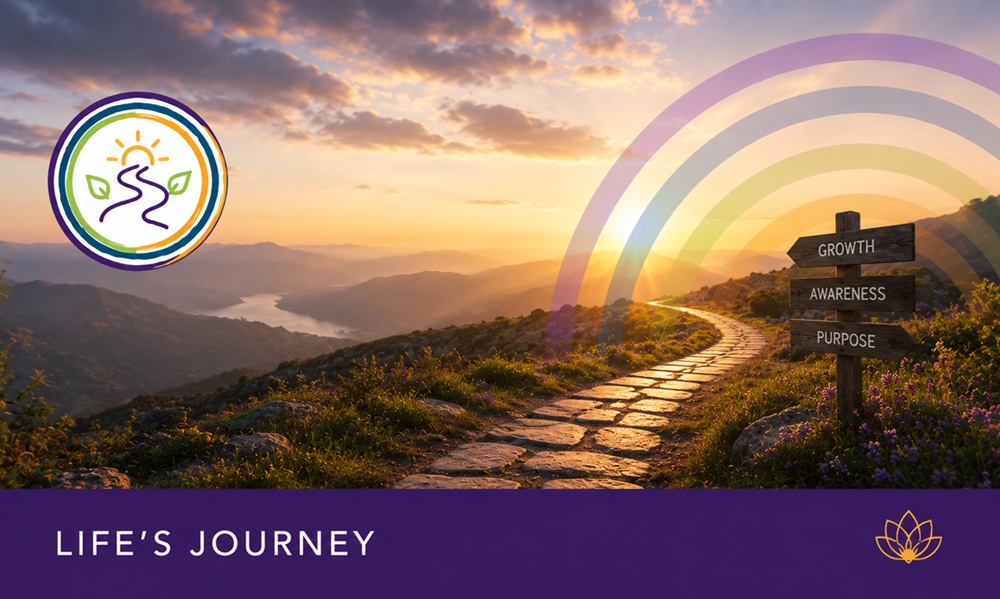
There comes a point in your life when you begin to ask deeper questions.
Why do I keep repeating the same patterns? Why do I react in ways I later regret? Why do some people seem genuinely at peace despite life’s challenges? Why am I stuck? How do things go wrong for me? Is there a better way to live?
When these nagging questions keep you awake, it can be exhausting. At this point, staying busy, overworking or scrolling is at best a distraction; at worst, it’s a reliable way to avoid them altogether.
The problem is that it can feel as though something is missing. A piece of the jigsaw that, if found, would make life’s questions easier to answer and bring peace of mind. This series explores how that missing piece is already present.
Asking these questions doesn’t mean anything is wrong. It’s simply the beginning of wanting to understand who we really are and how to find more peace and happiness in everyday life. I wrote this series to share what I’ve learned from my own experiences, in the hope that it might help someone else.
Where This Search Began
My journey began when I noticed the extent of suffering all around me, including within my own family. My parents had endured painful childhoods of their own, and I could see how difficult it was for them and for the people I loved to rise above the patterns they had inherited. Relationships broke down, things went wrong, and people were hurt.
Even as a child, something in me questioned why life had to be so painful. I somehow understood that another way was possible, one with more love, laughter and happiness. Looking back, I can see that searching for an answer to this question has been one of the most persistent themes throughout my life.
I hope the ideas in this series help you move through life with greater clarity, experience more peace, build stronger relationships, make wiser decisions, and discover a deeper sense of purpose. This journey is about reducing unnecessary suffering and remembering the qualities that already exist within you, as explored in this series.
What Do I Mean by Your Higher Self?
People describe the Higher Self in different ways. Some think of it as their authentic self, their wisest self, their true nature, their conscience, or their inner guidance. Others use more spiritual language, such as God or the Universe. Some authors I have learned from have coined their own term for it. When I talk to my children about it, I call it “The Universe”. Whatever the terminology, the Higher Self best describes the part of us that can respond from love rather than fear.
I was led to my Higher Self by recognising the divine within me and in everyone. The label is not important. What it represents to you is what counts. You do not need to hold any particular spiritual or religious belief to find these ideas useful.
What the Higher Self Means in This Series
Throughout this series, the Higher Self refers to the highest expression of who you are: the aspect of you that naturally embodies wisdom, integrity, compassion, creativity and peace. It is the version of yourself that makes decisions aligned with your deepest values rather than with your immediate fears. Living from this aspect of yourself changes your experience of life.
The concept of a Higher Self is accessible to everyone, but you have to be willing to consider its existence before you can recognise it.
I worked with a brilliant woman who was struggling with both her business and her personal life. When things went wrong, she would quickly become overwhelmed and find it difficult to see a way through.
We agreed that when she reached that point, she would stop trying to sort it out on the spot. Sometimes that meant removing herself for a while, or even going home, to give herself time to calm down. Once the intensity had passed, she could usually see things more clearly and decide what to do next.
We also began examining the assumptions she held about the people around her, both at work and at home. As she began questioning those assumptions rather than accepting them at face value, things began to change. Within months, both her business and her relationships had changed noticeably.
Living from your Higher Self is not about becoming someone else. It is about noticing the thoughts, beliefs and habits that have kept you from becoming who you already are. As you recognise them, you can question them and gradually let go of what no longer serves you. You are not creating a new version of yourself. You are uncovering more of the person who has always been there.
A Framework For Living
Much of the stress and unhappiness we experience stems from our identification with limiting beliefs and from our patterns of fear and judgement. These patterns are stored in our subconscious minds, leaving us unaware of them. Equally, we are unaware of the inner resources that have always been available to us.
Over years of working in leadership, coaching and behavioural change, and later studying neuroscience, I noticed that the people who had the greatest positive impact were rarely those with the highest status, the strongest personalities or the greatest technical expertise. Instead, they consistently demonstrated qualities such as Self-Awareness, emotional balance, compassion, integrity, courage and authenticity.
At first, I saw these as leadership qualities. Over time, I realised they improve every aspect of life. Whether you are leading an organisation, raising a family, building relationships, or striving to live a happier, wiser life, the same inner principles apply.
That realisation transformed what began as a leadership model into a framework for living.
The Four Foundations of Living From Your Higher Self
The series begins with The Journey: the questions that set us searching for a different way to live, and why becoming a better person was neither the aim nor the solution.
From there, the series is organised around four interconnected foundations. Together, they form the framework for Living From Your Higher Self.
1. Connection to Your Higher Self
Everything begins with recognising your inner wisdom: your connection to your Higher Self.
This includes intuition, discernment, stillness, presence, and the quiet guidance that helps us choose in line with our deepest values rather than our fears.
2. Self-Awareness
As our awareness grows, we begin to recognise the beliefs, emotions, habits and unconscious patterns that shape our experience. Once we can observe ourselves in this way, we realise we are not actors in a scripted play. At the highest level, we are the Director of the play.
When the Director calls “Cut” mid-sentence, just as we are about to say the thing we will regret, that is the moment we begin to observe our own patterns and give ourselves the chance to write a different scene. Self-Awareness gives us greater freedom to respond deliberately rather than reacting automatically.
3. Unity Consciousness
Our Higher Self recognises something our everyday thinking often overlooks: we are all connected and equally valuable. There is a common thread running through our humanity, whether we recognise it or not.
You may have met a stranger and felt a brief moment of recognition, or felt a sudden lift when a crowd or team moved together. Those moments are glimpses of the connectedness that lies beneath our separate, everyday selves.
Unity Consciousness is the recognition that, beneath our differences, we are connected. It encourages empathy, forgiveness, acceptance and respect, while reducing the separation that so often leads to conflict and suffering.
4. Inspiring Self and Others
Personal growth is never just about its impact on us. As we become more peaceful, authentic and compassionate, those qualities naturally influence those around us. We begin to inspire others without setting out to do so, by showing what is possible and by recognising the Higher Self in them too.
These four foundations build on one another. Connection deepens Self-Awareness, which opens the door to Unity Consciousness. Living from unity naturally inspires others. The journey begins within, but it never ends there.
The Five Practices That Put the Foundations to Work
Alongside the four foundations, there are five practices that help you apply them in everyday life. Each is explained in more detail later in the series.
1. Life School: Viewing Life as a Classroom
Life School is a way of approaching life as something to be learned from rather than as something that happens to us.
Once we begin to see our challenges and successes through this lens, life takes on a different purpose. It helps us recognise what works and what does not, and turns our experience into the material we learn from.
2. Discerning Your Thoughts: Choosing Between the Ego and Your Higher Self
Every moment is a choice between two ways of thinking: the ego, rooted in fear, judgement, separation, scarcity and control; and the Higher Self, grounded in love, wisdom, peace, compassion and trust.
Learning to recognise these two thought systems is one of the most practical skills on this journey. Rather than reacting automatically, we pause and ask: Which part of me is choosing this thought?
3. Your Emotional Compass: Listening to Your Emotional Guidance
Rather than seeing emotions only as something to suppress or control, we will explore how they can provide useful information. Difficult emotions alert us to fear, limiting beliefs or resistance, and invite us to ask whether there is another way to see the situation. This Emotional Compass deepens Self-Awareness and helps us move towards greater peace and clarity.
4. Transformational Relationships: The Mirror That Accelerates Growth
Relationships are where our deepest beliefs, fears and patterns become visible. They offer opportunities to practise forgiveness, compassion, healthy boundaries and understanding, making them our greatest teachers.
5. Love: The Foundation Beneath Everything
At the heart of all of this is one principle: love. This is not only an emotion but a way of seeing ourselves, others and the world. Compassion, forgiveness, courage, gratitude, creativity and peace are all expressions of it. Living from your Higher Self means choosing love a little more often than fear.
What Neuroscience Does and Does Not Show
Many of the ideas in this series have roots in philosophy, psychology and spiritual traditions. Neuroscience does not prove the existence of a Higher Self, but it does support some of the practices described here. Research into mindfulness and neuroplasticity shows that repeated patterns of thought and response can reshape the brain over time.
For me, this offered a practical explanation of something I was already experiencing. The more often we practise a different response, the more natural it can become. Living From Your Higher Self is therefore not just a philosophy but a way of changing how we relate to ourselves, others and life.
Finding Your Own Way Through This Series
There is no single right way to find your Higher Self, and your journey will not look exactly like mine. You will find your own teachers, experiences and turning points along the way. What follows is the path I have taken, shared in the hope that something in it helps you recognise your own. The articles that follow begin with the foundations that have shaped this philosophy.
Continue Exploring
Living From Your Higher Self is a journey of understanding and practice. These ten articles are designed to be read in any order, but together they provide a complete framework for living with greater peace, purpose and self-awareness.
Foundations
- The Journey (Current)
- The Higher Self
- Self-Awareness
- Unity Consciousness
- Inspiring Self and Others
Living the Philosophy
Articles in The Journey
Living From Your Higher Self: The Journey to Your True Self; Introduction
- The Question That Changed My Life
- Why Personal Growth Isn’t Enough
- Your Teachers Are Closer Than You Think
- The Road Ahead: What to Expect When You Begin
- What’s Waiting on the Other Side? Discovering the Peace You Already Carry
Enjoyed this article? Add People Development Magazine as a preferred source on Google:
Enjoyed This? . This Essential Guide brings the whole framework together in one place, free to download.
