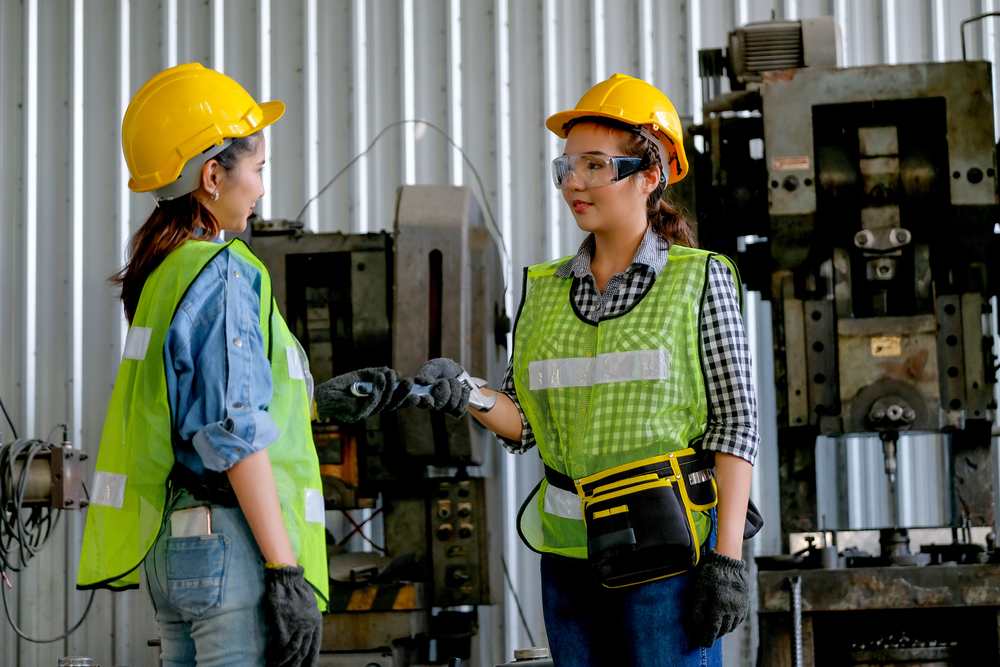
Women in the construction industry account for around 12% of the total workforce. It is an irony that ill-fitting PPE has, instead of protecting workers, at times created a hindrance. Women are particularly vulnerable in this matter as their involvement in these industries has been neglected. For example instances of safety glasses slipping down and ill-fitting clothing have resulted in accidents on-site and in factories.
Research And PPE For Women
88% of women in a survey, conducted by The Centre for Construction Research and Training, found that PPE did not fit. Meanwhile, 77% reported that this exposed them to hazards as a result. This anomaly means that women’s comfort and productivity are compromised in the workplace. Furthermore, the need to tug or pull at things, or moving to accommodate something in your way, is seen as detrimental to the working environment.
Resulting from this lack of consideration, women often purchase their own PPE or adjust it personally. They cut it up just to make it fit. An example of why this is a problem is the flame-retardant material that is compromised by alterations.
These incidents are reducing in numbers, with huge improvements being made throughout the last 10 years. More companies are now providing specific apparel for women. This promotes companies large and small to generate a better environment to work in. Thus, workwear will be made for all rather than some.
Governance of PPE For Women
Some of those trades are small vendors, some of whom have joined forces to create AWSAM (The Association of Women’s Safety Apparel). They have a desire to bring awareness, access and advocacy to women in the workplace.
The OHSA (The Occupational Safety and Health Association) has implemented a ruling. All PPE needs to properly fit each and every worker in the construction industry. This is expected to drive manufacturers, suppliers, distributors and employees in the right direction.
The CPWR (The Centre for Construction Research and Training) has put on record a list of companies. These companies are focused primarily on women’s workwear, as well as an inventory of products such as construction footwear, hearing protection, harnesses providing fall arrest systems, protective headgear, flame-resistant clothing, safety masks and maternity outfits.
The challenge to make the list mentioned above is a formidable one. The need to confront the anatomical difference in body shape is one worth tackling. It addresses the real, functional requirements of women in the workplace. Women’s body shape can be petite or tall; straight or curvy; wide in the hip and slim in the torso, or vice versa. Not to mention the changes undergone during pregnancy.
Reports have also suggested that women’s face and hand shapes are different to men’s. This would primarily affect the design of gloves and masks. However, just downsizing men’s PPE has proven to be ineffective.
Unisex clothing can be boxy and ill-fitting. It is not unlikely that, at some point, women’s PPE is just relabelled men’s PPE. Months of redesigning have to be instituted in order to get all variations catered for. However, institutions and companies are improving all the time.