Overview
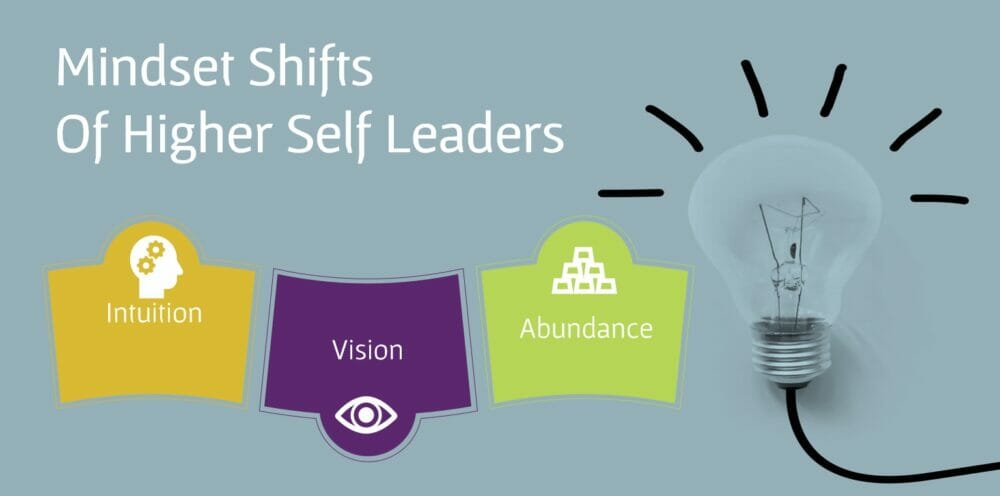
Higher Self Leaders drive powerful mindset shifts by blending intuition, unity consciousness, and self-awareness with insights from quantum physics and neuroscience. This article explores twelve transformative shifts, from scarcity to abundance, isolation to interconnectedness, and control to adaptation. Showing how leaders can create lasting growth, resilience, and inspiration in today’s uncertain world.
Introduction
Higher Self Leaders will be at the forefront of creating mindset shifts for themselves, their teams and their followers. This is because higher self leaders incorporate specific elements. Some of those ingredients include using intuition, unity consciousness, and the ability to inspire. They are self-aware and understand their emotional landscape. Using those ingredients effectively means operating at a level that most leaders aspire to.
The Definition of Mindset
The term “mindset” refers to a set of attitudes, beliefs, or ways of thinking that shape how an individual perceives and responds to their environment and experiences. It is a mental inclination or disposition that predetermines a person’s responses to and interpretations of situations. Mindsets can be powerful influencers of behaviour, decision-making, and problem-solving.
People may hold different types of mindsets. For example, a “fixed mindset” is one in which an individual believes that their abilities and intelligence are static and unchangeable. In contrast, a “growth mindset” is characterised by the belief that skills and intelligence can be developed and improved through effort, learning, and persistence.
Mindsets are not just limited to learning and intelligence. They can encompass broader attitudes towards life, such as optimism or pessimism, openness or resistance to change, and adaptability or rigidity in the face of new challenges. These mental frameworks significantly impact how individuals approach life’s challenges and opportunities.
The Impact of Mindsets on Perception and Reality
Quantum science is revolutionising our understanding of the universe and challenging long-held beliefs about reality. This emerging field suggests some intriguing concepts:
- The universe is fundamentally composed of pure energy.
- There is an interconnectedness of all things, as we are part of this universal energy.
- Energy, though invisible, shapes our reality based on our focus, beliefs, and thoughts. We tend to exclude information or energy that conflicts with our perceptions.
- Their mindset significantly influences an individual’s reality, and each observer may potentially experience a different reality.
- Leaders who embrace their higher self recognise the boundless opportunities this understanding offers.
Understanding these concepts opens up a world of infinite possibilities. Realising this potential often requires a significant paradigm shift, akin to a “Road to Damascus” moment. For most people, transitioning away from entrenched beliefs and thought patterns towards higher self-thinking is a gradual process. It involves evolving mindsets to align with a more expansive and interconnected view of reality.
In the context of these quantum science revelations, the power of the mindset becomes even more apparent. Studies in fields such as neuroplasticity demonstrate that our brains can change and adapt in response to new experiences and learning. This adaptability underlines the potential for mindset shifts to alter not just our perception but also our brain’s structure and function. By embracing a growth mindset, individuals can unlock new possibilities and experiences, transcending previous limitations imposed by a fixed mindset. This aligns with the quantum perspective of a fluid and dynamic universe, where change and evolution are constant and ongoing.
Mindset Shifts
For higher self leaders, the following seven mindset shifts are those which will revolutionise the workplace. Shifting their attention from:
1. Sickness to Wellbeing
Higher self-leaders concentrate and invest in physical, emotional and mental wellness. They will measure wellness, and their activities will be centred around being well. Wellness and set targets around wellbeing are celebrated. They know that focusing attention and energy upon absence and sickness creates more of the same.
2. Scarcity to Abundance
Instead of cutting costs, settling for second best, or laying off employees, for example, they develop ways to generate growth and increase wealth. They are generous and don’t let fear or guilt about finances dictate their decisions. They realise wealth isn’t all about money. It is about an abundant mindset.
3. Limited to Unlimited
There are no right or wrong decisions or beliefs. Each decision or belief works or doesn’t work. This is true for individuals as well as organisations. Moving beyond limiting beliefs and thinking can initially prove overwhelming when we realise there are infinite possibilities or paths to traverse. Higher self leaders listen to their intuition and dare to believe that what they truly desire can be achieved.
4. Powerlessness to Power
Higher self leaders will empower themselves, believing in their ability to create and change their current reality. They accept their current reality without resisting or wishing it away. They have faith and patience, knowing that with the right mindset, they can make positive changes.
5. Competition to Excellence
They relinquish the need to compare and compete with others, whether personally or professionally. Instead, they concentrate on only doing the best they can. They understand there is a niche for everyone and a contribution for everyone to make. They will focus on doing their best, not coming first.
6. Profit to Contribution
It matters not about the size of the contribution as long as it is authentic and borne of a desire to make a difference. Higher self leaders will shift from focusing on profit to making a meaningful contribution. It is the energy of contribution in the context of meeting a real need which is paramount. When they concentrate on contribution and make it a rule always to go the extra mile, that energy will bring abundance.
7. Management to Relationship
Higher self leaders know that cultivating relationships with all team members, not just management, is the way to achieve real and lasting results. They are conscious of employee experience and make genuine efforts to make life suitable for their people. Relationships built on mutual understanding, equal responsibilities, and shared ownership principles are key. They understand there is a mutual give and take.
8. Growth Over Fixed Mindsets
In the realm of business, where innovation and adaptation are paramount, leaders need to undergo a significant shift in their thinking. Firstly, they must move away from a fixed mindset, which rigidly assumes that abilities and talents are inherent and unalterable. This kind of mindset, unfortunately, puts a cap on potential and dampens the spirit of innovation. Conversely, and quite importantly, a growth mindset – one that is greatly inspired by the principles of quantum science – takes a different stance. It advocates the belief that skills and intelligence are not static but can be cultivated through dedicated effort, continuous learning, and resilience.
Furthermore, this transition is not only beneficial but also crucial for leaders who aim to create environments where the ethos of continuous learning is not only encouraged but also celebrated. In such settings, failure is not frowned upon but is seen as a fertile ground for growth and innovation. Consequently, by adopting this progressive mindset, leaders can effectively nurture a workforce that is not only adaptable and creative but also well-equipped to face the challenges of a rapidly evolving global landscape.
In essence, adopting a growth mindset is a transformative journey for leaders. It requires a thoughtful reevaluation of traditional beliefs about talent and intelligence and a bold embrace of the idea that these qualities can be developed. This mindset fosters a culture of curiosity, experimentation, and resilience, crucial for thriving in today’s dynamic business world.
9. Isolation To Interconnectedness
Quantum science teaches that everything in the universe is interconnected, a concept that leaders need to integrate into their strategic thinking. Moving away from viewing departments, individuals, or businesses as isolated entities, leaders should adopt a holistic approach. This interconnected mindset encourages collaboration across different sectors and disciplines, fostering innovation through diverse perspectives. It also means considering the broader impact of business decisions on the community, environment, and global market. For leaders, acknowledging interconnectedness promotes a more sustainable and responsible approach to business, aligning with the growing emphasis on corporate social responsibility and ethical leadership.
10. Certainty To Uncertainty
In the context of quantum science, uncertainty is a fundamental principle that challenges the traditional preference for predictability and control. Leaders need to embrace this uncertainty, understanding that it can be a source of creativity and innovation. This shift requires developing a comfort with ambiguity, allowing leaders to make decisions in a landscape where change is the only constant. Embracing uncertainty fosters a more flexible and adaptive leadership style, which is essential in today’s fast-paced and ever-changing business environment. For organisations, this means creating cultures where experimentation is encouraged and failure is seen as a stepping stone to success, fostering resilience and agility.
11. Linear Thinking To Quantum Thinking
Quantum thinking involves considering multiple possibilities and realities, a significant departure from the traditional linear, cause-and-effect approach. Leaders should adopt a quantum mindset, which enables more innovative and comprehensive problem-solving. This means looking beyond the obvious, exploring a range of potential outcomes, and understanding that actions can have a wide range of effects. In practice, this requires leaders to be open-minded, challenge existing assumptions, and encourage creative thinking within their teams. For businesses, adopting quantum thinking can lead to breakthrough innovations and strategies that disrupt traditional market paradigms.
12. Control to Influence and Adaptation
The dynamic nature of the quantum world renders rigid control less relevant, placing greater emphasis on influence and adaptation. Leaders need to shift from a command-and-control style to a more fluid approach that emphasises guiding and influencing. This involves being proactive in initiating positive changes and responsive to evolving circumstances. It’s about creating a vision and inspiring others to follow, rather than dictating every action. This shift is particularly relevant for businesses operating in global markets, where the ability to adapt to different cultures, regulatory environments, and market conditions is crucial for success. By focusing on influence and adaptation, leaders can create agile and resilient organisations capable of thriving in a complex, interconnected world.
There are some of the mindset shifts that higher self leaders operate under. What are yours?