


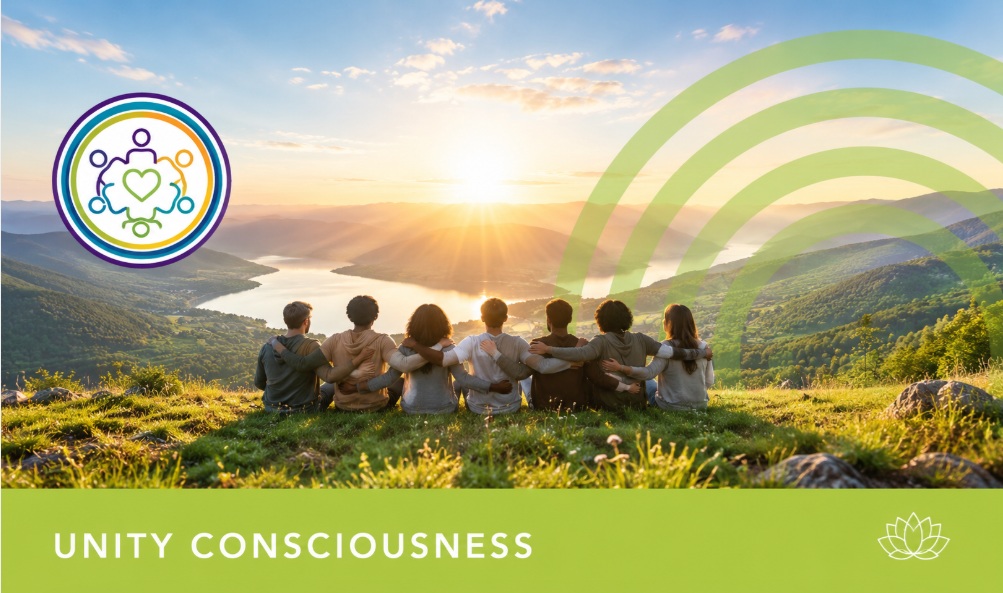
When you really look at the world, you see a place of suffering and unimaginable pain. While many people also experience happiness and even joy, these periods seem to be fragile or fleeting, particularly when life becomes difficult. My quest began with a desire to understand and ease my own suffering.
Intuitively, I knew there must be a better way. Like many people, I searched for answers in psychology, leadership, neuroscience and philosophy. Along the way, I also found myself drawn to the wisdom found in many spiritual traditions.
What fascinated me was that, despite their different languages and histories, they repeatedly pointed towards the same underlying idea: that beneath our personalities, beliefs and life experiences, we are far more connected than we usually realise.
The Idea of Unity Consciousness
When considering the term Unity Consciousness, you might think it sounds like an abstract or idealistic theory. However, when you apply the principles discussed throughout this series, you quickly realise it is a highly practical and impactful way of living. For me, it has completely transformed my relationships and how I navigate my life. Most importantly, while I still have extremely painful experiences, it has helped me to drastically reduce unnecessary suffering.
This section isn’t asking you to adopt a particular belief. Instead, I invite you to consider a different perspective and notice what changes if you begin looking at life through this lens. You do not need to decide whether Unity Consciousness is literally true to explore what happens when you live as though our connection matters.
What Do We Mean by Unity Consciousness?
Unity Consciousness is a spiritual and philosophical idea that beneath our individual identities lies a single shared consciousness from which we all arise.
Although we experience life through separate bodies, personalities and histories, Unity Consciousness proposes that, at our deepest level, our apparent separateness is not the whole story: we are expressions of the same underlying source of life.
Many spiritual traditions express related ideas in different ways. Hindu philosophy speaks of Brahman, the universal ultimate reality. Buddhism teaches interdependence and challenges the idea of a fixed, permanent self. Christian mystics wrote of union with God, while many Indigenous worldviews emphasise the relationship between people, community, land and the living world. The language differs, and these traditions should not be treated as saying the same thing. Yet the theme of connection appears repeatedly. What if the idea that we are all separate beings in a world of separation is not the ultimate truth?
The World Through the Lens of Separation
Most of us have been conditioned to see ourselves as separate individuals navigating a world of limited resources, competing needs and opposing interests.
From an early age, we learn to compare ourselves with others. We strive to succeed. We learn to protect our identity. We seek approval. We worry about losing what we have. Without realising it, we begin to organise our lives around questions such as:
- Am I enough?
- Am I more successful than others?
- Do I matter?
- Am I safe?
- Who is right and who is wrong?
These questions arise naturally from what I describe as the ego thought system, the part of our mind that experiences life through separation. The ego thought system is a useful way of describing the mental habits we use to navigate and protect ourselves in the physical world by identifying threats, making comparisons and protecting our individual identity.
Moving from Survive to Thrive
Unfortunately, we have been conditioned by the way most of the world lives to believe that survival is the ultimate truth of what life is about. When we live from this idea of separation, habits of comparison, conflict, and judgement naturally develop as a matter of course. This eventually becomes a default way of life. Understanding and being anchored in Unity Consciousness is what finally allows us to transcend this loop and live a life far beyond mere survival.
The ego is not something we need to fear or fight. In fact, meeting it with conflict only strengthens the very patterns we are trying to move beyond. Instead, we begin by noticing what it is doing. We observe its fearful stories without automatically believing them. We recognise that they arise from a perception shaped by separation, rather than assuming they tell us the whole truth.
This is where forgiveness becomes so important. Forgiveness is not about excusing harmful behaviour or pretending that pain doesn’t exist. It is about releasing our attachment to the fearful interpretation of what happened, while still seeing behaviour clearly. As we forgive ourselves and others for the ways fear has shaped our reactions, we loosen the ego’s grip and create space for the quieter guidance of our Higher Self.
Why Unity Consciousness Matters
When I first began to interpret life through the lens of Unity Consciousness, my entire understanding started to shift. Using this concept was, and still is, particularly challenging when I encounter people I don’t like, or whose behaviour I naturally judge. Now, I understand that we are simply looking at the world through different lenses. When I see someone acting hatefully, I realise they are acting from a belief system that does not serve them or anyone else. By removing judgement from the equation, I became far more interested in what connects us, and most importantly, what we can learn from one another.
This doesn’t mean we lose our individuality. It doesn’t mean we tolerate injustice or abandon healthy boundaries. Rather, it changes the foundation from which we respond. Our actions become less driven by fear and more guided by wisdom, compassion and discernment. We can still say no, leave, challenge wrongdoing, or protect ourselves; the difference is that we do not have to dehumanise another person to do so.
Supporting the Idea of Unity Consciousness
While science is forever progressing, I haven’t found a definitive study that proves beyond a doubt that we are all mystically connected. But whether you believe in a shared consciousness or not, it doesn’t take away from the practical value this mindset provides. I know from my own experience that treating life this way challenges everything I thought I knew for the better. If you look closely at the world around you, there are already endless examples of how deeply we depend on one another just to live our daily lives.
The simplest analogy is our own body. It consists of trillions of individual cells, each performing its own specialised role. Yet none exists for itself alone. Every healthy cell contributes to the wellbeing of the whole, and when groups of cells stop cooperating, as in diseases such as cancer, the health of the entire body is threatened.
The call is to love the body as a whole, and Unity Consciousness calls us to love the world as a whole. The point is simple: individual wellbeing and collective wellbeing are often intertwined. Ecology shows this vividly; systems thinking helps us understand how changes in one part of a system affect another, and research on human relationships shows how profoundly we influence one another. The idea of Unity Consciousness reminds us that complete independence is largely an illusion in everyday life.
For me, Unity Consciousness is more than an interesting philosophical or spiritual idea. It has become one of the guiding principles by which I try to live my life. The more I choose to see beyond separation, the more I notice fear giving way to understanding, judgement giving way to compassion, and conflict giving way to peace. I certainly don’t get it right all the time, but this simple shift in perception has changed how I experience the world.
Being Willing to Explore Unity Consciousness
One of the reasons Unity Consciousness is so foundational to this framework is because without it, living from your Higher Self becomes far more challenging. This concept more readily opens us up to love and connection. However, you don’t have to accept this philosophy as an absolute truth. The entire framework simply rests on your willingness to consider that there might be another way of seeing the world, and to notice what changes when you do.
Our actions become less driven by fear and more guided by wisdom, compassion and discernment


Try This: Seeing Beyond Separation
Today, think of someone with whom you’ve recently experienced frustration, disappointment or conflict.
For a few quiet moments, put aside the story about who was right or wrong.
Instead, ask yourself:
- What might this person be afraid of?
- What human need might they be trying to protect?
- If, just for this exercise, I saw this person as connected to me rather than wholly separate from me, what might I notice differently?
You don’t have to change your boundaries, excuse hurtful behaviour or suddenly agree with them.
Simply notice how your perception changes when you look beyond the separate identities involved.
Living From Your Higher Self doesn’t begin by changing the world.
It begins by changing the way we see it.
Once you open your mind to Unity Consciousness, the next place to look is how we connect with others.
Continue Exploring
Living From Your Higher Self is a journey of understanding and practice. These ten articles are designed to be read in any order, but together they provide a complete framework for living with greater peace, purpose and self-awareness.
Foundations
- The Journey
- The Higher Self
- Self-Awareness
- Unity Consciousness (Current)
- Inspiring Self and Others
Living the Philosophy
What Is Unity Consciousness? How Seeing Beyond Separation Changes Everything
Articles In Unity Consciousness